
90% of Gen Z Are Going to the Movies: It’s Where Culture Happens

The big screen isn't just relevant, it's leading the way in connection, emotion, and conversation. There’s momentum building in our culture right now. Not in our devices, our algorithms, or our timelines, but in the way we choose to spend our most precious currency: attention. And increasingly, the place where people are spending it is not online. It is in the movie theater. At a time when nearly every moment of our day is interrupted, sponsored, or skipped, the simple act of sitting down, focusing up and letting a story unfold on a massive screen feels radical. Intentional. Sacred, even.
In the Age of Distraction, Cinema Is the Ultimate Opt-In
There’s momentum building in our culture right now. Not in our devices, our algorithms, or our timelines, but in the way we choose to spend our most precious currency: attention.
And increasingly, the place where people are spending it is not online. It is in the movie theater.
At a time when nearly every moment of our day is interrupted, sponsored, or skipped, the simple act of sitting down, focusing up, and letting a story unfold on a massive screen feels radical. Intentional. Sacred, even.
The Experience Generation Is Here—and They ARE Moviegoers
There is a reason cinema is experiencing so much cultural significance. Gen Z, often dismissed as perpetually distracted, craves something more meaningful. They are the torchbearers of the Experience Economy, opting for memories over merchandise, connection over consumption, and authenticity over excess. The idea of “owning stuff” is being replaced by “doing stuff,” and few activities deliver the combination of social bonding, emotional impact, and cultural relevance like going to the movies.
In fact, 90% of Gen Z went to a movie in a theater in 2024 (Fandango 2025 Moviegoing Trends & Insights Study). Nearly an entire generation at the movies! Let that sink in.
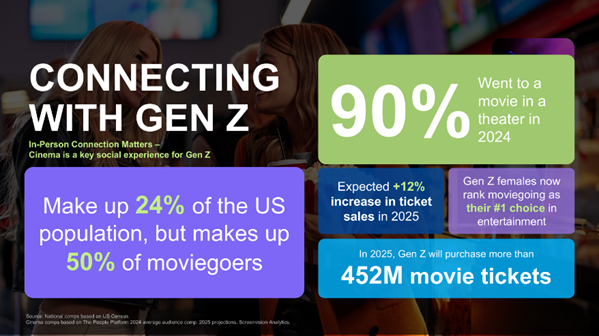
And the trend is not slowing down: this summer alone, Gen Z is expected to purchase more than 452 million movie tickets. That is not just box office data, it is a generational vote of confidence. A belief that something about the cinema experience is worth showing up for, again and again.
Gen Z females now rank moviegoing as their #1 choice in entertainment. Gen Z males put it second only to gaming. They crave real social connection, emotional fulfillment, and the chance to be active participants in the cultural conversation. A trip to the theater doesn’t just entertain it uplifts, delivering a +20% boost in positive feelings after the experience (Alter Agents, 2024).
And while TikTok may be where trends start, the theater is where cultural moments are cemented. Where they become larger than life and worthy of conversation.
For Families, Cinema Is the Last Real Shared Screen
And then there’s the other engine of cinema’s momentum: families.
In a world of personalized feeds and algorithmic silos, it is increasingly hard to find activities that transcend age and interest. The living room may be the gathering place for some, but even there, everyone’s watching something different. Tablets, phones, earbuds - everyone’s “together,” but not really.
Now consider the cinema. They pick a movie and travel to the theater together, grab some popcorn, and sit side-by-side, immersed in the same story. That’s not nostalgia, it’s relevance. It’s ritual. It’s real.
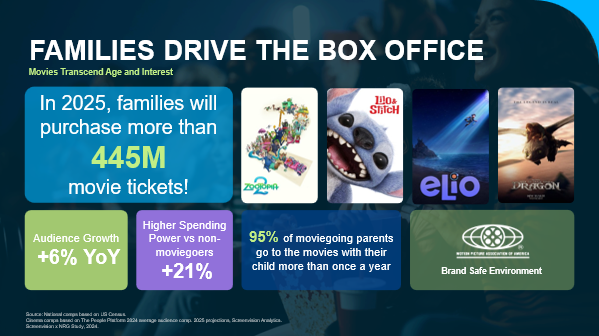
In 2025, families are projected to purchase more than 445 million movie tickets (Box Office Pro / Screenvision Analytics). The number of family-friendly titles is growing - from 11 in 2022 to 25 in 2025. And they’re bringing in bigger groups, with PG-rated movies averaging 3.6 people per showing. The cinema becomes more than a screen, it becomes a table. A place to reconnect, to laugh together, to feel something together.
In a culture that often celebrates multitasking and micro-moments, the theater insists on macro-emotion. And families are saying yes.
Cultural Moments Deserve Cultural Stages
We are living in an era where brands want more than impressions. They want impact. They want to be a part of the moments that matter to their customers. But as consumer attention fragments, it’s getting harder to earn that kind of relevance.
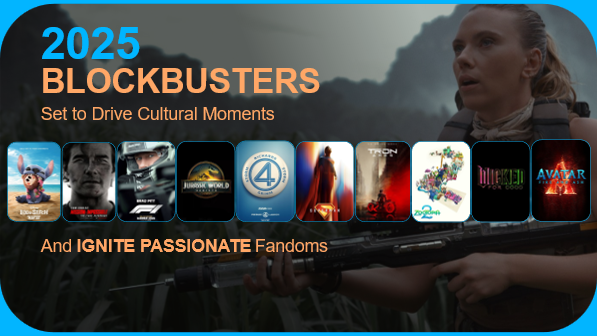
Here’s where cinema shines. Movies are among the most talked-about cultural events in the world. They dominate headlines, inspire memes, spark debates, and drive trends. Whether it’s a record-breaking box office smash or a quiet critical darling, the communal experience of cinema turns content into conversation.
Brands that align with these moments are not just “running media,” they’re participating in pop culture. They are showing up when people are emotionally engaged, socially present, and ready to react.
And because cinema offers a consistent cadence of new releases - every week, all year - it delivers a fresh cultural canvas for brands to paint on. Whether it’s a massive global premiere or an indie standout, the theater is both iconic and intimate.
Emotional Investment Is the New ROI
We spend a lot of time in marketing talking about reach and frequency, but not enough about resonance.
Cinema delivers all three.
When audiences go to the movies, they’re not passive. They plan the outing. Buy the tickets. Commit their time. And they’re ready to feel something. That kind of emotional investment is rare and powerful. It turns moviegoers into fans. It turns fans into communities. It turns moments into memories.
In an attention economy, nothing is more valuable than a fully focused audience. And in 2025, more people are planning to go to the movies than ever before. In fact, 95% of moviegoers say they plan to see as many or more movies this year than they did last year.
They’re not watching out of habit. They’re watching out of a hunger for connection, for culture, and for content that cuts through the noise.
And for brands, that’s the takeaway: Cinema is the number one video platform delivering premium, emotionally engaging content in a transparent, brand-safe environment. That’s what matters and that’s what wins.
Cinema’s Not Competing with Screens -- It’s Competing with Noise
Here’s the thing: the media landscape is more crowded than ever. Between streaming platforms, sports broadcasts, social feeds and podcasts, it is not that audiences lack options. It’s that they lack peace. Presence. The ability to fully focus on one thing without being pulled in a hundred directions.
Cinema wins not because it shouts louder, but because it tunes everything else out.
Consider this: the average one-hour primetime TV show has about 30 ads. A single NFL game can pack in more than 80 commercials. Streaming? More and more interruptions unless you pay a premium. And online? You are constantly dodging pop-ups, pre-rolls, banners, and branded content. It’s exhausting.
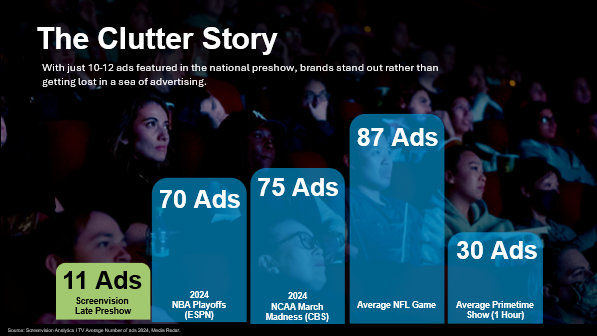
Now picture the movie theater. Just 10-12 ads in the national preshow. A captive, self-selected audience that came to engage. Strategic second screens. No distractions. Just storytelling, in its purest form, on the biggest stage.
That’s not just media. That’s emotional architecture. A place where brands can build and thrive.
The Takeaway? Theaters ARE Cultural Campfires
So where does all of this leave us?
It leaves us in a world where the most forward-looking thing we can do might be to look back and rediscover the power of gathering, storytelling, and presence.
In an era of clicks and skips, cinema reminds us what it feels like to be still, to be moved, to be together. And for brands, for storytellers, for communities, it’s a space where meaning still holds value.
If we want to meet people where they truly are - not just geographically, but emotionally - we need to meet them in the place built for storytelling: the movie theater. Here, attention isn’t captured or bought, it’s given freely. Here, stories move us, and brands can be part of the moments that stay with people long after the lights come up.
Sources:
- Fandango 2025 Moviegoing Trends & Insights Study
- Box Office Pro estimates and Screenvision Analytics
- Alter Agents, Cinema: An Emotional Story, 2024
- NATO, The Strength of Theatrical Exhibition, December 2024
- The People Platform, 2024
- MediaRadar, 2024
Posted at MediaVillage through the Thought Leadership self-publishing platform.
Click the social buttons to share this story with colleagues and friends.
The opinions expressed here are the author's views and do not necessarily represent the views of MediaVillage.org/MyersBizNet.

Kevin McGaw
Kevin McGaw is a B2B and integrated marketing leader based in the NYC Metro Area. He establishes authentic connections, drives teams to achieve shared goals, and crafts standout go-to-market narratives. At the core of his strategy lies impactful thought lead…