
"About That with Carl Mayer:" Eleanor Carey (Episode 12: New Regulations in Pharma Advertising)
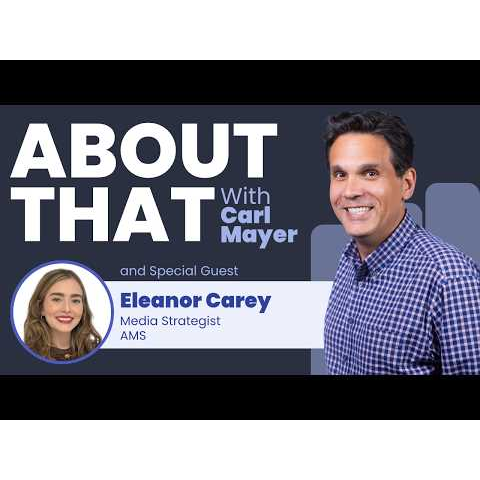
In this episode of "About That", Carl Mayer speaks to Eleanor Carey, Media Strategist in Strategy, Research & Planning at AMS, about new regulations in pharma advertising and how it is affecting marketers.
About Eleanor Carey:
Eleanor Carey is a Media Strategist at AMS, where she develops data-driven media plans that help brands maximize the value of their investments. She specializes in identifying and reaching the right audiences, ensuring robust measurement frameworks are in place, and translating insights into actionable strategy. Eleanor leads high-level planning that balances current performance with what’s next—testing new channels, approaches, and opportunities for growth. With a strong understanding of both traditional and digital landscapes, she brings a thoughtful, forward-looking perspective to every campaign.
Carl Mayer: Ask your doctor or medical professional if About That is right for you. Am I even allowed to say that? I don't know. FDA regulations are a lot to go through. Fine print, obtuse language, legalese. Luckily, somebody dove into it all and came back telling us what we need to know. And that somebody is Eleanor Carey.
Eleanor is a key part of AMS’s Strategy, Research, and Planning team. She's also published a couple of articles recently about changes in pharmaceutical marketing regulations. Eleanor, thank you for coming by About That.
Eleanor Carey: Thank you for having me.
CM: Now there have been a lot of changes going on and they're in the articles that we've linked to, But before we even get into that, how did things look prior to this?
EC: Yeah. So to talk about the changes that have recently been happening, we need to go back to the late 90s when the FDA issued clearance for what we know now is direct to consumer advertising. And those advertising regulations were pretty much for traditional media types. TV spots, print ads, full web pages, static web pages, and a lots changed since the 90s, what those regulations look like for the direct to consumer ads. It was the advertisements that we know with someone gardening or someone playing and hugging their grandchild with the music. And it's all uplifting. Then it's punctuated by heavy risks and disclaimers.
So like I said, a lot's changed, media types have changed and regulation is kind of starting to catch up. But we're very far from those ads.
CM: You're right, the media landscape of the 90s is unrecognizable when you compare it to where we are today. So things definitely did need to change. What are some specific things that did change?
EC: Yeah. On September 9th of 2025, the White House issued a memo. And essentially right now pharma marketing is coming to a head. We're seeing stricter regulation on direct-to-consumer ads, political pressure on GLP one, GLP ones, telemedicine, the price of prescription drugs. It's all kind of coming to a head. Brands are, actually we saw pharma marketing budgets drop a bit. But I would argue that it's not because it's going anywhere. It's a recalibration moment where people are deciding how to move forward under these new regulations.
Instead of, you know, brands asking themselves, how do we fit the required language into this ad? Regulators and frankly the public is asking, is the communication from this pharma brand genuinely clear, balanced and helpful in the world right now with like algorithmic targeting and bidding on keywords?
What does that look like? Why am I getting served the ad and not my peer? You know, there's no like required language or anything in the copy that's a lot more nuanced on the channels like influencer marketing, and short form video, and keyword bidding. So stricter scrutiny.
CM: So given this recalibration and the stricter scrutiny and all the new rules, how can pharmaceutical marketers adhere to those rules, work within those guardrails, and still have an effective campaign?
EC: Yeah. It's easy to view regulations as a constraint on what your work, but I would argue it's an opportunity for marketers.
I think 3 things to do. First is to design, excuse me, yes, design for transparency and not compliance. So don't be reactive to these new regulations, but be proactive. Display clearly the key benefits and risks central, next to each other, equal size on your website. Do modules of like patient health information. They can fill out forms.
And that leads me to the second. Secondly, redefine what success looks like. So in addition to reach and traffic to your website, success could look like does a patient fill out the risk form? Does that risk form fill out lead to a patient then being well informed and reach out to schedule an appointment with their clinician?
Thirdly, run a 90 day test and learn sprint. Ship some of the traditional TV dollars or evaluate where you can in your budget and ship some dollars into measurable CTV and digital video. Test out creative. Test essentially, imagine what it could be like in the future and prepare in the now. That could be, you know, a huge differentiator for brands if and when stricter regulation comes.
CM: The most recent article published in pharmaphorum called Pharma’s Search Loophole Is A Preview Of What Comes Next. A great article. It covers a lot. So yeah, I encourage everybody to read it. It's linked here.
But what are some of the, I’ll let you explain. They are using search as a loophole.
EC: Yes, yes. And by loophole, I don't mean that as like, you know, slap them on the wrist or anything. It's a loophole without any judgment you know. It's just that regulation, FDA regulation hasn't caught up to modern ad channels. The research is extensive. It's very interesting. We’ll link it in the article, like Carl said.
But yeah, brands can essentially bid on keywords that are not for their FDA approved use for their drug. And because they're not making a claim, for example, Ozempic can bid on weight loss, can bid on weight loss competitor brands. They're not, even though it's a diabetes medication, they're not making a claim necessarily in the messaging, but they can bid on those keywords and appear alongside inquiries.
I think this is interesting because you know, with AI and conversational AI beginning to test ads, you know, what does the next generation of search look like? I believe it's going to shift targeting and how brands target can accomplish what messaging can't.
So even if they can't appear, even though certain brands can't appear in certain conversations traditionally in like the messaging sense, there are ways to target intent-based targeting when consumers are, you know, very engaged and they can appear alongside it. I think it's very interesting and it'll be, I'm curious what that looks like as new ad channels continue to monetize.
CM: You got to kind of admire it. I mean, every time there's a new rule.
EC: Hey, hat’s off
CM: Absolutely.
EC: Respect. (Eleanor laughs)
CM: Well, thank you, Eleanor Carey for being here today.
EC: Thank you.
CM: On About That and thank you guys for watching. We'll see you next time.
Click here to view previous episodes.
Posted at MediaVillage through the Thought Leadership self-publishing platform.
Click the social buttons to share this story with colleagues and friends.
The opinions expressed here are the author's views and do not necessarily represent the views of MediaVillage.org/MyersBizNet.

Carl Mayer
Carl Mayer is Vice President, Integrated Media/Active Entertainment. Carl’s career in media spans 25 years, with foundational expertise in Broadcast and Cable TV buying. For over a decade, he has focused specifically on campaigns for film releases and …