
An Interview with Andrew Graff, CEO, A&G: Disrupting Advertising’s Status Quo
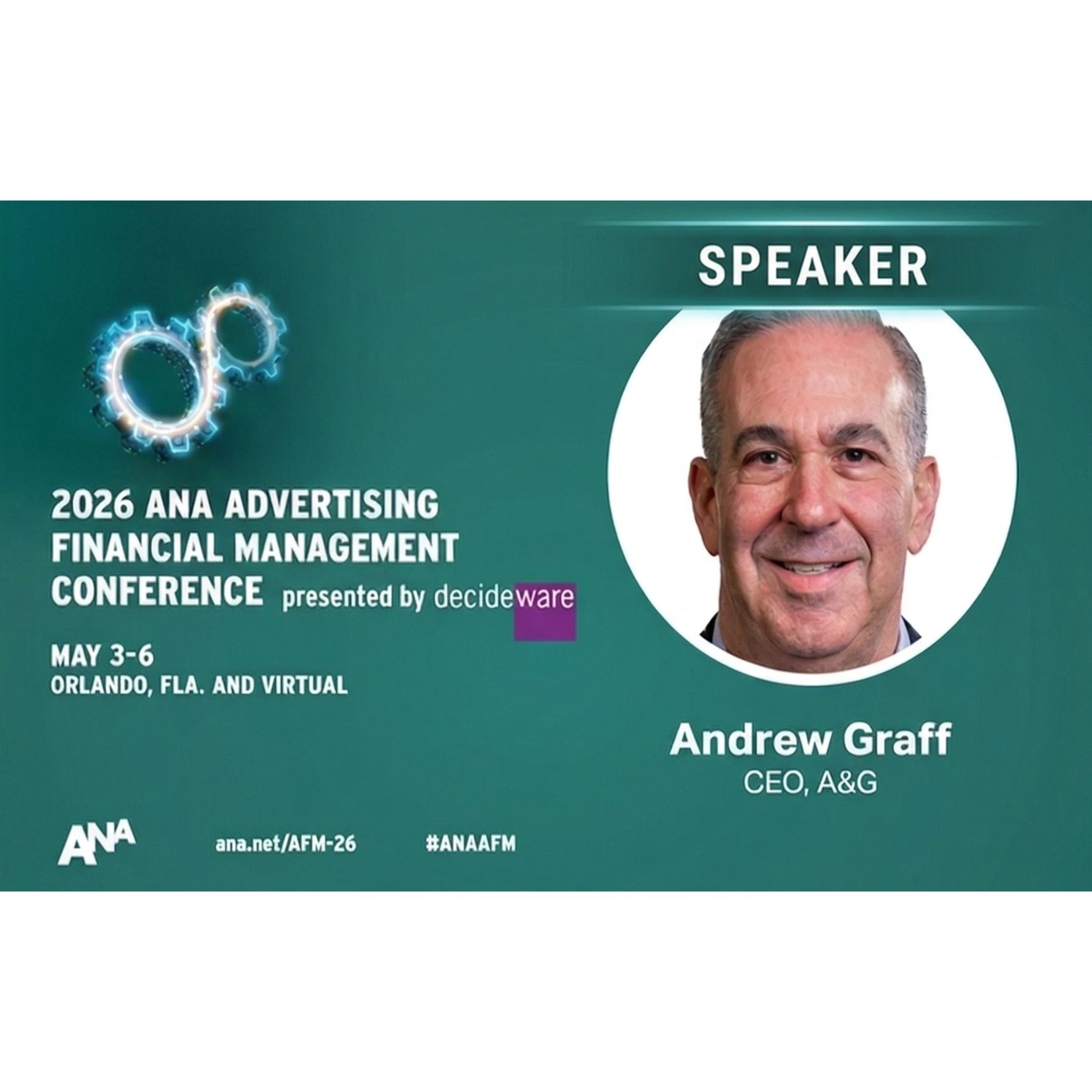
As the advertising landscape faces continued volatility, the relationship between agencies and clients is being redefined by a shift from measuring "hours spent" to "value created." For leaders like Andrew Graff, CEO of A&G (Allen & Gerritsen), this isn't just a trend—it’s a career-long mission. Known as a "status quo disruptor," Graff has long championed a move away from legacy compensation models toward an integrated, outcome-based approach that prioritizes human truths over synthetic metrics.
In anticipation of the ANA Advertising Financial Management Conference, taking place May 3–6 in Orlando, Greg Wright, Senior Vice President at ANA, sat down with Andrew to discuss how his philosophy of perpetual curiosity and behavioral science is shaping the future of agency partnerships. His insights provide a preview of the high-level discussions on financial efficiency, sustainability, and growth that will take center stage at the conference this May.
Greg Wright, ANA: You’ve famously described yourself as a "status quo disruptor." How does that mindset of perpetual curiosity influence the way you lead an independent agency in today’s volatile market?
Andrew Graff: It’s core to my DNA. I love being in the business of creativity. I never believe there’s only one way to tackle something. Just because it worked in the past doesn’t mean it’s the right approach now.
And it’s core to our agency. We can’t sit still in the creative business. Great advertising isn’t set and repeat. We must keep challenging so everything becomes an experience that reinforces the brand where people are right now. Every detail matters when our clients’, consumers’ and employees’ lives are changing rapidly.
Greg Wright, ANA: You’ve mentioned that "brand is how you show up, not just what you say." For a modern CEO, what does it mean to "show up" for your employees and community in a way that impacts the bottom line?
Andrew Graff: It’s showing people they’re valued. When we celebrate someone’s anniversary with a donation to the charity of their choice, we’re giving them the satisfaction that they’re making a difference. And when we bring in collaborators and fractional talent, we give them benefits which most agencies don’t. By demonstrating our commitment to them, we inspire a greater commitment to us and our clients.
Greg Wright, ANA: A&G has thrived for 40 years by knowing when to pivot. What is the most important "zag" you’ve made as a leader that defined the agency's current trajectory?
Andrew Graff: We’ve stayed focused on creativity and bucked the tradition of hourly billing that stifles it. Faced with the industrywide margin squeeze, we decided our value is how our work impacts a client’s business, not how long it takes us. So, we went to fixed pricing and pegged our incentive to outcomes. The only question that matters is how we can make clients more successful. We’ve carried that torch against the industry headwinds for eight years, and our resolve only grows stronger.
Greg Wright, ANA: You have been a vocal critic of legacy compensation models, even moving away from traditional timesheets at A&G. Why do you believe the hourly billing model is a "transparency trap" for the advertising industry?
Andrew Graff: Hourly rate is a cracked foundation for the advertising business. It’s inauthentic pricing. Our job is to maximize client output, not agency input. Hyper measurement of all the inputs creates a disincentive to solve client problems at the speed they need to be competitive.
Scope is an authentic system for the impact we’re expected to create. It’s what we’re producing and what that’s worth. If we must fill out timesheets by the hour, we clearly haven’t scoped the work precisely.
Greg Wright, ANA: If the industry moves away from the 40-hour-week billable lens, how do you redefine "value" in a way that satisfies both an agency’s creative soul and a client’s financial audit?
Andrew Graff: We start by defining the architecture of the real problem a client’s looking to solve. Then we identify what they want to learn, so they can present to their organization, which establishes the business analytics that matter. And then we define what success looks like, what they personally get measured on. That clear objective is a rallying point for us, and it aligns directly with what procurement is after. Ask any of our clients, and they’ll tell you they all appreciate the simplicity.
Greg Wright, ANA: As we look toward Orlando this May, what is the one unignorable truth about the future of the client-agency relationship that most industry leaders are still trying to ignore?
Andrew Graff: Everybody’s trying to ignore the need to simplify our business and put it on an outcome’s basis. To do that, we need to bring the right people together to think more holistically and create the best surround sound approach to a brand ecosystem. Consumers don't care about marketing plans, and they don't view life in silos. So, agencies need to step ahead and show clients the way to a truly integrated structure.
It’s time for clients to acknowledge the difference between commoditized production and bespoke creativity and craft. The former is what everyone’s arguing about. The latter is what agencies like ours do best, which clients value. That’s got to become the thing worth paying for. It’s how we’re doing business, and I believe proving every independent agency can.
Greg Wright, ANA: You’ve integrated behavioral science into your creative process. Do you believe most marketers are currently too reliant on big data while ignoring the human truths that actually shift consumer behavior?
Andrew Graff:You can't ignore the fact that marketing in all forms is about relationship. What attracts, converts, and keeps consumers is making their lives better so they invite you in. To do it, we need to understand how they live, not just why they buy.
That takes originality and craft. It starts with understanding how they weave the fabric of their lives. We won’t achieve lifetime consumer value by forcing the quick jump starts of synthetic relationships.
I’ve heard agency CEOs say clients don’t care because they just need some kind of performance to point to. Clients should care. Consumers reject inauthenticity in a heartbeat, and you can’t grow if you don’t retain them. Once you alienate a consumer, it’s incredibly hard to win them back.
Greg Wright, ANA: A&G uses the "ampersand" as a philosophical engine—the idea that a great idea shouldn't stop short. How can brands apply this "and then what?" logic to their customer experience (CX) to build ecosystems instead of just ads?
Andrew Graff: Challenge the status quo in what marketing does, who does it, and how it gets done. Shift your emphasis from creating wow to moving the right people to make a brand part of their lives. It’s not a quick hit, but a continual journey that relies on all marketing elements to work together at uncommon levels.
Put PR and creator marketing at the center of brand efforts. Then you can influence the entire web of relationships that shape consumers’ worlds. Through an earned lens, you can see people as they live more clearly and accelerate the sharing cycle that makes them validates them and inspires their advocacy.
Andrew Graff’s commitment to bespoke creativity and outcome-based pricing highlights a pivotal shift in how the advertising industry defines success. By moving away from the transparency trap of hourly billing, agencies and clients can refocus on what truly moves the needle: genuine human connection and business impact.
If you're ready to explore these unignorable truths and gain actionable insights for your own organization, join us this May 3–6 for the 2026 ANA Advertising Financial Management Conference in Orlando. Alongside speakers like Andrew, you’ll engage with top marketing, procurement, and finance leaders to tackle the industry’s most pressing financial issues. Register now to secure your spot at the center of the conversation.
This article was written by Greg Wright, Senior Vice President of Brands and Means at the ANA.
Posted at MediaVillage through the Thought Leadership self-publishing platform.
Click the social buttons to share this story with colleagues and friends.
The opinions expressed here are the author's views and do not necessarily represent the views of MediaVillage.org/MyersBizNet.