
Are Super Bowl Ratings Becoming More Volatile?

For decades, ratings for the Super Bowl remained stable throughout the game. You had a massive audience, modest swings depending on game script, and a predictable dip as the game was closing. That has changed in recent years as the event has become truly cross-platform and the increasing presence of a second screen has provided an easy way for people to check out of an uninspiring game. Based on the minute-by-minute data of the past four Super Bowls, it is becoming clear that the game’s competitiveness has more impact on viewership than ever. The game script isn’t just affecting whether you watch, but also how you watch. This is causing marketers to rethink how they approach the Super Bowl as an advertising platform.
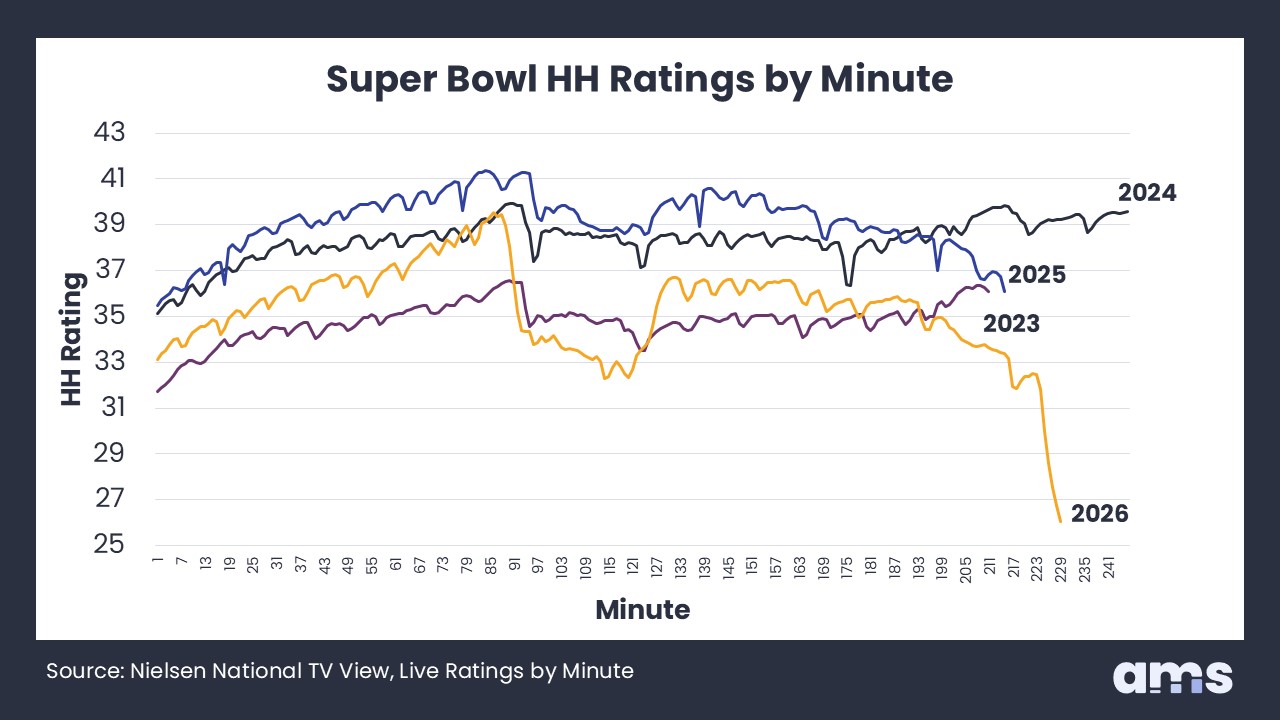
Peak viewership within the game has been earlier than expected in the last two Super Bowls, with each one reaching its apex in the second quarter leading into the halftime show. Both games’ scores were lopsided by halftime, and the minute-by-minute ratings show declined steadily throughout the second half. Compare that to the Super Bowls in 2023 & 2024 (both were decided by three points), and you’ll see that viewers remained throughout the entire game and that ratings never dipped below where they started at kickoff. From this data, it seems like the first half and halftime show are must-see TV, but the second half is only “must-see” if the game is close. This poses a challenge for advertisers, as they must be more conscious about where they want their ads placed more than ever.
Lopsided games aren’t new to the Super Bowl, but their impact on ratings are. The 2014 Super Bowl (a 43-8 win for Seattle over Denver) was the most-watched game in history at the time and, according to Nielsen, ratings only dropped 5% from the peak to the closing minutes of the game. For comparison, the 2026 Super Bowl dropped 13% from the peak to closing minutes.
One key reason is the rise of second-screen usage. According to an Adtaxi survey for the 2025 Super Bowl, approximately 70% of Americans used at least two devices when watching. Not only is second-screen usage becoming the norm, the second screen is now a frictionless way to disengage from the game. Once the suspense disappears, viewers no longer must commit to a bad game. They can instantly turn their attention to social media, group chats, streaming, etc.
Even when the game is lopsided, the Super Bowl still delivers a massive audience on average. It is still a cultural phenomenon that draws both fans and non-fans, but as it becomes more cross-platform, the game is no longer seen as a single linear event. Viewers are treating it as multiple events in one night: the game, the halftime show, the commercials, and the concurrent Internet experience. That’s why you have been seeing ads that veer away from the traditional format (think Coinbase’s karaoke ad from Sunday): Advertisers are becoming aware of the fact that the viewers’ attention is harder to keep due to other distractions via the second screen. It takes more effort for marketers to get people to engage with the brand beyond the TV spot.
Cross-platform distribution of the Super Bowl has expanded the audience, but at the same time, it also can reduce late-game engagement. For advertisers, this is makes placement strategy even more important. The first half of the game is a much safer bet than the second half since the outcome is much more in question earlier in the game. Attention studies prove this, as the recall rates for ads during the second half of the past two Super Bowls show that ads in the second half scored much less with attention than first half spots. Advertisers can try to avoid late-game risk by buying early placements, but second half spots can be more valuable if the game is close. So, a first half spot can be seen as a high floor option, while the second half can be seen as the high ceiling option.
We are now in the cross-platform era of the Super Bowl. The big game is still the biggest stage in advertising, but it is no longer a single, linear viewing experience. For advertisers, this means that winning the Super Bowl isn’t just about buying a spot in the game. They need to be strategic in encouraging attention and driving engagement across multiple screens, as they can't rely on the game itself to keep the viewers engaged.
Posted at MediaVillage through the Thought Leadership self-publishing platform.
Click the social buttons to share this story with colleagues and friends.
The opinions expressed here are the author's views and do not necessarily represent the views of MediaVillage.org/MyersBizNet.

Daniel Senor
Daniel Senor is Senior Research Analyst for Strategy, Planning & Insights, at Active International, where he has worked across a wide range of clients with expertise in television. Throughout his career, Danny has developed an expertise on all things rel…