
Back to the Future: Revisiting Erwin Ephron’s 1999 Blueprint for Advertising Accountability
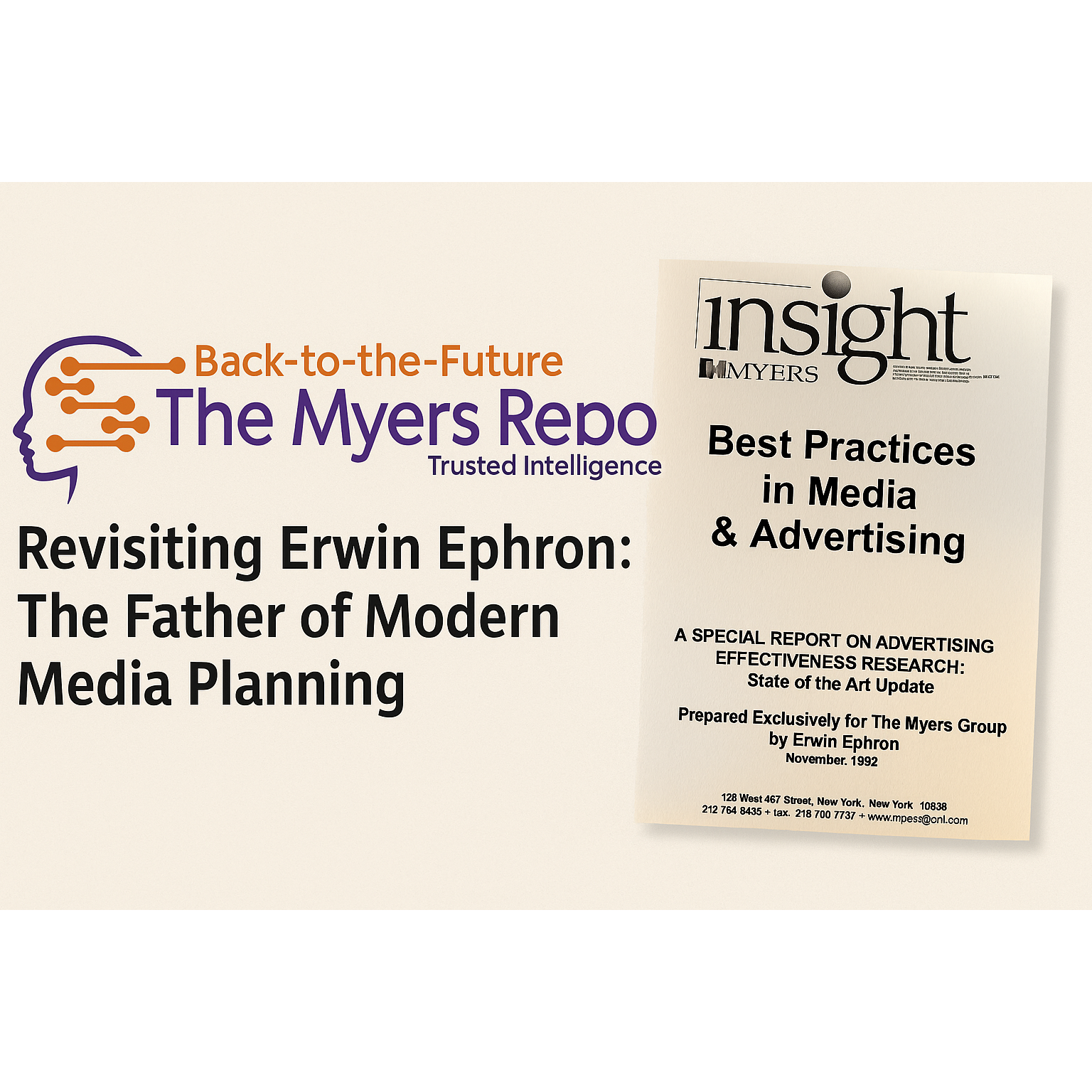
In November 1999, Erwin Ephron -- widely regarded as the “father of modern media planning” -- prepared a Special Report for The Myers Report that remains startlingly prescient. With his signature clarity and provocative insights, Ephron dissected the advertising industry’s ongoing struggle to measure effectiveness, forecasting challenges that persist into the AI-dominated media landscape of 2025. His call for accountability, precision, and realism in how we assess advertising performance rings louder today than ever before.

As we revisit this historic document through a Back-to-the-Future lens, Ephron’s brilliance not only illuminates the road we’ve traveled; it reminds us of the path we’ve still failed to fully walk.
“The Multi-Million Dollar Melon” Still Rolls On
Ephron’s metaphor -- that advertisers were blindly spending millions without knowing the return -- might seem quaint in an era of machine learning, predictive analytics, and real-time dashboards. But two decades later, most marketers are still haunted by the same question: does advertising work?
Despite massive data capabilities, the digital age has ironically intensified the noise Ephron identified as the enemy of signal clarity. His observation that “the signal-to-noise ratio favors the noise” is painfully evident in today's fractured ecosystem where attribution wars, algorithmic opacity, and walled gardens obscure even the best-intentioned efforts to gauge impact.
Short-Termism and the Long Tail of Effectiveness
Ephron’s tension between short-term sales impact and long-term brand value has morphed into the defining strategic dilemma of modern marketing. He warned that the “promise of long-term effects is the agency’s temporizing argument to get advertisers to stay with ineffective advertising.” That critique could apply today to many performance marketing efforts that prioritize clicks over connection, and volume over value.
What Ephron anticipated was the creeping triumph of short-termism -- what we now call the ‘quarterly culture’ -- and the industry’s resistance to investing in measurement systems that reward patience. In today’s generative AI landscape, where instantaneous content can be produced at scale, his caution about time adding “noise” has multiplied exponentially.
The Industry’s Reluctant Dance with Accountability
Perhaps most prophetic was Ephron’s critique of the industry’s self-interest. Agencies feared being judged by metrics they couldn’t control. Advertisers hoarded learnings. And effectiveness research was sidelined for more politically convenient KPIs like awareness and intent.
Flash forward to 2025, and the reluctance persists, now enhanced by programmatic complexity and AI-model opacity. Ephron’s call for collaborative transparency and shared learning stands unmet. His frustration with siloed knowledge echoes in today’s debate over clean rooms, privacy regulations, and data interoperability.
A Blueprint That Still Works
Ephron offered four essential purposes for effectiveness measurement, a framework that remains foundational and future-proof:
- Accountability through rigorous ROI modeling (marketing-mix modeling, media attribution, econometrics).
- Actionability through in-market diagnostics (brand penetration modeling, real-time optimization).
- Diagnostics to fix campaigns mid-flight (pre-testing, tracking, A/B testing).
- Rules and principles that scale learning across brands and campaigns (data mining, single-source studies).
In a world now awash in AI and automation, these remain guiding lights. As brands grapple with synthetic media, influencer-led storytelling, and algorithmically shaped media buys, Ephron’s insistence on measurement tools that serve both insight and action has never been more necessary.
Recency Theory in a World of Always-On
Ephron’s most famous contribution -- recency theory -- posited that advertising is most effective when it reaches the buyer close to the purchase occasion. While his model was built in a world of scheduled media and predictable purchase cycles, the principle remains remarkably adaptive. In today's environment of continuous media consumption and on-demand purchasing, recency is being redefined by context-aware AI, real-time bidding, and intent modeling.
Yet the spirit of Ephron’s insight remains intact: timing matters. Relevance matters. And more frequency isn’t necessarily better.
A Final Question for the Future
Erwin closed his 1999 report with a question that still haunts us:
“Why in the end? Why don’t we know more at the start before we spend the money?”
It’s the same question every CMO asks today. Despite two decades of progress in data, technology, and media innovation, we remain fundamentally uncomfortable with uncertainty and resistant to investing in long-view measurement infrastructures.
As we build toward a future of co-intelligent media where generative AI crafts messaging, personalizes delivery, and even defines KPIs, the wisdom of Erwin Ephron’s report calls us back to foundational truths. Not because they are nostalgic, but because they are necessary.
Jack Myers, founder of The Myers Report and author of The Tao of Leadership: Harmonizing Technological Innovation and Human Creativity in the AI Era, worked closely with Erwin Ephron for more than two decades and continues to champion Ephron’s legacy of empirical, accountable, and forward-thinking media strategy.

Jack Myers
With over five decades of experience in corporate leadership, B2B research, management insights, and technological trends, Jack Myers is a visionary leader and a trusted source for guidance and preparation as generative AI and machine intelligence dominates …