
Confidence is the New Competitive Advantage in B2B Marketing
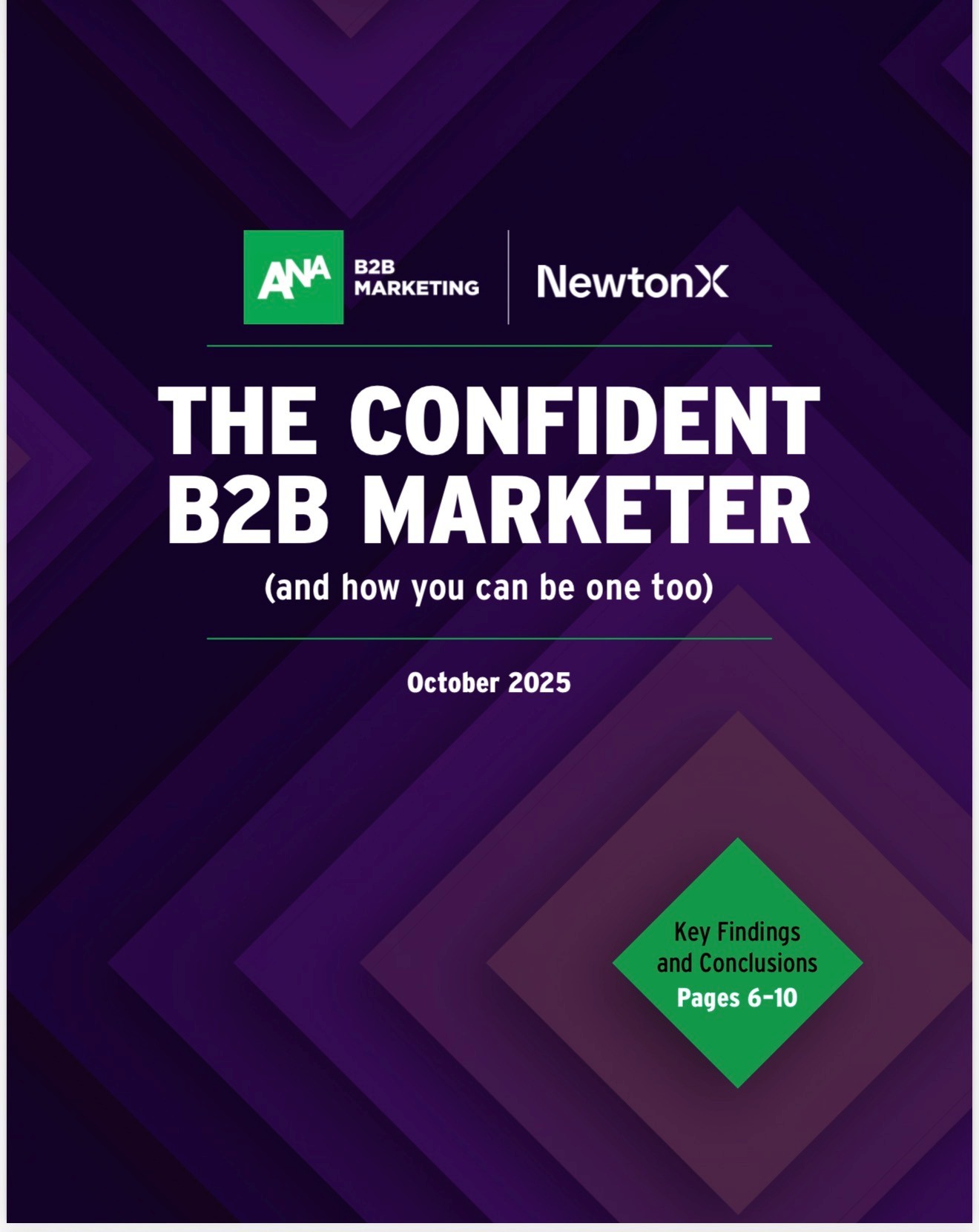
B2B marketing is in the middle of a reset, driven less by hype cycles and more by a deeper shift in how companies grow and how buyers make decisions. We’ve seen that transformation up close, partnering with CMOs and B2B marketing leaders navigating it. One finding from our new ANA and NewtonX research stopped us cold: Even the most senior marketing leaders at the world’s biggest companies still wrestle with the same core challenge.
It’s not about knowing which technology and channels to invest in. It’s not about how to use AI, or where to focus the next campaign. It’s confidence -- specifically, confidence in their ability to prove that everything they do is driving financial impact.
Despite record investments in technology and innovation, only 39 percent of senior B2B marketers are “very” or “extremely” confident in their ability to measure marketing’s impact on business performance. Think about that: More than half of the most capable marketers on the planet still don’t feel they can connect their work to revenue with conviction.
This lack of confidence has ripple effects. It’s why we see so many marketing teams trying to reverse-engineer business impact from surface-level success -- chasing viral posts, or quarterly vanity metrics that look impressive in a slide deck but don’t always translate to growth. These activities can build brand and influence, but they often become substitutes for the harder work of proving commercial value.
But the story doesn’t end there. Because when we looked deeper into the 39 percent who are confident, a different pattern emerged. Their confidence wasn’t accidental. It was the result of deliberate choices and disciplined execution in a few key areas:
- Sales alignment. Confident Marketers are nearly four times more likely to report a “fully aligned” relationship with sales, characterized by shared goals, joint planning, and strong trust.
- Balanced investment. They resist the false trade-off between brand and demand, treating brand as future pipeline. As a result, they are almost twice as likely to be increasing their long-term brand spending in the next year.
- AI readiness and data integration. They lay the groundwork for innovation by building integrated data systems, making them over four times more likely to have a tech stack ready for an autonomous, AI-driven future.
- Measurement maturity. They move beyond vanity metrics, making them about twice as likely to use advanced or intermediate attribution models that connect marketing activity directly to financial outcomes.
Confidence, in other words, isn’t a personality trait. It’s a capability which emerges from how an organization is structured, how it collaborates, and how it connects its work to growth.
That insight carries a profound implication for the future of B2B marketing. The mandate for the modern B2B leader is clear: Stop chasing validation and start building the structural capability of confidence. The marketers who can prove they are a growth engine won’t just earn a seat at the table. They’ll be the ones setting the agenda. And they’ll be able to prove it. The report is available at www.ana.net/confidentmarketer.
This article written by Bill Zengel, and Daniel Sills. Daniel is the Director of Brand Partnerships at NewtonX, where he leads the company's co-branded thought leadership, marketing partnerships, and external communications.
Posted at MediaVillage through the Thought Leadership self-publishing platform.
Click the social buttons to share this story with colleagues and friends.
The opinions expressed here are the author's views and do not necessarily represent the views of MediaVillage.org/MyersBizNet.
Daniel Sills
Daniel is the Director of Brand Partnerships at NewtonX.