
CTV Is Bought on Everything Except the Ad
By Stefan Maris
I spent years at FreeWheel/Comcast building the plumbing that decides which ad runs in which commercial break, and served as Chief Partnership Officer at Nielsen, measuring what that plumbing delivers. Between the two, we knew a lot about every ad: the audience it was bought against, who actually saw it, and the outcomes it drove. But none of these systems could tell us why one ad persuaded people, and another didn't.
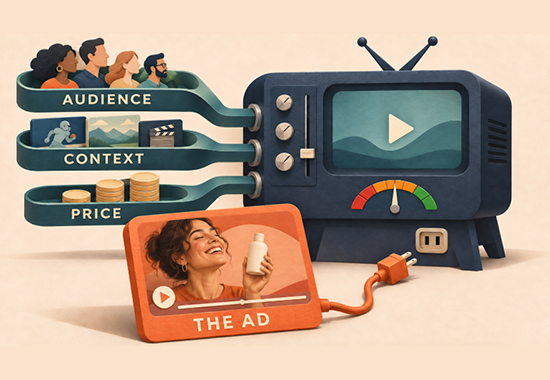
That blind spot is still there. Connected TV gives buyers household-level audiences, show-level context and auction-level pricing, and every one of those inputs gets modeled, scored and optimized. The ad rarely is. One camp focuses on creative optimization, then hands the ad off and hardly ever asks where it runs or who sees it. The other focuses on media activation and treats the ad as a given that can't be changed. Both are good at their half. Very few link the two.
That would be fine if creative didn't matter much. But… it matters most. Nielsen's analysis of nearly 500 campaigns puts creative at 47% of advertising's sales effect, more than reach (22%) or brand (15%). Yet when marketers were surveyed, they guessed creative at 17%.
Why does the ad carry so much weight? Because it's the only part of the buy that actually talks to the viewer. Reach, targeting, and context decide who gets the chance to see it. The ad decides what happens next. And viewers are ruthless editors: they size up an ad in a split second, and the ads that speak to what they want are the ones that persuade. Perfect targeting times an irrelevant ad still equals zero. Media gets the ad in the room. The creative decides whether it sells.
Why the gap is getting bigger
The three biggest shifts in CTV right now keep optimizing the old levers, and for the most part, they still leave the creative out. With the power of AI behind them, the gap gets bigger, not smaller: we're running the same playbook, just with a bigger engine.
The first is curation. A lot of the energy in premium CTV now goes into curated deals. But look at the mechanism: curation packages audiences and inventory, the same who-and-where logic buyers already run in their DSPs, now moved to the sell side. That isn't a bad thing, since sellers know their supply best. But the ad is still missing from the package.
The second is contextual targeting. The smartest contextual players now pair audiences with the content around the ad, some down to the scene level, which is real progress. But the match is still between the person and the program, and it leaves out the biggest lever: the ad itself.
The third is agentic buying. Agents optimize whatever they can see. They will get extremely efficient at doing what we have done for the last 20 years. But unless the creative becomes an input, they will still miss the biggest lever.
The walled gardens already figured this out. On Meta and Google, the creative is part of the optimization, and the system learns which ad works for whom. Open CTV is where it's still missing.
The creative needs to be part of the CTV buy
For twenty years, this industry got very good at deciding who sees an ad, and where. The next step-change improvement won't come from finding the household a little more precisely. It will come from bringing the creative into the decisioning. In my view, two things need to happen.
1. Treat the creative as a data input for decisioning. Give every ad deep metadata: its tone, its promise, the need it speaks to. Today a creative ID only tells the platform which file to serve. Describe each ad in the same vocabulary you use for audiences and content, and pass that into the deal so the optimization can use it. If your audiences and your creative can't be compared, your buy can't be optimized end to end.
2. Include the creative in your optimization strategy. Most CTV optimization adjusts audiences, supply and price, and leaves the creative alone. Read results across creative, audience, and context together, not as separate silos, then feed what you learn into the next buy. Judge it on real outcomes, like site visits and purchases, wherever you can measure them. We've seen what this can do: in a recent quick-service campaign, matching the creative to the audience and the content this way delivered 25% higher return on ad spend, measured on actual card purchases.
The ad is already sitting in the ad server. It's time we started buying on it.
 Stefan Maris is Co-Founder and CEO of RMTLabs. He was previously Chief Partnership Officer at Nielsen and led business development at FreeWheel/Comcast, with two decades building TV and CTV ad tech infrastructure.
Posted at MediaVillage through the Thought Leadership self-publishing platform.
Click the social buttons to share this story with colleagues and friends.
The opinions expressed here are the author's views and do not necessarily represent the views of MediaVillage.org/MyersBizNet.
