
From Fragmentation to Flow
What’s Actually Cool About Marketing Right Now
Old school: Media investments are allocated by channel, like search, social, display, CTV, and optimized within its own lane. What’s cool: Using AI to coordinate everything at once, from adjusting bids, audiences, creative variations, and channel mix in real time, via “the COOL company.”
At a high level, the COOL company is trying to do something many marketers have been piecing together manually.
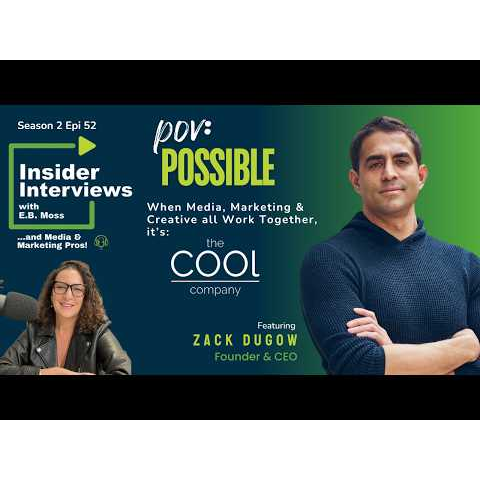
Through a series of ad tech acquisitions, it brought together creative automation, media buying, attribution, localization, and publisher tools into a single AI-driven platform called Cool AI. Founder and CEO Zack Dugow explained how, complete with a data-driven case study, during the fourth annual POSSIBLE Conference in Miami last month, and on one of the episodes of Insider Interviews captured there, tagged “POV: Possible.”
Fragmentation is a harsh reality of marketing today, Dugow pointed out. It affects measurement, buying and planning, and even creative, with different teams, tools, and metrics often operating in parallel instead of in sync. This cobbled approach works well enough, but not always cohesively. “People will often allocate and say, ‘Here’s my budget for TikTok… and here’s my budget for display ads, and here’s my budget for search ads,’” he said, adding that the problem is that performance doesn’t follow those boundaries. “Customers don’t behave in neat channel buckets, and neither do results.”
Instead of optimizing each channel separately, the COOL version of reality is a full stack solution. “We build the ad creative, we buy the media for you, and whatever gets you customers at the cheapest price, that’s what we optimize towards. Then we do all of the attribution, telling you where the sales came from,” Dugow said. A passionate athlete, Dugow has essentially built a kind of fantasy football team for modern marketing, pulling together capabilities that usually operate separately and having them work toward the same ROAS goal.
The company goal, Dugow said, is that the system works for all advertisers regardless of scale. “You could be a big airline, or you can know nothing about advertising with a little car wash on the corner,” he said. In either case, he said, “we’re going to build the ads for you and buy all the media to get you customers at the cheapest price and tell you what’s driving the most sales.”
What’s In a Name
Dugow is occasionally teased about the bold choice of the company’s name. It’s not exactly understated. But given what he’s building, it’s also not exactly wrong: COOL actually stands for “Creative, Open-minded, Optimistic Leadership.”
Dugow seems to embody the acronym, having observed early on the challenges with digital advertising and ad blockers, which sparked the creation of the first of their four constituent brands. Dugow built a site to drive engagement by allowing people to predict outcomes of TV shows and sporting events, monetized by ads and data around those predictions. Perhaps better at building than naming products, he acknowledged that the name “Insticator,” intended as a hybrid of “Instinct” and “Indicator,” has met with some kidding for its proximity to “instigator.” But Dugow laughed all the way to the bank as the startup made the Inc. 5000 list multiple times, with the SSP achieving an almost 200% revenue growth over a one three‑year period.
Meantime, the now collective that is COOL has its own bragging rights, best illustrated by the case study Dugow shared on both the “Innovation Stage” at Possible and on the podcast episode.
When Optimization Doesn’t Stop
In a controlled test with National Veterinary Associates, the COOL team compared results from their AI platform against a human-managed campaign with the same budget. The results were striking. “For that same amount of money… they got 289% more phone calls, appointments, better call quality,” he said, describing what he called “a transformative return on investment in ad spend.”
Where a human team might make dozens of optimizations in a given week, Dugow’s system made thousands; more than 8,000 changes over a two-week period. Each individual change is small. Together, they add up.
“Say the value of that 81st change is .001% better,” he said. “What human is gonna log in, take 20 minutes to make a change that improves something one one-thousandth of a percent?” With AI, those micro-improvements don’t get skipped. “All of thousands of those .001s all add up… to be now 80% better here… and 30% better here.” Dugow joked that unlike human teams, “our AI doesn’t have to eat, or get treated to a cruise... It’s just always improving things while humans’ sleep.”
His point is that AI isn’t just about speed or savings. It’s about handling a level of decision-making that humans realistically can’t keep up with.
Measurement Still Needs a Gut Check
Even with better performance, measurement doesn’t suddenly get easier or more transparent. His advice is to use a third party to help with objective measurement and ask better questions. Dugow pointed out how marketers often rely on attribution models they can’t fully explain. “I cannot tell you how many customers and partners… say, ‘Our attribution showed that we’re getting a 2½X return,’” he said. “And then you ask them to explain how the attribution is done… and they won’t know.”
So, it’s not just about whether the number looks good, but whether anyone understands how it was calculated in the first place. Ask, he said, “What is actually being measured? What assumptions are baked into the model? And most importantly, does it line up with what’s happening in the business?”
“Ultimately, at the end of the day,” he adds, “you should be looking at your own internal business metrics… what were my sales numbers? If you're a restaurant, it may be ‘how many entrees did I sell’? If you’re DTC commerce, it's what were my sales numbers? Make sure that's aligning with what you're getting in any third-party report.
So, What Changes
Dugow’s interest in bringing what once felt like fantasy into the real world doesn’t stop at marketing systems. In Dugow’s world, his best friend is a dog is named “Barry,” short for Ser Barristan Selmy from Game of Thrones. It’s a small detail, but a telling one. The line between what once felt like fantasy and what’s now operational reality is getting thinner.
To further close the gap between what’s possible and what’s actually being done now, marketers might start by revisiting long-held assumptions, from about how budgets are allocated, how performance is measured, and how decisions are made, then shift from managing campaigns to managing systems. And, if you asked Dugow, it might start by getting COOL.
Posted at MediaVillage through the Thought Leadership self-publishing platform.
Click the social buttons to share this story with colleagues and friends.
The opinions expressed here are the author's views and do not necessarily represent the views of MediaVillage.org/MyersBizNet.

E.B. Moss
E.B. Moss is an award-winning writer, podcaster and strategist who creates content that opens revenue doors and brings out the human to human side of B2B marketing. An expert in explanatory journalism, E.B. served as an inaugural editor at media trades &l…