
HISTORY’s Moment in Media: The Al Capone Vault Special That Changed TV
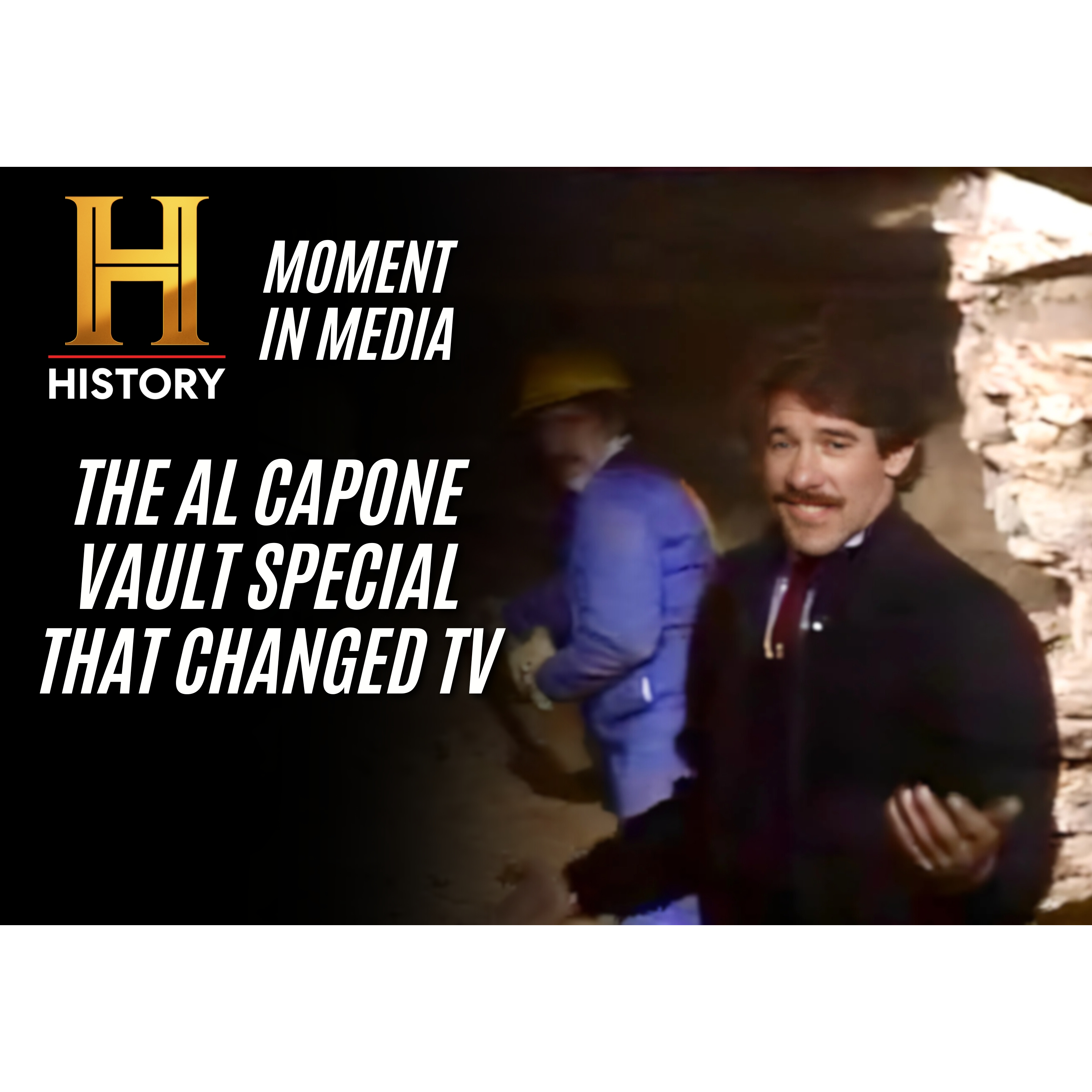
On the evening of April 21, 1986 -- 39 years ago this month -- Geraldo Rivera hosted a live, two-hour special from the basement of the defunct Lexington Hotel on the South Side of Chicago called The Mystery of Al Capone’s Vaults. Rivera and his producers speculated they’d find untold secrets and treasure, perhaps even the corpses of his gangland rivals, in the hidden space beneath the hotel that Capone had made his headquarters. Instead, they found nothing. A few old bottles and a lot of dirt.
But the syndicated broadcast also pulled a remarkable 30 million viewers and jumpstarted a new phase of the provocative newsman-slash-entertainer’s career, one that led to an entirely new kind of television talk show.
Capone, of course, was one of the most notorious gangsters in history, running a sprawling Chicago-based criminal enterprise that newspapers at the time estimated brought in $100 million. He lived opulently in a hotel suite, with a taste for fine suits and opera. In 1932, he was finally convicted -- not of the many murders he was believed to have ordered, but for tax evasion. He was sentenced to 11 years in prison, much of it served at Alcatraz, the notorious lockup on an island in the San Francisco Bay. He was released early due to his poor health -- dementia caused by an old case of syphilis -- and died in 1947 at his estate in Florida. The public was long fascinated by his story.
Rivera, the New York-born son of a Puerto Rican father and a Jewish mother, briefly practiced law before turning to TV journalism. He’d started in the 1970s at New York’s WABC-TV, where he was an accomplished reporter. His reporting on the horrifying conditions at a mental institution for children on Staten Island won him an Emmy and a prestigious Peabody Award. He later moved on to, first, a national late-night talk show on ABC, and then Good Morning America and finally to a featured reporter slot on the then-new weekly newsmagazine 20/20.
But in 1985, his contract with ABC wasn’t renewed, after he’d publicly criticized ABC News chief Roone Arledge, his one-time mentor, for nixing a segment by another reporter about President John F. Kennedy’s relationship with Marilyn Monroe. By 1986, he needed a job.
In the meantime, a pair of LA-based television producers were looking for ideas for specials. (One of the two, Doug Llewelyn, was also then the host of The People’s Court.) They learned about a concrete wall in the basement of Capone’s Lexington Hotel, behind which some believed the late mob boss’s possessions might remain. Their first idea for a host was Robert Stack, the actor who’d played federal agent Eliot Ness, the man charged with bringing down Capone, on the ’60s TV series The Untouchables. But with their plan for a live special, they realized they needed someone who could work without a script. Rivera, the out-of-work flamboyant newsman -- then clearing his head by sailing in the Caribbean -- was the perfect candidate. They reached him by ship-to-shore radio.
Rivera signed for a $50,000 fee. No network was interested -- without knowing in advance what he’d find, they didn’t want to take the risk -- but Tribune Entertainment, a major TV station owner based in Chicago, signed on. And the producers went to work, leaving seemingly no stone unturned in building hype (or ad time unsold). When the night of the broadcast came, hundreds of other reporters were on the scene to report the findings. They also had Chicago’s medical examiner there, in case bodies were found, and agents from the IRS, to whom Capone still owed an unpaid tax debt, in case there was money.
Workers used dynamite to blast down the wall. Nothing was there. Rivera, who’d become convinced something really would turn up, was despondent. With time to fill at the end of the live broadcast, he sang the song “Chicago.”
Then the ratings started coming in. It was a hit -- the highest-rated syndicated broadcast in television history, due in part to the high level of media hype and the promise of a potentially explosive or lucrative discovery. The next year, Rivera and Tribune Entertainment launched his daytime talk show, Geraldo. His long career was on to its next phase -- and what would be dubbed “trash TV” had arrived.
Click the social buttons to share this story with colleagues and friends.
The opinions expressed here are the author's views and do not necessarily represent the views of MediaVillage.org/MyersBizNet.