
HISTORY’s Moment in Media: The Bill of Rights Clears Congress
The U.S. Constitution was drafted during the notoriously hot summer of 1787 and signed by delegates to the Constitutional Convention in Philadelphia on September 17 of that year. Delaware was the first state to approve it, in December, and it went into effect on June 21, 1788, when New Hampshire became the ninth state to ratify, the threshold required to make the new governing document legally binding.
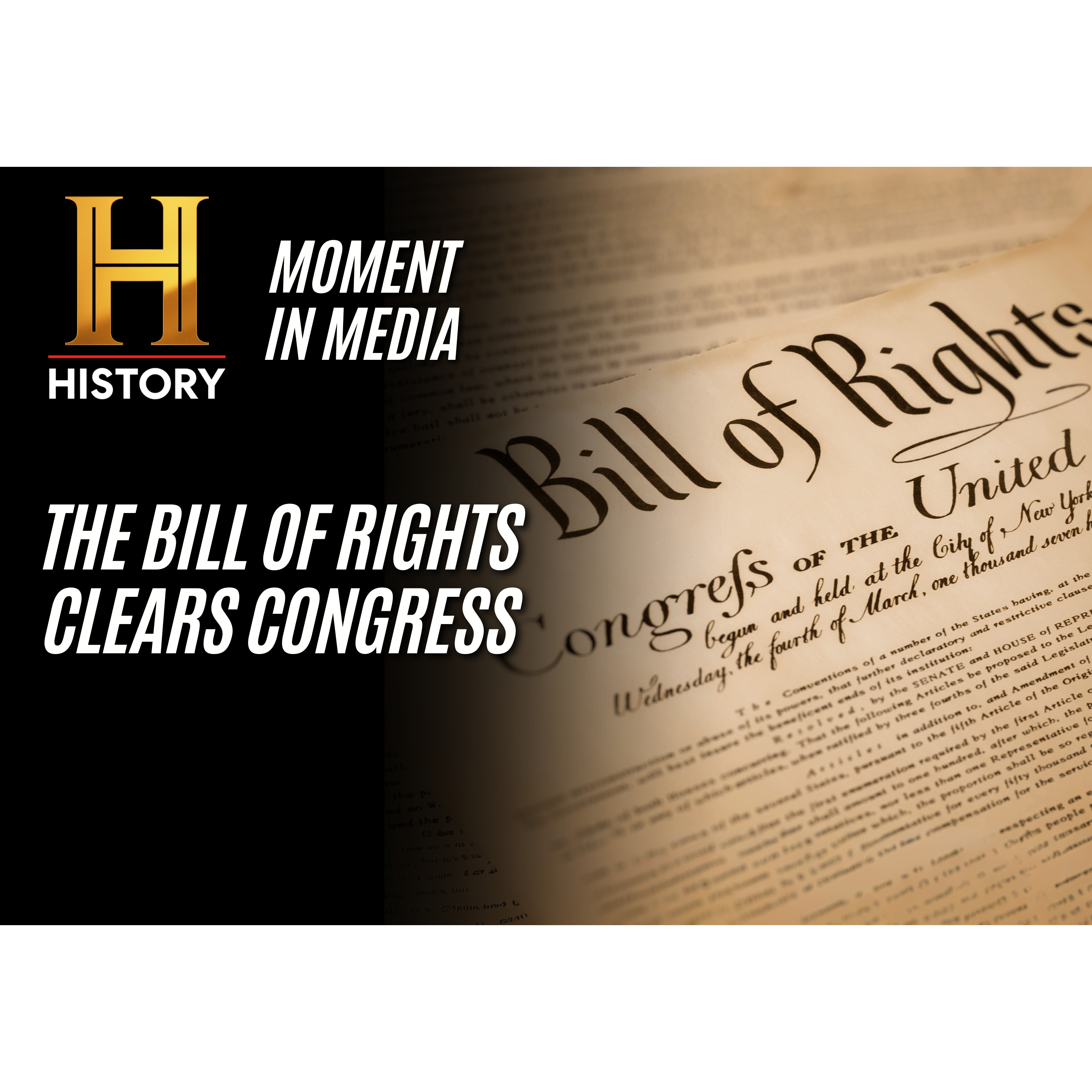
But the Constitution, as originally drafted, contained no guarantees for American citizens’ individual rights. On September 25, 1789 -- 236 years ago this month -- the first U.S. Congress approved 12 amendments to the Constitution designed to protect those rights, including the rights to free speech and freedom of the press, and sent them to the states for ratification.
Ten of those 12 amendments were approved by the states, becoming the Bill of Rights. And because the first two proposed amendments didn’t garner the necessary state votes, what was passed by Congress as the Third Amendment -- “Congress shall make no law respecting an establishment of religion, or prohibiting the free exercise thereof; or abridging the freedom of speech, or of the press; or the right of the people peaceably to assemble, and to petition the Government for a redress of grievances” -- on that date became the First Amendment to the Constitution.
When delegates gathered in Philadelphia in May 1787, their mandate was to amend the Articles of Confederation, the original governing compact among the 13 former British colonies, which created only a loose central government among the various independent states. It became clear, however, that a new structure was needed, and the convention spent that summer negotiating the trade-offs that enabled the Constitutional system. Focused on the compromises and power balancing necessary to establish this new government, the delegates did not include any language on citizens’ rights. Late in the deliberations, several delegates raised this concern -- but the convention didn’t want to reopen discussion and risk the whole arrangement falling apart. Many delegates also believed that the preexisting rights guarantees -- in state documents like Virginia’s Declaration of Rights, from which Thomas Jefferson drew in drafting the Declaration of Independence -- would be sufficient.
James Madison, later the fourth president, was a chief drafter of the Constitution and, together with Alexander Hamilton and John Jay, a coauthor of the Federalist Papers, a series of newspaper articles explaining and defending the Constitution as ratification was pending with the states. Initially not seeing the need for a rights declaration, during the ratification process he became convinced. As a highly contested debate raged in Massachusetts, with Anti-Federalists concerned that the Constitution placed too much power in the hands of the central government, a deal was reached that became known as the Massachusetts Compromise, proposed by Governor John Hancock: “Ratify now, amend later.” Once the first Congress was sworn into office, Madison took up the work of drafting the promised amendments.
Today, an original draft of the 1789 Joint Resolution of Congress proposing the Bill of Rights sits alongside the Declaration of Independence and the Constitution -- together, the three documents are known as the Charters of Freedom -- in high-security display cases in the rotunda of the National Archives, in Washington, D.C. That version shows the 12 proposed amendments, one of which (on the apportioning of the House of Representations) is now moot, and the other of which (preventing members of Congress from raising their own salaries until after the next election) became law on May 7, 1992, when Michigan became the 38th state to ratify it. It’s now the 27th Amendment.
Posted at MediaVillage through the Thought Leadership self-publishing platform.
Click the social buttons to share this story with colleagues and friends.
The opinions expressed here are the author's views and do not necessarily represent the views of MediaVillage.org/MyersBizNet.