
How General Motors Quietly Reshaped the Entire Advertising Industry in 1992
A confidential 1992 consulting recommendation sparked the birth of GM Planworks, dismantled the agency status quo, and triggered the commoditization of media buying -- now, its author says it’s time to reverse course.

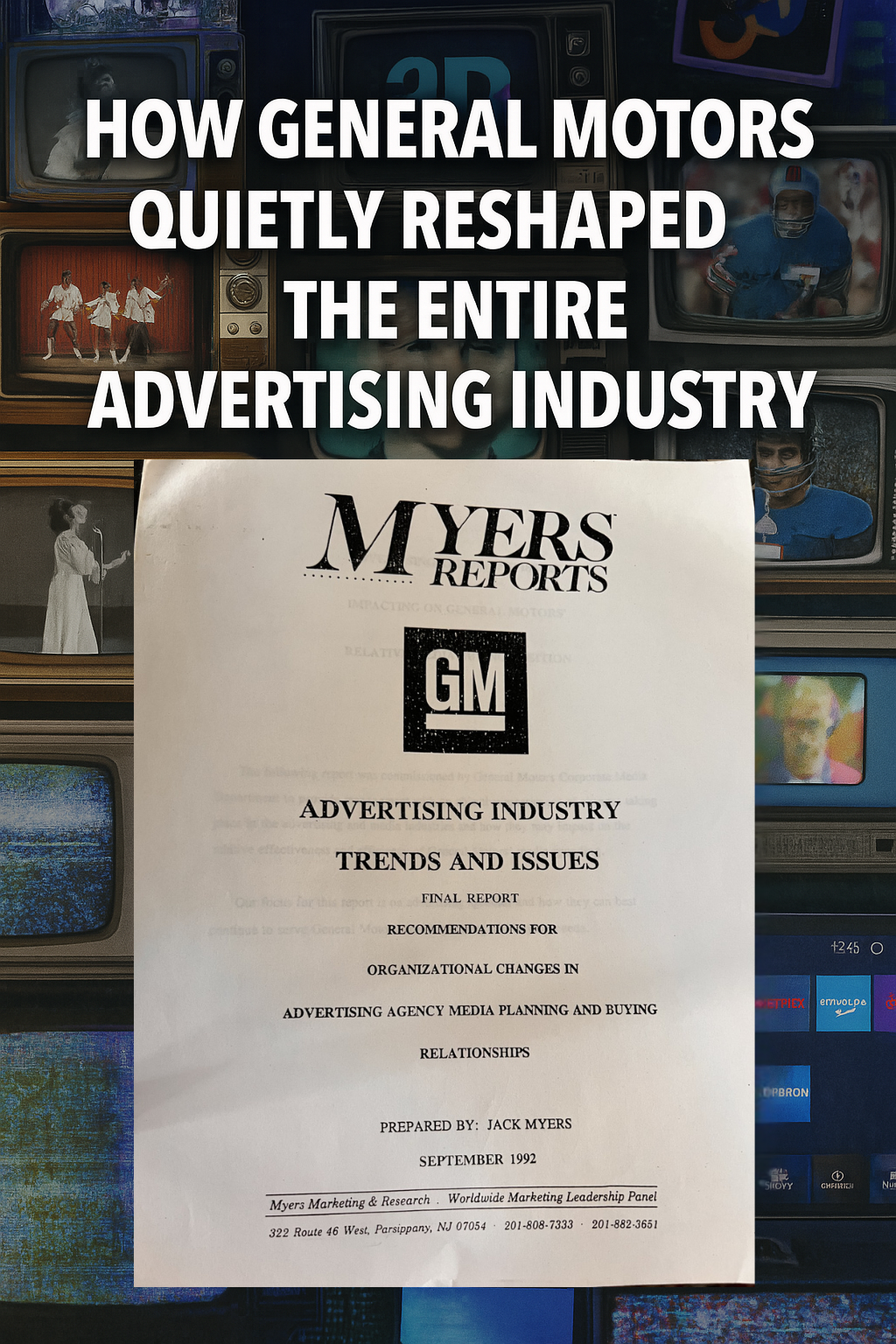
In 1992, I was commissioned by General Motors to develop a consulting report that was positioned publicly as an assessment of the media buying landscape. But privately, its purpose -- and what it ultimately delivered -- was something much more transformational. The report, developed for GM’s Corporate Media Department led by Michael Browner and Betsy Lazar under the direction of CMO Phil Guarascio, became a catalyst for a radical shift in agency-client relationships, ultimately leading to the creation of GM Mediaworks under Interpublic Group and the broader industry-wide separation of media and creative into distinct profit centers.
What I observed then and predicted with clarity has since shaped the trajectory of media buying, including the rise of in-house corporate media departments, the unbundling of media services, and the commoditization of media. Now, more than 30 years later, I believe the advertising industry is again at an inflection point, one that calls for equally bold decisions to restore balance between media and creativity, to inject technointelligence into planning, and to leverage generative AI to rebuild the value of media brand equity.
1992: A Blueprint for Disruption
At the time, General Motors' media buying structure was highly fragmented. Network television buying was divided across multiple Agencies of Record (AORs) by daypart, with inconsistent communication between planning and buying. Through my research and confidential interviews with more than 60 senior media executives and agency leaders, I learned that 80% of marketers expressed concern with their agencies’ capabilities in media, and only 8% were fully satisfied with their ability to evaluate media buying performance.
The situation was clear: agencies were becoming increasingly focused on turning media into a profit center. The divergence between agency financial priorities and client performance goals had grown unsustainable.
I wrote then, and I stand by it now, “Control over its own destiny is the critical element for maintaining General Motors’ successful management of the media process… GM can proactively direct and control the nature of change… or it can wait and lose control.”
I recommended then that General Motors fully consolidate its media buying, either in-house or under a holding company, specifically suggesting a dedicated unit under Interpublic. The result was GM Mediaworks, followed by the later consolidation of media planning and buying into GM Planworks under Publicis Groupe’s Starcom.
What Followed: Power Shift and Commoditization
The decision set off a domino effect that transformed the agency model. Media buying was unbundled, media agencies emerged as independent entities, and client-side media departments gained prominence. While this led to more efficiency, it also commoditized media -- reducing its strategic and creative value.
Media became transactional. Value was equated with scale, CPMs, and buying efficiency. Planning and storytelling were decoupled, and the role of media as a strategic business asset began to erode.
As a client I spoke with warned then, “Agencies don’t have a clear vision anymore of why they’re in the media business… there are just too many media dollars being spent for me to leave it in the hands of the agency without tight controls.”
The Radical Realignment of Advertising and Why It Still Matters Today
Fast forward to 2025, and we are again in crisis but for different reasons. Media is now abundant, and supply far outpaces demand. Inventory is cheap. Data is ubiquitous. Algorithms decide more than people do. But media value - real, strategic, brand-building value - is at its lowest ebb in decades.
We are over-optimized and under-inspired.
The pendulum has swung too far in the direction of commoditization. Media agencies now hold the most power in the advertising ecosystem, often more than their clients or the media companies themselves. But without a renewed focus on creativity, strategy, and brand equity, that power is precarious.
We need a new transformation; one that restores creative intelligence to media and reimagines how media drives business outcomes.
A New Framework: From Commoditization to Convergence
I believe it’s time to challenge the current model and introduce a new vision. One grounded in equilibrium, ingenuity, and future-facing intelligence. The next transformation should center on five strategic imperatives:
1. Creative Integration in Media Agencies
Media agencies must build internal creative teams, not to compete with traditional creatives, but to translate data and insights into compelling, human-centered media experiences. Creativity is not the enemy of efficiency; it is its multiplier.
2. Technointelligence for Media Equilibrium
I advocate for the evolution from raw data to technointelligence - a strategic fusion of technology, analytics, and human judgment that restores balance in the media ecosystem. Media equilibrium means optimizing not only for cost, but for culture, attention, and outcomes.
3. Generative AI as a Value Builder
Rather than using generative AI only to reduce costs or automate content, we must use it to rebuild media’s value as a financial asset, a brand-building vehicle, and a lever of enterprise growth. Media brand equity must be tracked, managed, and reinvested in.
4. Strategic Rebalancing of Supply and Demand
The advertising economy must shift from the over-supply mentality to demand cultivation. That means designing media strategies not around volume, but around value to the consumer, the brand, and the business.
5. Reinventing the Agency-Client-Media Triangle
It’s time to reshape the triangle of influence that governs our industry. Agencies, clients, and media must collaborate in new ways aligned not by contracts, but by shared performance metrics and long-term brand health.
Lessons Still Relevant Today
Back in 1992, I argued that “communications, continuity, and control” were the bedrock of effective media management. That remains true. But today, those principles must evolve:
- Communications must be accelerated through AI-enhanced transparency and real-time collaboration.
- Continuity must extend to learning models, where institutional intelligence compounds over time.
- Control must shift from guarding information to designing intelligent systems of governance.
The strategic insight that powered GM Mediaworks is still relevant: consolidation isn’t about efficiency alone. It’s about clarity of vision. The moment demands that media again serve as a strategic lever of competitive advantage.
Leading the Next Era
As I continue my work advising corporations and media organizations, speaking to leaders about The Tao of Leadership and the future of media, I remain convinced that we are poised for another renaissance. If we can rebalance creativity with technology and reclaim media as a source of brand and cultural value, the next chapter can be even more powerful than the last.
We’ve transformed media once. Now, it’s time to do it again with foresight, with purpose, and with the courage to lead.
To connect with me for insights, briefings, or speaking engagements, visit www.jackmyers.com or message me directly on LinkedIn.

Jack Myers
With over five decades of experience in corporate leadership, B2B research, management insights, and technological trends, Jack Myers is a visionary leader and a trusted source for guidance and preparation as generative AI and machine intelligence dominates …