
How To Interpret New Attention and Media Quality Research
Last week, advertising industry trade associations on two continents—CESP in France and CIMM in the United States—published new POV papers on attention measurement and media quality metrics.
Adelaide Metrics contributed to both papers, and we appreciate the work each association is doing to bring more structure, transparency, and rigor to an increasingly important area of media measurement. While the papers approach the topic from different angles, they point to the same broader trend: quality is becoming a central lens through which to assess media value, and attention is becoming one of the key foundations for how that quality is measured.
CESP Paper Overview: A closer look at attention measurement in France
Centre d'Étude des Supports de Publicité(CESP), France’s equivalent of the U.S. Media Rating Council (MRC), together with the Institut de Recherches et d'Études Publicitaires (IREP), which is similar to the U.S. Advertising Research Foundation (ARF), published its second white paper on the attention metrics provider landscape in France, following its initial analysis in 2024.
CESP’s latest paper examines the current attention measurement landscape in France, focusing on eight data providers, their methodologies, media channel coverage, and reporting.
Key findings
- Attention measurement has become more sophisticated, but not more standardized.
- Attention indicators vary widely.
- Attention duration is the most likely candidate for a shared KPI, but with caveats.
- Attention should not be confused with effectiveness.
- Wider adoption depends on transparency and a shared framework.
Adelaide’s take on the CESP paper
CESP considered several other attention-related projects conducted by international associations for context, including the 2025 IAB/MRC Attention Measurement Guidelines and the 2024–2026 ARF Attention Validation Initiative.
CESP’s finding that there is no standardized attention-measurement approach among the providers it examined is reminiscent of the ARF’s findings, particularly in Part 2 of its Attention Validation Initiative, which focused on creative attention measurement providers. Like CESP, the ARF found that the range of methodologies used by participating creative attention measurement companies created a “choose-your-own-adventure” path for advertisers, with insufficient coherence across reported attention data results and low or no comparability.
That lack of creative attention measurement standardization may still be limiting broader adoption in the U.S. today.
Attention duration is a commonly reported measure among attention measurement providers. While it is not what we report at Adelaide, we recognize that duration-based attention metrics can be useful in the context of creative development. Because creative has a significant influence on how much time someone spends with an ad, it is easy to imagine attention duration data serving as a training input for AI-based creative development and testing.
But for media quality measurement, we do not believe duration-based attention metrics are the right approach.
Goodhart’s Law states that when a measure becomes a target or KPI, it stops being a useful measure. Duration is shaped by a combination of factors: the media environment, the creative itself, and the audience seeing the ad. If buyers optimize media toward duration-based attention metrics, they may inadvertently incentivize:
- Poor user experience design
- Salacious creative
- Delivery toward audiences that tend to pay attention for longer
- Attention duration as the de facto campaign outcome: shifting focus away from the advertiser’s actual business objectives
Media’s goal should not be to maximize attention for its own sake. It should be to understand which media environments are most likely to capture attention and contribute to outcomes.
We agree with CESP’s conclusion that attention should not be confused with effectiveness. Attention is not a performance or brand-effectiveness KPI. Rather, it is a contributing variable to advertising outcomes, helping advertisers evaluate whether an ad placement is likely to create the conditions for impact.
We also agree with CESP that the wider adoption of attention measurement depends on a transparent, stakeholder-accepted framework. Until the market reaches that level of alignment, attention will remain valuable, but harder to apply consistently as a universal indicator of media quality.
Through our membership dues and continued collaborations, Adelaide will support CESP’s efforts to bring a more standardized view of the value of attention-based metrics for media in France and across the EMEA region.
CIMM Paper Overview: Media quality as market infrastructure layer
The Coalition for Innovative Media Measurement (CIMM) published Quality Matters: Navigating Quality In Media Buying and Measurement, a commissioned perspective on quality as a relevant input to media buying and measurement.
The paper addresses what CIMM describes as a growing market gap: the lack of a shared framework for understanding how placement-level characteristics influence marketing effectiveness. It argues that media quality should evolve from a secondary optimization variable into a form of market infrastructure—measurable, transactable signals that help the market distinguish, value, and price differences in advertising opportunities.
Co-authored by Erez Levin and Gabriel Dorosz (who worked with Adelaide during his time leading attention measurement efforts at The New York Times), the paper builds on existing transparency requirements and frameworks as defined by the Association of National Advertisers (ANA) around data quality and made-for-advertising (MFA) sites.
Key findings
- Not all impressions are equally valuable.
- Media quality is a distinct input to buying and measurement.
- Quality should be treated as a spectrum, not a binary filter.
- Attention is an important dimension of quality, but not the whole of it.
- Media quality needs to become easier to define, validate, and use.
Adelaide’s take on the CIMM paper
The Quality Matters paper reflects Adelaide’s point of view on the meaning and importance of media quality well.
For CIMM, media is the clear focus. While creative and audience quality are part of the broader discussion, media quality takes precedence as an actionable data lens for planning, buying, measurement, and optimization. Rooted in digital media performance observations, the paper sets out what buyer and seller expectations for media quality can and should become.
We strongly agree with the paper’s central themes. Media quality is not a subjective judgment; it is a measurable, placement-level signal that can help advertisers predict media value before, during, and after a campaign. We also agree that quality should not be treated as a binary pass/fail threshold. The quality of impressions varies significantly both within and across channels and is shaped by a wide range of environmental and contextual signals.
But simply put, we think the paper describes a problem Adelaide has already spent years working to solve. It calls for a standardized, transactable, and broadly accepted way to evaluate media quality. That is what our metric, AU, was built to provide.
Adelaide’s AU is an attention-based media quality metric that measures the probability that an ad placement will capture attention and contribute to outcomes. It has been created for 19 unique media channels, contracted for use by every major holding company and large independent media buying agency, and distributed programmatically across every major DSP and SSP.
Other efforts have sought to characterize media quality through aggregated, multi-factor scores, often with viewability or content context markers as components. Examples include:
- 2025 ARF Audience x Science project from Colgate-Palmolive and GroupM: The Evolution Of Quality Media
- 2026 ARF Audience x Science project from NBC and Eyesquare: Ad Effectiveness Across Broadcast, Social, and Streaming Video
- The Trade Desk’s TV Quality Index
There are two major differences between Adelaide’s AU and the measures created by the efforts listed above: outcomes and distribution.
- Outcomes
When Adelaide creates an AU model for a channel, we gather relevant exposure, placement, and contextual data points to build a simple algorithm which we then train on real full-funnel outcome data, from upper-funnel brand lift to lower-funnel sales. That outcomes-training step is critical to AU’s value. Media quality scores constructed only from observable characteristics, such as viewability, clutter, and placement size, can be descriptive. But without outcomes training, they cannot reliably predict the objectives advertisers aim to achieve.
- Distribution
The other difference is distribution. Since its earliest days, AU has been guided by the idea of “AU Everywhere,” a strategic approach to making a consistent, omnichannel media quality signal available across the media ecosystem. That distribution has established AU as the market leader in media quality reporting and buy-side and sell-side applications.
Even so, the work is not finished. Media quality will only become more valuable as the market develops clearer definitions, stronger validation methods, and more consistent ways to apply quality signals across planning, buying, and measurement.
In the past year, Adelaide has worked with and learned from innovative media owners, including Uber Ads and Kinective, as well as major media portfolio and data companies, such as Nielsen Media Research. As CIMM members and active participants in organization projects, we look forward to collaborating on follow-up research projects demonstrating AU’s relevance and value in the context described in the “Quality Matters” paper.
What the two papers signal
The publication of the CESP and CIMM papers on the same day last week is an indication of how important and necessary attention and media quality have become to the advertising ecosystem.
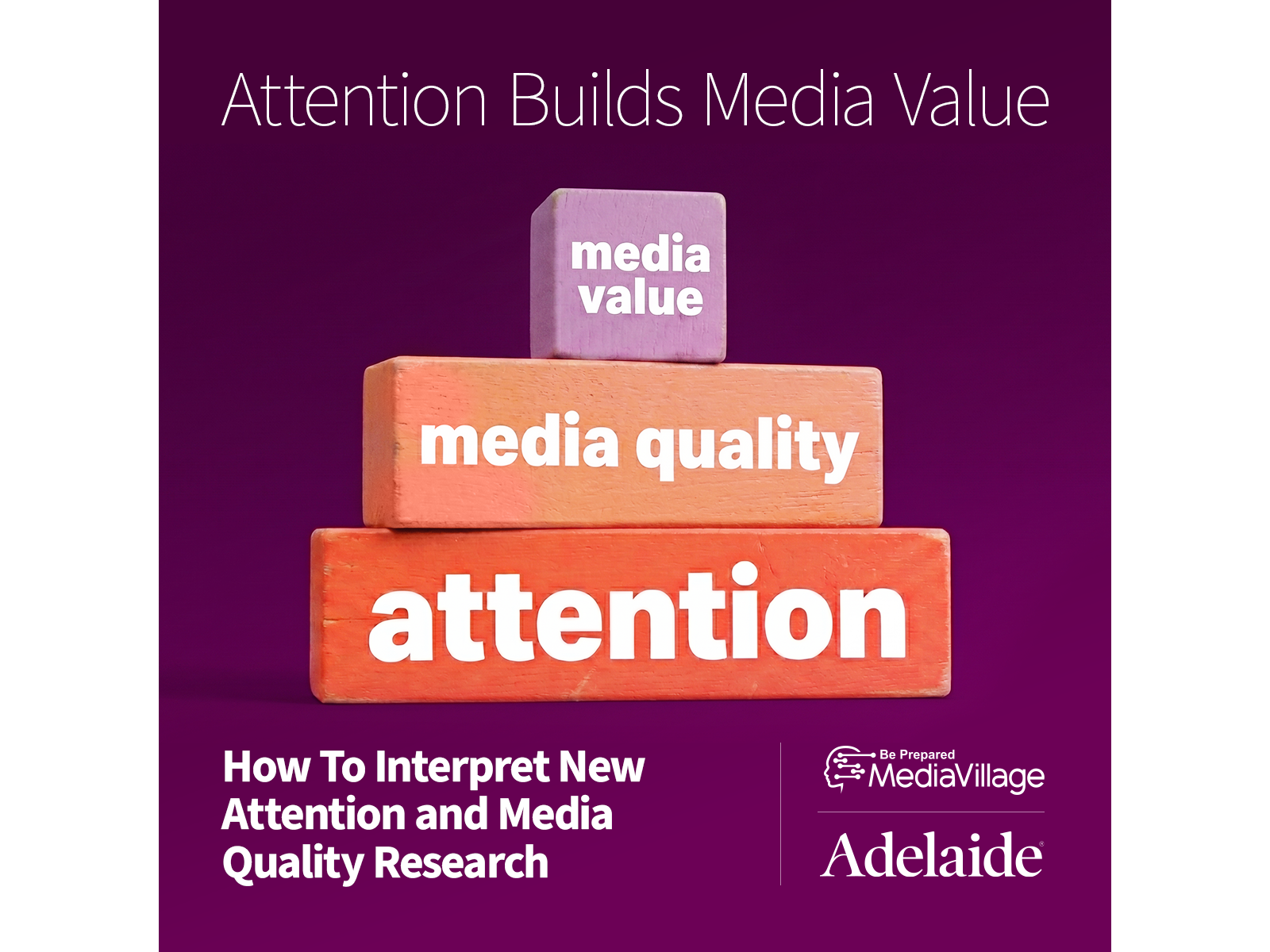
The papers approach the issue from different perspectives but point to the same conclusion: quality is becoming the leading mechanism for assessing media value, and attention is becoming the foundation for measuring that quality.
Posted at MediaVillage through the Thought Leadership self-publishing platform.
Click the social buttons to share this story with colleagues and friends.
The opinions expressed here are the author's views and do not necessarily represent the views of MediaVillage.org/MyersBizNet.

Claire Browne
Claire joined Adelaide in 2024 after 16 years as VP/Director of Media Research at RPA, a large independent full-service agency. Clients included American Honda Motor Company, La-Z-Boy Furniture Galleries, CoStar Group, and ARCO Gas. Prior experience in media…