
How To Measure Attention: The ARF’s Three-Part Validation Initiative
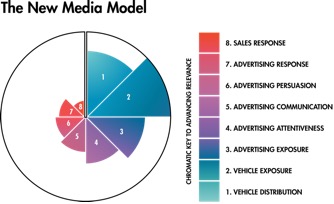
Attention is one of the oldest principles in advertising. AIDA—Attention, Interest, Desire, Action—was first introduced in 1898 and remains the earliest widely adopted framework for how advertising works. It identified “Attention” as the first step in moving someone from exposure to action. The Advertising Research Foundation (ARF) built “Advertising Attentiveness” into its New Media Model.
So, while attention measurement can sometimes sound like a new discipline, the underlying idea is not new at all. What is new is the quality, scale, and variety of methods now available to measure it.
In recent years, as a wave of attention measurement companies have entered the market with new approaches and solutions, the ARF has been a steady supporter. In the early 2020s, the ARF hosted and promoted The Attention Council, which Adelaide co-founded in 2019 alongside fellow measurement firms. In 2024, The Attention Council became part of CIMM, the ARF’s measurement subsidiary, where it now operates as the industry’s main subject-matter working group. The ARF has also featured research from several attention measurement companies, including Adelaide, across its conferences and events.
In 2022, responding to growing market interest, the ARF launched its Attention Measurement Validation Initiative, a three-phase, multi-year effort to describe, test, and quantify attention measurement with the highest degree of scholarly rigor. That initiative has now concluded with the publication of the Phase 3 report, which focuses on media attention.
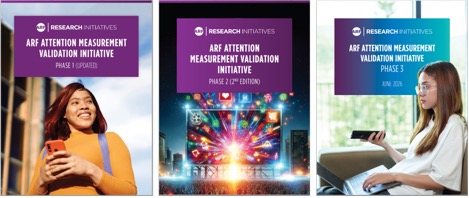
Taken together, the three phases give the industry a useful framework for understanding where attention measurement is the strongest, where it is still developing, and how marketers should apply it in practice.
Phase 1, initiated in 2022, mapped the attention measurement landscape. The report described 29 providers and found wide variation in how they defined attention, what methods they used to measure it, and what data sources they relied on. One important distinction was that providers could be roughly sorted into two groups: those that measure the attention a creative asset earns and those that measure the attention a media environment earns. That distinction matters because creative and media both influence an ad’s ability to capture and hold attention, but their roles in that process are different.
Phase 2, published in 2024, focused on creative attention measurement. A dozen providers scored the same set of ads, and the ARF assessed whether their findings agreed. The results were inconclusive, not because the work lacked rigor, but because “attention” to a piece of creative can mean genuinely different things depending on what is being measured and how. One method studies visual focus, another studies emotional response, a third studies memory encoding. These are all real signals, but they don’t necessarily resolve into one common verdict on a given execution. Creative attention is hard to standardize, and the ARF’s Phase 2 report was candid about that.
Since then, the market has largely settled on a practical view that different creative attention measurement methods serve different needs, customers and use cases. A variety of approaches appears to be working well for all parties, and there has not been a strong push toward standardizing creative attention around a single metric or method.
Phase 3, published this year, turned to media attention measurement and tested it in the field. The study followed four live national campaigns across four advertiser categories. Each campaign was measured in-flight by up to seven independent providers; eight providers participated across the full study, though not every provider measured every channel.
At the channel level, the findings were strikingly consistent. Despite using different methods, providers generally agreed that television and online video drew more attention than social channels. When independent media measurement providers leveraging different methods arrive at the same answer, that answer is typically understood as a more reliable characterization of something real about the medium, rather than something idiosyncratic about the measurement method.
That finding is meaningful because it suggests that media attention can be measured consistently enough to inform planning, comparison, and decision-making.
But Phase 3 was also clear about attention measurement’s limits. The channels with the highest attention did not always produce the strongest brand lift, and channels with more modest attention sometimes did. That does not invalidate attention measurement; it reinforces the fact that attention is one input in media planning and evaluation.
Media weight, reach, targeting, and frequency all need to work alongside attention in a campaign. A high-attention placement with little investment behind it can be outperformed by a lower-attention placement that receives significant support.
The Phase 3 report closes with five recommendations for marketers:
- Understand what an attention metric actually measures before using it. Some methods estimate the probability that an ad is noticed; others capture visual focus, cognitive engagement, or emotional response. Marketers should ask any provider what their metric captures, where its limits lie, and whether it comes with guidance they can act on.
- Ask for historical platform norms, not just raw scores. Different platforms generate different baseline levels of attention, so a number only becomes meaningful when marketers understand what is typical for that placement or environment.
- Keep the measurement approach consistent across campaigns. Because each method captures something distinct, holding one framework steady helps marketers distinguish a real change in performance from a change in method.
- Use judgment for the most granular decisions. Attention is clearest at the broad channel level. The more granular the optimization, the more it should be paired with experience and context.
- Use attention alongside media weight, reach, and frequency. Attention describes the conditions an ad meets, not the outcome it will produce. When attention and lift diverge, marketers should examine creative, targeting, design, and investment weight before concluding the attention score is wrong.
At Adelaide, we read these recommendations as a fair description of how good media attention measurement should work. Candidly, they also closely reflect how we have tried to build our solution.
Adelaide measures media quality using attention-based data. Our metric, AU, estimates the probability that an ad placement will capture attention. It is trained on real outcomes and reported against norms, so a score can be read in context. AU is a comparable metric across 19 channels and is designed to accompany reach, frequency, and other planning inputs.
The ARF’s Phase 3 guidance and Adelaide’s approach point in the same direction, which is a good place for a measurement company to find itself.
The larger lesson of the ARF Attention Measurement Validation Initiative is that attention is not magic, and it is not a single portable number that answers every question. But it can be a dependable compass for media decision-making when it is measured consistently, read against norms, and used alongside the other levers of a campaign.
Four years of careful work by the ARF have brought much-needed discipline to attention measurement and how the industry discusses, evaluates, and applies it.
We thank the leaders of the ARF Attention Measurement Validation Initiative, Chief Research Officer Paul Donato and Senior Director, Research & Insights Tracy Adams for their work, as well as ARF CEO Scott McDonald for his support of the project.
Posted at MediaVillage through the Thought Leadership self-publishing platform.
Click the social buttons to share this story with colleagues and friends.
The opinions expressed here are the author's views and do not necessarily represent the views of MediaVillage.org/MyersBizNet.

Claire Browne
Claire joined Adelaide in 2024 after 16 years as VP/Director of Media Research at RPA, a large independent full-service agency. Clients included American Honda Motor Company, La-Z-Boy Furniture Galleries, CoStar Group, and ARCO Gas. Prior experience in media…