
How to Use AU to Distinguish Media Price from Media Quality
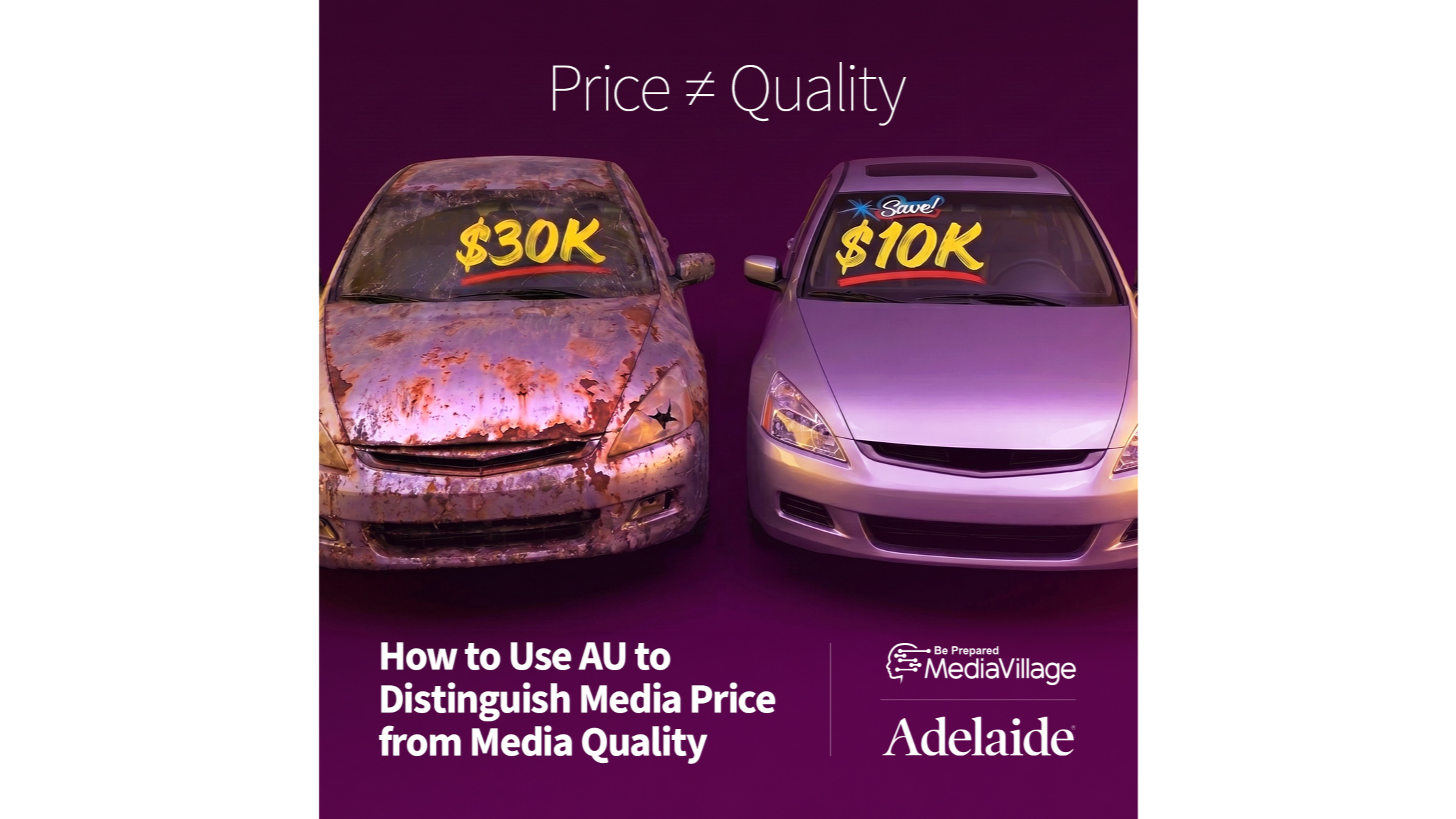
Media negotiations have traditionally started with two numbers: how much an ad unit costs and how large an audience it delivers. Those numbers tell you what you paid and who you might reach, but they do not tell you whether the audience paid attention or whether the media had an effect.
As audiences and media consumption fragment across hundreds of channels and millions of placements, the same CPM can mask very different underlying realities. Two ad units can deliver similar audiences at similar prices, while one is far more likely to capture attention and drive outcomes. Price measures what the media costs. Value measures what it is worth.
In recent years, due to a range of industry dynamics, media price and media value have become increasingly misaligned. The measure that helps close the gap between them is media quality.
At Adelaide, we define media quality as the probability that an ad placement will capture attention and contribute to a business outcome. We express that probability through our proprietary metric AU, a 0–100 score built from attention research, exposure signals, and real outcome data. AU has been independently audited by MediaSense and has completed a pre-audit with the Media Rating Council.
To tell cost apart from quality, advertisers need a way to evaluate both side by side. Here’s how AU can help.
1. Observe that price and quality are not correlated
If we start with the assumption that you get what you pay for in the media marketplace, then the more expensive impression should be the better one. But that is not what we see in the data.
In one Adelaide analysis of more than 80,000 placements, with CPMs ranging from $0.10 to $60, media quality and price showed no meaningful correlation. Some of the lowest-cost inventory earned the highest AU scores, signaling strong opportunities to capture attention and drive impact, while some of the most expensive earned very little.
AU vs. CPM By Individual Placements
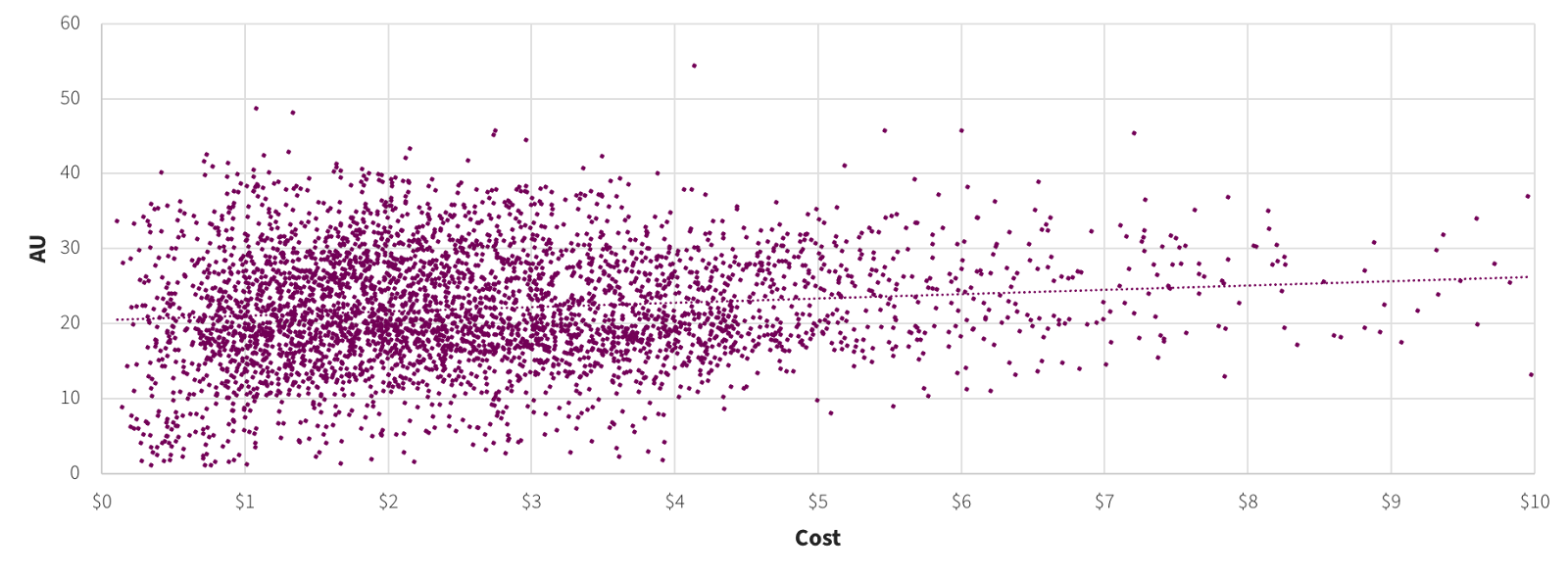
Cheap media can look far less efficient once quality is accounted for, while high-quality media can look more efficient than its CPM alone would suggest. Traditional digital performance metrics like viewability do not convey quality; they merely confirm that an ad was visible, not whether it made an impact.
2. Assess the price of the quality, not just of the impression
To compare cost and quality, advertisers need a common frame of reference. Adelaide recommends establishing client-specific AU thresholds based on the level of media quality needed to support a brand’s business goals. Those thresholds make it possible to evaluate impressions not only by what they cost, but by the attention and impact they are expected to deliver.
More quality is not always worth more money. The goal is not to achieve the highest AU in every instance. It is to achieve the strongest quality per dollar, up to the point where paying more stops producing a return.
Adelaide provides clients with quality threshold-finding tools to identify the minimum level of media quality required to support their outcomes. Advertisers buying above their thresholds see 33% higher upper-funnel lift and 53% stronger lower-funnel lift, at comparable CPMs. (Source: Adelaide 2025 Outcomes Guide)
3. Decide how much quality is worth paying for
Adelaide’s client, Haleon, has publicly demonstrated how this idea can work in practice. The consumer-health company behind Sensodyne, Panadol, and Centrum has spent the last several years rebuilding how it evaluates and buys media, moving away from cost efficiency as the primary signal toward a more balanced view of quality, effectiveness, and value.
That shift was supported by a rigorous evidence base, including a first-to-market Amazon DSP study with Publicis and Adelaide in which high-AU media drove 34% more conversions at a 25% lower cost per conversion.
Today, Haleon applies that thinking globally through a granular media value framework. Rather than applying one universal quality floor or chasing the highest AU in every environment, it sets quality standards by brand, market, and KPI. The goal is to understand the level of media quality needed to support a specific business outcome, then buy against that standard as efficiently as possible.
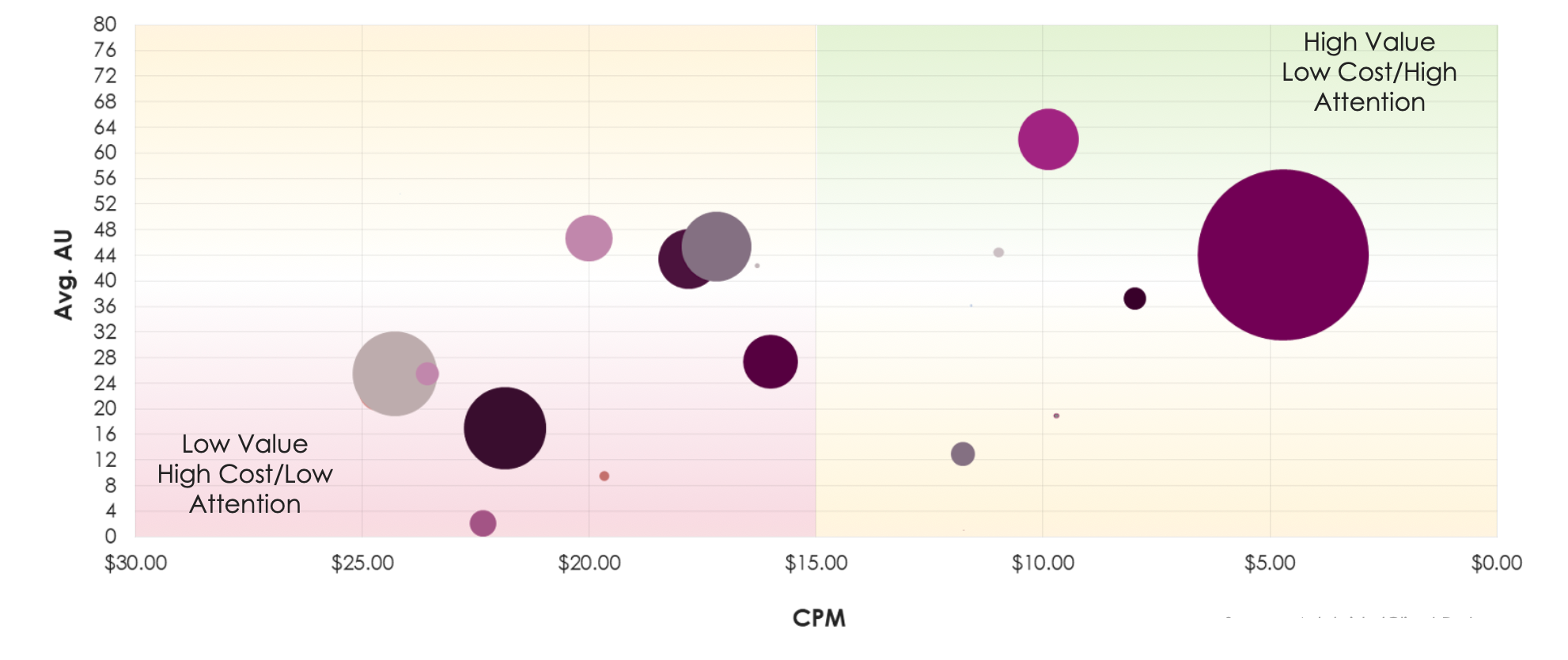
In practice, that means using AU to curate high-attention private marketplaces, inform campaign optimization, and negotiate preferred deals, all in service of buying the best quality per dollar, not the most quality at any price.
AU vs. CPM By Publisher and Placement Volume (Example Curation View)
4. Bring procurement in
Media procurement teams exist to protect the advertiser’s money by ensuring the agency delivers what it promised and the brand is not overcharged. For years, in the absence of a durable quality measure, procurement has focused largely on one number: unit cost.
Other industries have evolved their approach to procurement and cost management. Manufacturing and IT moved from lowest unit price to total cost of ownership decades ago. Procurement teams in those industries buy the highest-value part, not the lowest-priced. Media industry adoption of similar practices has lagged because buyers and sellers have lacked a precise media quality metric that could be evaluated alongside price.
AU gives procurement a way to make that comparison. It can be benchmarked across 19 media channels, creating broad comparability, while Adelaide’s participation in independent audits helps meet procurement's need for transparency.
With a quality-adjusted, brand-specific AU threshold in hand, media buyers can also change what they ask for. Instead of asking publishers and partners only for impressions at a target CPM, they can ask for a quality-based package that includes transparency into how inventory scores, curation that meets or exceeds the brand’s quality threshold, and pricing that reflects quality-adjusted delivery. The best publishers are ready to have that conversation.
5. Change what procurement can evaluate
A new metric only matters if it changes incentives. Give procurement teams a relevant media quality metric, and their operating model can shift from policing price to protecting value.
When agency targets include a quality threshold, incentives shift from booking savings to ensuring efficient outcomes, plus the agency is no longer penalized for recommending the higher-quality, slightly pricier buy.
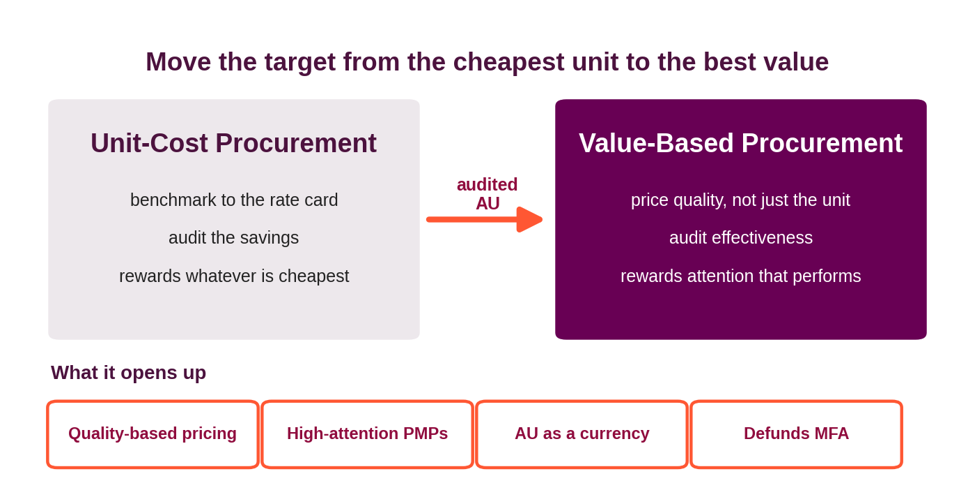
Workflows can evolve alongside these new quality requirements. Quality thresholds can be incorporated into RFPs, insertion orders, and programmatic guaranteed deals, backed by third-party-audited reporting. A delivery guarantee can become a quality guarantee.
Audits can widen to match. Independent media audits already verify delivery and price. With an audited quality metric, they can also verify whether the media delivered met the set quality standard. None of this requires procurement to surrender its rigor; instead, it gives teams a more complete basis for measuring value beyond volume.
Advertisers’ conversations with publishers and agencies can also change, moving from pressure on unit price alone to a more productive discussion about quality-adjusted value. Both sides can work from a shared, auditable definition of quality, a shift Haleon was early to recognize.
This is ultimately a story about aligning incentives. When buyers, sellers, agencies, and procurement are all rewarded for delivering value instead of the lowest price, quality stops being undercut by inventory that looks identical on a rate card, and the cheapest media stops being the default option.
From price to value
Adelaide is not proposing a new metric for its own sake. We are suggesting a change in the metrics that the market prioritizes.
Price tells you what you spent. Quality tells you what you bought. Value is the distance between them, and AU finally lets buyers and sellers measure it.
The media industry does not need more complexity at the negotiating table; it needs better decision criteria.
Posted at MediaVillage through the Thought Leadership self-publishing platform.
Click the social buttons to share this story with colleagues and friends.
The opinions expressed here are the author's views and do not necessarily represent the views of MediaVillage.org/MyersBizNet.

Claire Browne
Claire joined Adelaide in 2024 after 16 years as VP/Director of Media Research at RPA, a large independent full-service agency. Clients included American Honda Motor Company, La-Z-Boy Furniture Galleries, CoStar Group, and ARCO Gas. Prior experience in media…