
Jack & Tim Live: The SPORTS Episode
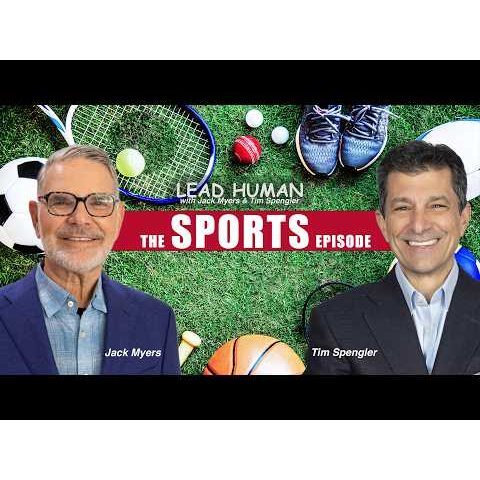
From college sports and billion-dollar TV rights to ticket prices, broadcasters, and the emotional power of fandom, Jack and Tim ask a bigger question: when does monetization start destroying the very thing people love? Watch or listen at Lead Human with Jack Myers and Tim Spengler.
For the first time on Lead Human with Jack Myers and Tim Spengler, there was no guest. No interview. No formal setup. Just Jack and Tim doing what listeners have apparently been asking for since the beginning: extending their opening banter into a full episode.
And what better subject than sports?
As Tim put it right at the top, sports today have become something much bigger than entertainment. “The power of sports today is at a new high. It’s almost communal, I think, in a way that hasn’t been before in this technology-driven, fragmented world,” he said. “I could argue this is about the only times and places where we all show up together.”
That idea became the center of the conversation. In a world of on-demand streaming, binge watching, and endless scrolling, live sports may be one of the last truly shared experiences left.
“Live sports, it’s live sports, it’s on demand binging, and it’s creator scrolling,” Tim said. “Those are the three. And the live sports one is so powerful across all demographics.”
Jack agreed, adding that sports still creates something increasingly rare: emotional connection and even productive disagreement. “It’s creating passion and polarization even,” Jack said. “New York, Boston, where you can still come together and have a conversation that’s meaningful, purposeful, and where everyone walks away feeling good.”
But if sports is one of the last great communal spaces, what happens when money starts driving every decision? That led naturally to college athletics and NIL.
Jack raised the now-famous imbalance: “A quarterback making $3 million when a professor is making $140,000. Where’s the balance in terms of what is a university today?” Tim’s response was thoughtful and surprisingly practical. “The toothpaste is certainly out of the tube with college sports and NIL,” he said. “I do struggle a little with the $3 million for the quarterback… but the product’s never been better.”
Rather than taking a moral position, Tim pointed to something he learned from legendary Duke coach Mike Krzyzewski. “This is what it is. So, this is what I have to do,” Tim recalled Coach K saying. “He was so unbelievably current and evolved without an opinion. He wanted to win. He liked his kids. He was happy to see them get paid.”
Tim admitted that perspective changed him. “I was so impressed by no comment about is it a good or bad state. He’s in the state trying to win with what it was… and I was like, I can’t argue with that.”
From college sports, the conversation widened to sports as business. Tim argued that sports now occupies the cultural role it has long held in Europe and South America. “Sports is now in this country more like what sports has been in Europe and South America around football. I mean soccer. That’s religion.”
What has changed is not just passion, but how aggressively that passion is being monetized. “Advertisers are running to sports,” Tim said. “Because of the lean-in of the consumers, because of this passion, because it’s this moment.” And once advertisers show up, everyone else follows.
Tim pointed to the economics of the upcoming FIFA World Cup and the 2028 Summer Olympics as proof. “The tickets for the final game are over $10,000 a ticket,” he said of the World Cup. “Roughly 10X what it was four years ago.” For the Olympics, Tim had his own painful example. “I bought track and field for over $1,000 a ticket… It’s like a vacation I spent for two tickets and it’s two years in advance.” His conclusion was blunt: “I think it’s not great.”
Jack connected that to the broader rights marketplace, where leagues, owners, and streamers are all pushing for maximum extraction.
“Are executives destroying the emotional infrastructure that makes sports so valuable in the first place?” he asked.
Tim believes that may be exactly what is happening. “The owners and the league can make more money by selling more of the rights to the streamers,” he said. “The streamers can pay more because they can turn around and charge us an extra ten bucks a month.”
His bigger concern is simple: “There’s so much power and everyone who has the power is trying to maximize the value. But it’s interesting that I don’t know if some of this is good for the consumer.”
That may be the entire thesis of the episode. Sports is no longer just competition. It is a case study in capitalism, access, identity, and belonging.
The episode ended, appropriately, with fandom—favorite teams, best rivalries, greatest sports moments, and legendary announcer calls. It was lighter, funnier, and full of personality, from Jack’s lifelong Yankees loyalty to Tim’s defense of the Chicago Blackhawks jersey and the famous “band is on the field” call.
But even there, the bigger theme remained. As Tim closed the episode, he reminded listeners that sports and leadership are not separate conversations.
Jack put it even more directly: “I agree. Sports is where the human spirit is unleashed in every single game. And that’s what sports is all about.” That may be the best definition of Lead Human yet.
Watch or listen at Lead Human with Jack Myers and Tim Spengler.

Jack Myers
With over five decades of experience in corporate leadership, B2B research, management insights, and technological trends, Jack Myers is a visionary leader and a trusted source for guidance and preparation as generative AI and machine intelligence dominates …