
Jeanniey Walden on Trust, AI, and the Human Edge
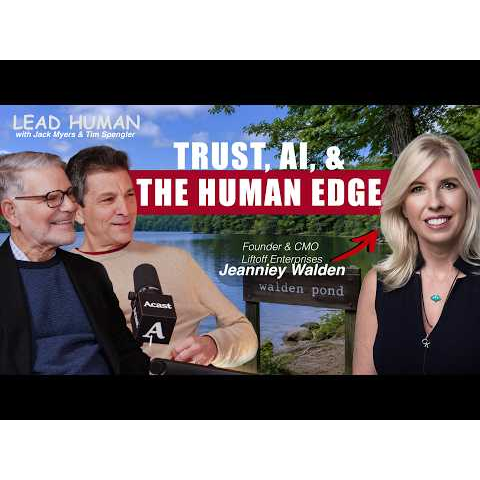
Listen and Learn at Lead Human: “When leaders substitute scripted ambiguity for honesty, trust deteriorates. In today’s environment, distrust does not remain private.”
What happens when a former Fortune 500 CMO, startup advisor, CEO, author, and unapologetic experimenter with artificial intelligence joins Lead Human? You get a conversation that feels less like an interview and more like a strategic briefing on how business leadership is being rewritten in real time.
In the latest episode of Lead Human with Jack Myers and Tim Spengler, Jeanniey Walden, founder and CEO of Liftoff Enterprises, brought a rare combination of operational experience, entrepreneurial urgency, and human clarity to a discussion that moved fluidly from customer trust and corporate communications to AI experimentation, startup agility, and the realities of modern work.
Listen to the full conversation with Jeanniey on Lead Human with Jack Myers and Tim Spengler at your favorite podcast platform and view at YouTube. Link to the full archive and all podcast platforms at www.lead-human.com. It is worth engaging with in full because what Jeanniey shares is often controversial and always original.
Her message is not technological. It is fundamentally human.
“If you trust somebody or something,” Walden said early in the conversation, “then you establish a belief in them. And if you establish a belief in a brand, that’s what drives the business.”
That idea became the intellectual anchor for everything that followed.
Because while the technologies evolve at extraordinary speed, Walden’s central argument is that the underlying architecture of business remains remarkably stable. Trust creates belief. Belief creates engagement. Engagement creates economic value. The tools may be new. The human dynamics are not.
Her own career reflects that continuity. Starting at JCPenney earning $5.25 an hour in customer service, she learned early that some of the most difficult customer interactions can become the strongest opportunities for advocacy if handled with empathy, intelligence, and accountability. When digital marketing emerged, she did not see disruption. She saw expanded possibilities.
“That entire digital world of opportunity opened up,” she explained, “where now you could understand more about the person immediately and you could leverage that in such a fantastic way to build trust, belief and business.”
Her interpretation of AI follows that same logic. Artificial intelligence does not replace the fundamentals of leadership or customer engagement. It changes the speed, scale, and precision with which those fundamentals can be applied.
One of the most compelling moments in the discussion came from an ordinary example. On her drive to the studio, Walden searched for parking using Google Maps. Rather than simply listing nearby garages, the platform surfaced customer commentary, warning her which locations were unsafe, slow, or highly recommended.
That, in her view, is not a convenience feature. It is a preview of a transformed decision environment.
“AI is creating this huge level of visibility into what the rest of the world believes in trust.”
For marketers and business leaders, this matters because customer sentiment is no longer passive background noise. It is becoming integrated directly into decision systems. Walden’s practical leadership framework for navigating this world is what she calls the AIR method: authenticity, inspiration, and relatability.
“If you do not show up authentically to your customer, if you’re not inspiring them... and if you’re not doing it in a relatable way where you’re speaking their language instead of corporate speak, you’re not going to get anywhere.”
Importantly, she does not position AIR as a branding exercise. She presents it as a leadership operating model.
For marketing organizations, the greatest failure is often relatability. Brands become fluent in their own language and increasingly disconnected from the language customers actually use. Her “barbecue test” is both simple and devastatingly effective: if you were explaining your business to someone at a backyard barbecue, what words would naturally come out of your mouth? Now compare that vocabulary to your website, pitch materials, and campaigns.
If the language does not match, neither does the connection.
For executive leadership, the greater vulnerability is authenticity. Walden was particularly direct about the communication failures that emerge when leaders avoid uncomfortable truths.
“No CEO wants to say the true answer, which is yes, we’re going to do what we need to manage the bottom line.”
Her point was not that leadership should abandon discipline or strategic discretion. It was that employees already understood the underlying economic realities. When leaders substitute scripted ambiguity for honesty, trust deteriorates. In today’s environment, distrust does not remain private. It migrates quickly into public digital ecosystems like Reddit, Glassdoor, and Fishbowl, where reputational damage compounds.
The AI conversation became especially compelling when Tim pressed Walden repeatedly on how she remains so current.
Her answer was strikingly practical.
“Just use it.”
Not theoretical observation.
Not passive curiosity.
Use.
She described experimenting with ChatGPT through everyday prompts, testing search outcomes, integrating AI into business workflows, and pushing herself into direct engagement with the tools rather than waiting for polished frameworks to emerge.
Her most memorable example involved a hacked website. Facing a hosting company demanding $800 and a five-day delay to investigate the issue, she turned instead to Claude.
“Claude said, ‘Oh my God, your site’s been hacked. Go here, do these things.’”
Working simultaneously with the AI and customer support, she restored the site in minutes and spent hours understanding the deeper issues afterward. The lesson was unmistakable. AI literacy is not built through observation. It is built through friction, experimentation, and problem solving.
Perhaps the most strategically significant idea Walden introduced was her reframing of AI not simply as a tool, but as a decision-making participant.
“AI should be another customer profile that you’re planning towards.”
That insight deserves attention.
Businesses have historically designed messaging for identifiable human customer segments. Walden argues that increasingly, businesses must also account for AI-mediated decision systems that will influence or even make purchasing decisions on behalf of humans. Her parking example becomes more consequential in that context. Today, AI helps inform your decision. Tomorrow, your assistant may evaluate the options, reserve the space, coordinate the route, and complete the transaction before you ever think about parking.
That is not speculative futurism. It is emerging commercial architecture.
The conversation also turned toward leadership culture and modern work realities. Walden’s rejection of “work-life balance” in favor of “work-life blend” reflects a reality many leaders quietly acknowledge. Hybrid work, global operating rhythms, and digital access have permanently blurred the boundaries between professional and personal time.
“We live in a blended society now.”
Her response is not resignation. It is intentional integration. She and her husband, both CEOs with demanding schedules, have created what she calls “Walden Weekends,” transforming business travel into shared personal experience rather than treating life and work as permanently competing categories.
The underlying theme throughout the episode was not productivity.
It was agency.
Walden does not frame AI as an external force acting upon helpless organizations. She frames it as an environment demanding engaged, experimental, deeply human leadership.
That is what makes this episode worth your time.
Because the conversation is not ultimately about software platforms, AI models, or digital transformation.
It is about how leaders remain credible while the ground shifts beneath them.
How trust survives acceleration.
How curiosity becomes strategic advantage.
And how the most human qualities may become the most economically valuable.
The future may be machine-assisted. But leadership remains profoundly human.
Listen to the full conversation with Jeanniey on Lead Human with Jack Myers and Tim Spengler at your favorite podcast platform and view at YouTube. Link to the full archive and all podcast platforms at www.lead-human.com. It is worth engaging with in full because what Jeanniey shares is often controversial and always original.

Jack Myers
With over five decades of experience in corporate leadership, B2B research, management insights, and technological trends, Jack Myers is a visionary leader and a trusted source for guidance and preparation as generative AI and machine intelligence dominates …