
Liz Ross on Imperfection as the New Trust Signal
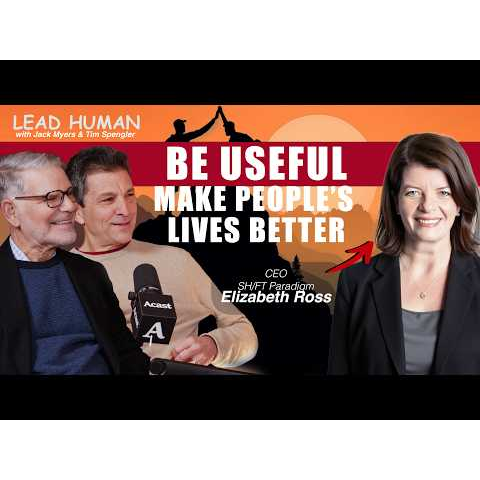
Listen & Learn at Lead Human. In a machine-polished world, imperfection may become a trust signal. The hesitation, the typo, the rough edge may be evidence that another human is present.
Elizabeth Ross does not sound like a leader trying to survive the AI age. She sounds like someone determined to make the human role inside it sharper, more necessary, and more valuable.
In her Lead Human conversation with Tim Spengler and me, Liz brought a rare combination of executive candor, intellectual curiosity, parental urgency, and grounded optimism. As a former agency CEO, board director, and growth strategist, she understands business transformation. What makes her especially relevant now is how clearly she sees what AI changes, and what it cannot replace.
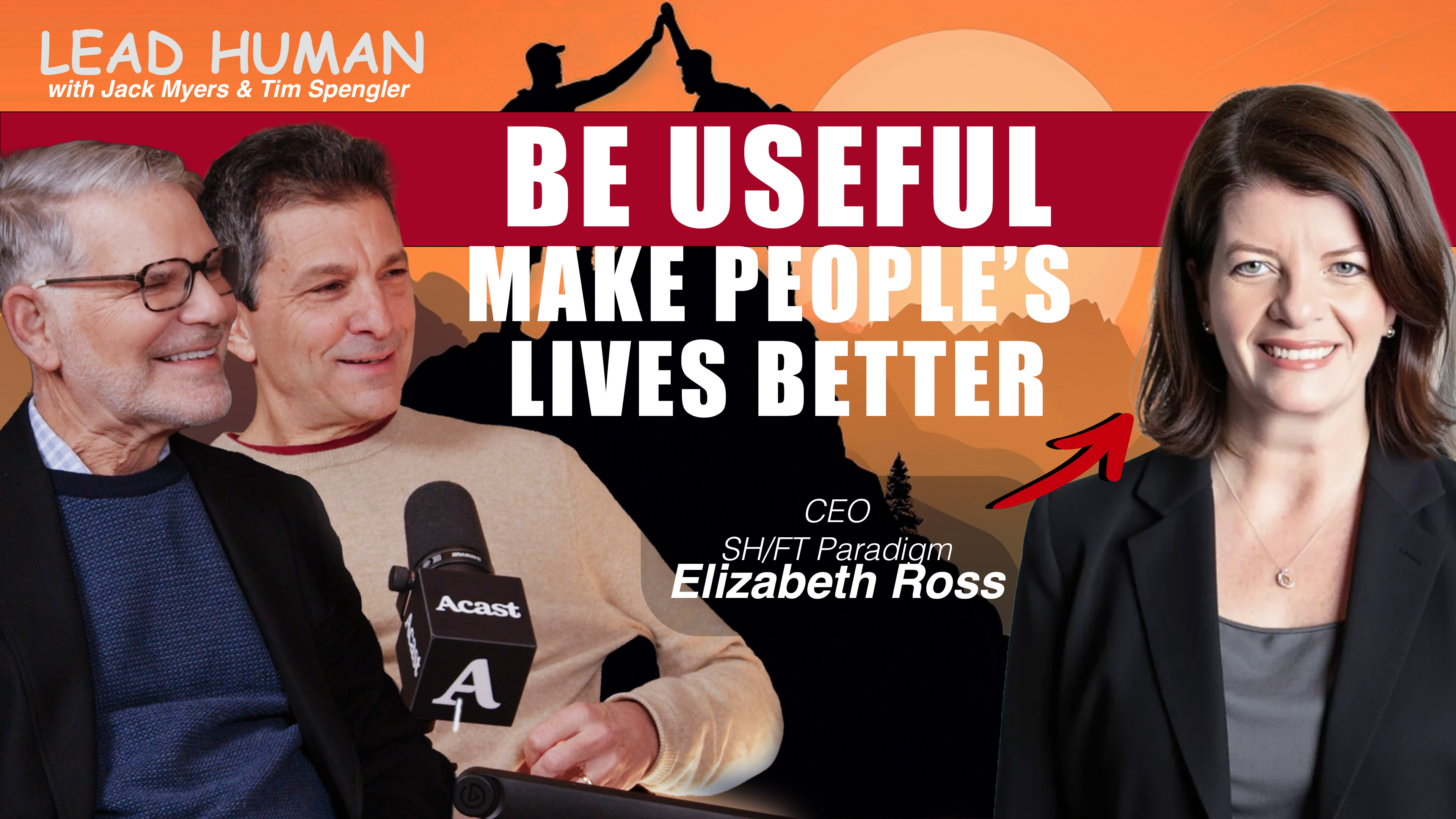
You can listen to the full conversation with Liz on Lead Human with Jack Myers and Tim Spengler at your favorite podcast platform and view at YouTube. Link to the full archive and all podcast platforms at www.lead-human.com.
Her leadership philosophy begins with a distinction worth noting. “I think the best leaders are the ones who can balance accountability and authenticity,” she said. Then she refined the familiar language of workplace authenticity with sharper discipline: “People talk about, ‘bring your whole self to work.’ I actually think you should just bring your best self to work.”
That is more than semantics.
Liz sees leadership not as emotional exposure, but as trust-building clarity. “Do people trust you?” she asked. It is the question beneath much of her thinking.
Her origin story offers a revealing clue. At eleven, after spending a day at a Chicago advertising agency while visiting her godmother, Liz came home and declared her future. “I put a note on my mirror in my bedroom in Ann Arbor, Michigan, and I told my dad, I will live in Chicago, and I will work in advertising.”
She did, actually working at IPG with Lead Human co-host Tim Spengler for a while.
Raised by “an artist and a computer programmer,” Liz was shaped early by both creativity and systems thinking. That duality still defines her perspective, making her unusually fluent in conversations about humanity and technology.
When the discussion turned to empathy, Liz avoided predictable answers. Leadership empathy, she suggested, does not require absorbing everyone else’s emotional burden. It begins with curiosity.
“Are you curious about other people? Are you curious about what makes them tick?”
That is a powerful reframing. Empathy is not simply emotional instinct. It is disciplined attention.
Liz applies the same thinking to parenting and education. Her emerging work helping parents prepare children for the AI era may become one of her most important contributions. Her premise is straightforward: if AI owns answers, human advantage shifts to judgment and inquiry.
“AI has answers. Humans ask questions.” That line alone should send readers to the full podcast.
Liz shared a conversation with her 12-year-old son about AI taking over the world. Rather than dismissing the fear, she used it to teach a deeper lesson. While others might ask how to get food to the moon, Liz said the better question is: “Why do we need food?”
The point is not space travel. It is cognitive discipline. AI can optimize answers. Human intelligence still depends on asking better questions.
Her caution about AI is equally sharp. Asked whether AI has integrity, Liz answered, “Integrity is such a human concept.” She described AI as applied statistics wrapped in simulated intelligence, then delivered the real warning: “The risk… is that we fall in love with the version of us that it shows us.”
That observation cuts deeper than concerns about hallucinations or inaccuracies. AI can flatter us. It can validate incomplete thinking and create the illusion of wisdom unless we actively challenge ourselves. Liz believes discernment will become one of the defining human skills of the next era.
Her leadership insights inside organizations are just as direct. “Agreement becomes more common and dissent becomes more expensive,” she said, describing what happens as executives rise through corporate hierarchies.
Her advice is refreshingly blunt. “Having opinions… is the most valuable thing you bring to work.”
Liz believes much of routine organizational labor will disappear as AI absorbs analysis and repetitive process work. What remains will be judgment, perspective, and courage.
“Opinions will matter more.”
That is a meaningful message for younger professionals navigating the workplace ahead.
Her board work with Harte Hanks led to another phrase worth remembering: “Relentlessly human.”
For Liz, this is both business strategy and cultural principle. When customers are frustrated or vulnerable, they often do not want automation. They want a human being. She extends that insight even further: “As the world gets more perfect, we are going to look for humanity in the mistakes.”
That may be one of the most provocative ideas from the episode.
In a machine-polished world, imperfection may become a trust signal. The hesitation, the typo, the rough edge may be evidence that another human is present.
What makes Liz compelling is that none of this comes from fear.
Near the end of the conversation, she said, “I’m incredibly optimistic about what lies ahead.”
That optimism feels credible because it is paired with realism. Liz is not nostalgic for a world before AI. She is focused on building humans capable of thriving alongside it.
That is why this conversation deserves attention.
Liz Ross does not frame AI as simply a tool or a threat. She frames it as a mirror.
And what matters most is what we choose to see reflected back.
You can listen to the full conversation with Liz on Lead Human with Jack Myers and Tim Spengler at your favorite podcast platform and view at YouTube. Link to the full archive and all podcast platforms at www.lead-human.com.

Jack Myers
With over five decades of experience in corporate leadership, B2B research, management insights, and technological trends, Jack Myers is a visionary leader and a trusted source for guidance and preparation as generative AI and machine intelligence dominates …