
Raise Your Hand! (Video)
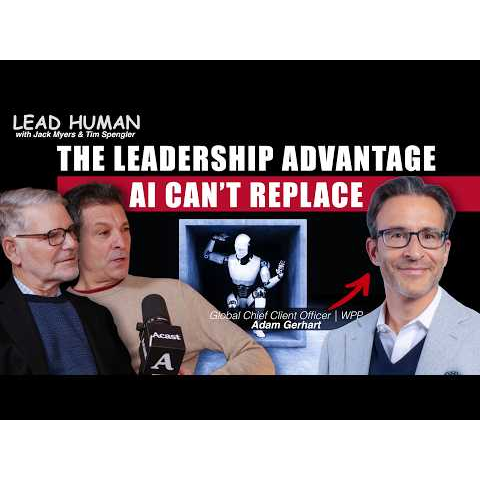
WPP’s Adam Gerhart on Curiosity, Clarity, the Human Edge, and the Leadership Advantage No One Can Automate.
View or listen to the Lead Human podcast at www.lead-human.com.
In a media and marketing ecosystem being reshaped by AI, automation, and accelerating economic pressure, the instinct is to look to technology for answers. Adam Gerhart offers a different perspective. One that is both more grounded and, for leaders, more demanding.
As Global CEO of Mindshare and a two-decade “homegrown” leader within WPP, Gerhart represents a rare continuity in an industry defined by churn. His journey from assistant media planner to global leadership is not just a career story. It is a case study in how human qualities scale inside complex systems.
And it begins with something deceptively simple.
Raise your hand.
Gerhart credits much of his trajectory to a mindset of curiosity and proactive engagement. At every point where complacency might have set in, he chose expansion instead. New roles. New geographies. New challenges. “Every time I thought I was getting bored, I raised my hand, and there was always something else,” he explains.
This is not generic career advice. It is structural insight.
Large organizations, often dismissed as bureaucratic and limiting, are in fact underutilized opportunity engines for those who understand how to navigate them. The constraint is rarely the system. It is the individual’s willingness to engage with it.
Gerhart’s model reframes scale not as a barrier, but as a multiplier for those with the right orientation. Curiosity becomes a strategic asset. Risk-taking becomes a career accelerant. And mobility, both intellectual and geographic, becomes a differentiator.
But what distinguishes Gerhart is not just how he grows his career. It is how he defines leadership itself. Link towww.lead-human.comto view or listen to the podcast at your preferred platform.
He is explicit in rejecting the premise that leadership is about being the smartest person in the room. His competitive advantage lies elsewhere. “One of my superpowers… is the ability to understand people and bring them together around a common cause,” he notes.
This aligns directly with what you have consistently framed in The Myers Report and Lead Human: in an age of cognitive abundance, intelligence is commoditized. Human discernment is not.
Gerhart operationalizes this through a leadership model grounded in service. Leadership, in his framing, is not authority. It is responsibility. “I am in service of others, not the other way around,” he says.
That distinction matters more now than at any point in modern business history.
AI can optimize workflows. It can generate content. It can model outcomes. But it cannot read a room. It cannot interpret silence. It cannot resolve the emotional friction that defines real organizations.
Gerhart is clear-eyed about this boundary. Technology will remove friction from tasks, but not from relationships. And relationships remain the substrate of leadership effectiveness. “What technology will never do is understand the body language and signals beyond what’s on a page,” he observes.
This is where many organizations are misallocating focus.
They are over-investing in tools and under-investing in the human capabilities required to use them effectively. Gerhart’s approach suggests a rebalancing. Technology as enabler. Humanity as differentiator.
That framing extends into how he advises leaders to navigate uncertainty.
In a moment defined by volatility across political, economic, and technological systems, Gerhart rejects prediction as a strategy. “There’s a big difference between prediction and preparation,” he explains.
Preparation, in his model, is built on three capabilities: experimentation, adaptability, and the willingness to pivot. This is not abstract thinking. It is operational discipline.
Leaders who are waiting for clarity will be outpaced by those who build systems that can respond to ambiguity.
At the same time, Gerhart introduces an equally important counterbalance: the need for a clear North Star. Not as a fixed path, but as a directional anchor in a nonlinear journey.
This duality, clarity of purpose combined with flexibility of execution, is emerging as a defining leadership requirement in the AI era.
His perspective on client relationships reinforces this shift.
Link to www.lead-human.com to view or listen to the podcast at your preferred platform.
In a landscape of increasing complexity, Gerhart reduces client expectations to two core needs: simplicity and assurance. “They want simplicity and assurance. That’s what it comes down to,” he states.
This is a critical insight for media and marketing leaders.
Complexity has become the default condition of the industry. But complexity is not value. It is friction. The organizations that win will be those that can abstract that complexity away for clients while delivering consistent, reliable outcomes.
Simplicity is not reduction. It is sophistication expressed clearly.
Assurance, in turn, is about trust. Not as a brand attribute, but as a performance metric. Deliver what you say. Repeatedly. Under pressure.
Gerhart’s leadership philosophy ultimately converges on a set of principles that are both timeless and newly urgent:
Curiosity over complacency
Empathy over ego
Preparation over prediction
Simplicity over complexity
Service over status
These are not soft skills. They are hard advantages in a system being redefined by machines.
For The Myers Report audience, the implication is clear.
The next phase of competitive advantage will not be won through better management of technology alone. It will be won by leaders who can integrate technology with a deeper, more disciplined understanding of human behavior, motivation, and connection.
Gerhart’s journey and perspective offer a blueprint for that integration.
The full conversation expands on these themes with practical examples, personal stories, and actionable guidance for leaders at every stage of their careers.
To listen or watch the complete episode, visit www.lead-human.com and choose your preferred platform.
Because in a world where intelligence is increasingly abundant, the leaders who matter will be those who know how to make it human.

Jack Myers
With over five decades of experience in corporate leadership, B2B research, management insights, and technological trends, Jack Myers is a visionary leader and a trusted source for guidance and preparation as generative AI and machine intelligence dominates …