
Rediscovering Jacques Ellul: Prophet for the AI Era and Guiding Voice in the Age of Technological Totality
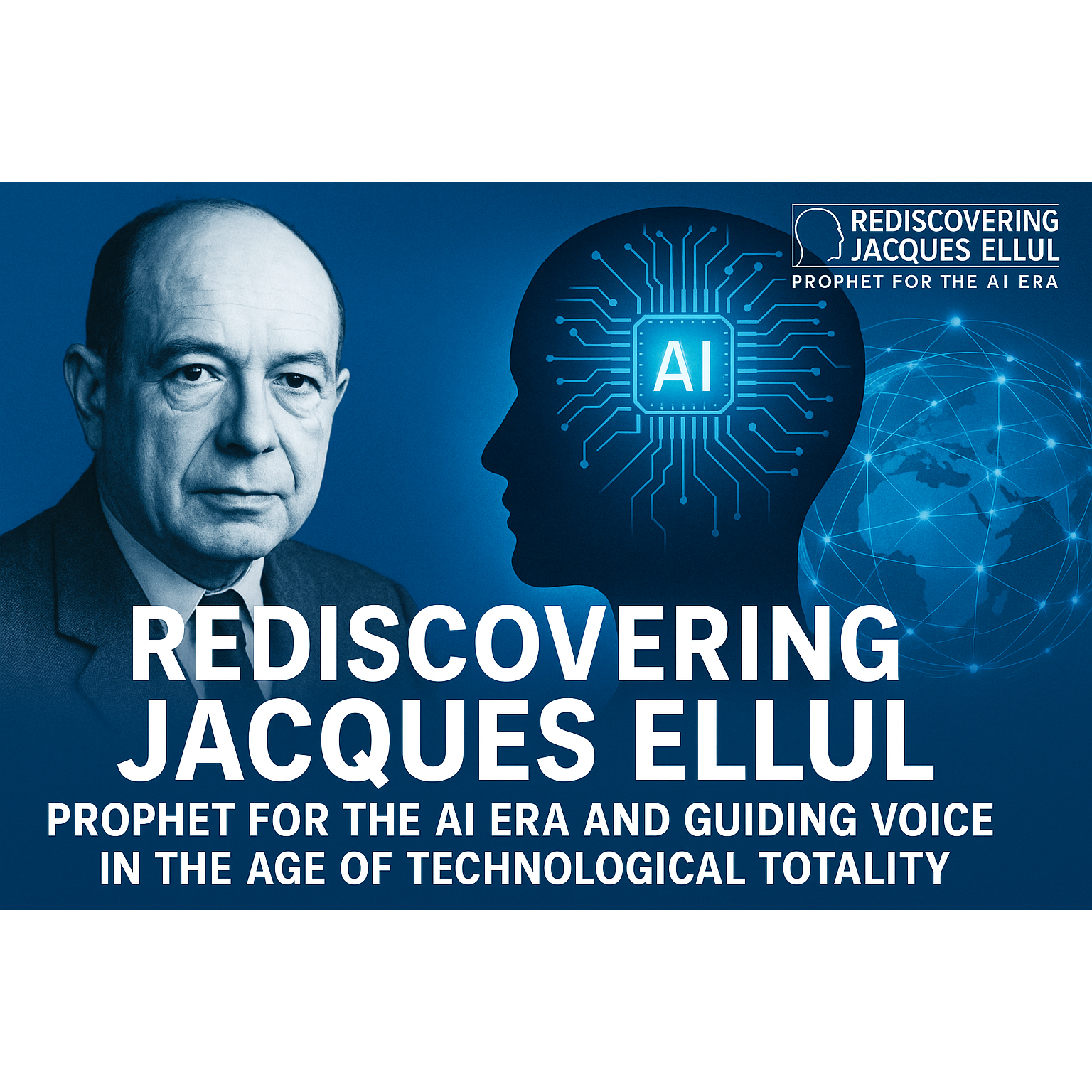
In a moment when generative AI, algorithmic bias, and digital determinism are reshaping every facet of our lives, from governance to intimacy, it’s worth pausing to revisit the rarely spoken yet profoundly prescient voice of Jacques Ellul. His works -- The Technological Society (1954) and Propaganda: The Formation of Men's Attitudes (1962) -- remain essential reading for anyone seeking to understand not just the “how” but the “why” and “what now” of technology’s grip on society. For leaders navigating today’s complex and rapidly changing landscape, Ellul's critique is neither outdated nor irrelevant. On the contrary, it has never been more urgent.

As I reflect on the research, experiences, and insights that informed The Tao of Leadership in the AI Era and continue to shape my forthcoming book, Your Third Brain, Ellul stands as a towering intellectual presence -- one who foresaw the dilemmas we are only now beginning to confront. While his name may not trend on LinkedIn or appear in TEDx headlines, his understanding of technique, propaganda, and the moral vacancy of uncritical technological adoption offers foundational truths that technology industry leaders and innovators must confront.
Technique as Autonomy
At the heart of Ellul’s philosophy is his definition of technique -- not just tools or machinery, but the totality of methods rationally arrived at and having absolute efficiency in every field of human activity. What alarmed Ellul was that once a new technique emerges, it inevitably propagates itself. Its adoption becomes compulsory, not optional. The society that fails to adopt the new technique is left behind, and any discussion of moral or social consequences becomes irrelevant -- or worse, silenced.
In this, Ellul provides a critical lens for understanding how generative AI has taken hold. As I wrote in The Tao of Leadership, we are no longer at the stage where we choose whether to adopt AI; the momentum of its advancement is too great. But leadership still matters. Leadership that centers on integrity, empathy, and intentionality can serve as the human compass guiding us through a world increasingly defined by machine logic.

Ellul's cautionary voice resonates clearly: innovation without ethical self-inquiry leads not to empowerment, but to enslavement -- often masked as progress. Your Third Brain extends this idea, offering practical tools for aligning human creativity and consciousness with the technological mind. But that alignment must be purposeful, not passive.
Propaganda and the Illusion of Choice
In Propaganda: The Formation of Men’s Attitudes, Ellul argued that modern propaganda is not coercive but immersive. It does not dictate what to think, but what to think about -- and, more importantly, what not to question. In a digital world shaped by recommendation engines, curated feeds, and frictionless content, we find ourselves enveloped by what Ellul called integration propaganda. It affirms our worldview, isolates us from conflicting information, and makes dissent feel not only uncomfortable, but unnatural.
For corporate and governmental leaders, this insight is sobering. We may believe we are informed decision-makers, but too often we are simply reflecting back the systems that have shaped our informational ecosystem. In The Tao of Leadership, I argue that leadership in the AI era demands more than strategic fluency or technological literacy -- it requires a profound inner awareness of the systems of influence that guide our perceptions, choices, and identities.
Ellul helps us see that in an age of ubiquitous information, the greatest leadership challenge is not access, but discernment. The future belongs to those who can step outside the machinery of influence and still find clarity, conscience, and the courage to say no to the next shiny thing when it compromises human dignity.
What Ellul Missed -- and What We Must Add
Ellul was a Christian anarchist and moralist at heart. His suspicion of technology's unchecked expansion was profound, but his worldview was arguably pessimistic. He distrusted any form of organized resistance or reform within the system, viewing the technological society as nearly irreversible.
This is where today’s visionaries must respectfully part ways with Ellul. While his critique was unflinching, it lacked a path forward -- a blueprint for harmonizing innovation with human potential. That’s where The Tao of Leadership offers a necessary evolution: I accept Ellul’s diagnosis but reject fatalism. I believe that through intentional, empathetic, and principle-driven leadership, we can forge a new synthesis between the machine mind and the creative soul.
The five principles I advance -- Harmony, Flexibility, Balance, Stability, and Integrity -- are not abstractions. They are tools for living and leading in a world Ellul warned us about, but which we must now learn to reshape with wisdom rather than fear.
Ellul’s Place in the Emerging Canon
Jacques Ellul remains relevant not just for historians of media and communication, but for every venture capitalist funding AI startups, every CEO navigating digital transformation, and every young product designer wondering whether ethical guardrails matter. His legacy is not a roadmap but a warning -- one that today’s leaders can no longer afford to ignore.
As we collectively awaken to the real stakes of living in a world increasingly defined by code, automation, and synthetic realities, Ellul remains a prophet in the wilderness. But he doesn’t have to be. If we choose to listen, integrate, and evolve from his insights, his legacy can become not just a critique of where we went wrong -- but a cornerstone of how we get it right.
Jack Myers is the author of The Tao of Leadership: Harmonizing Technological Innovation and Human Creativity in the AI Era, Media Ecology for the Quantum Age, The Future of Men, and aa forthcoming book on a future of unimagined possibilities. He is the founder of MediaVillage and The Myers Report and a leading voice at the intersection of technology, creativity, and human potential.

Jack Myers
With over five decades of experience in corporate leadership, B2B research, management insights, and technological trends, Jack Myers is a visionary leader and a trusted source for guidance and preparation as generative AI and machine intelligence dominates …