
When Viewers Become the Show: AI-TV Turns Television Inside Out
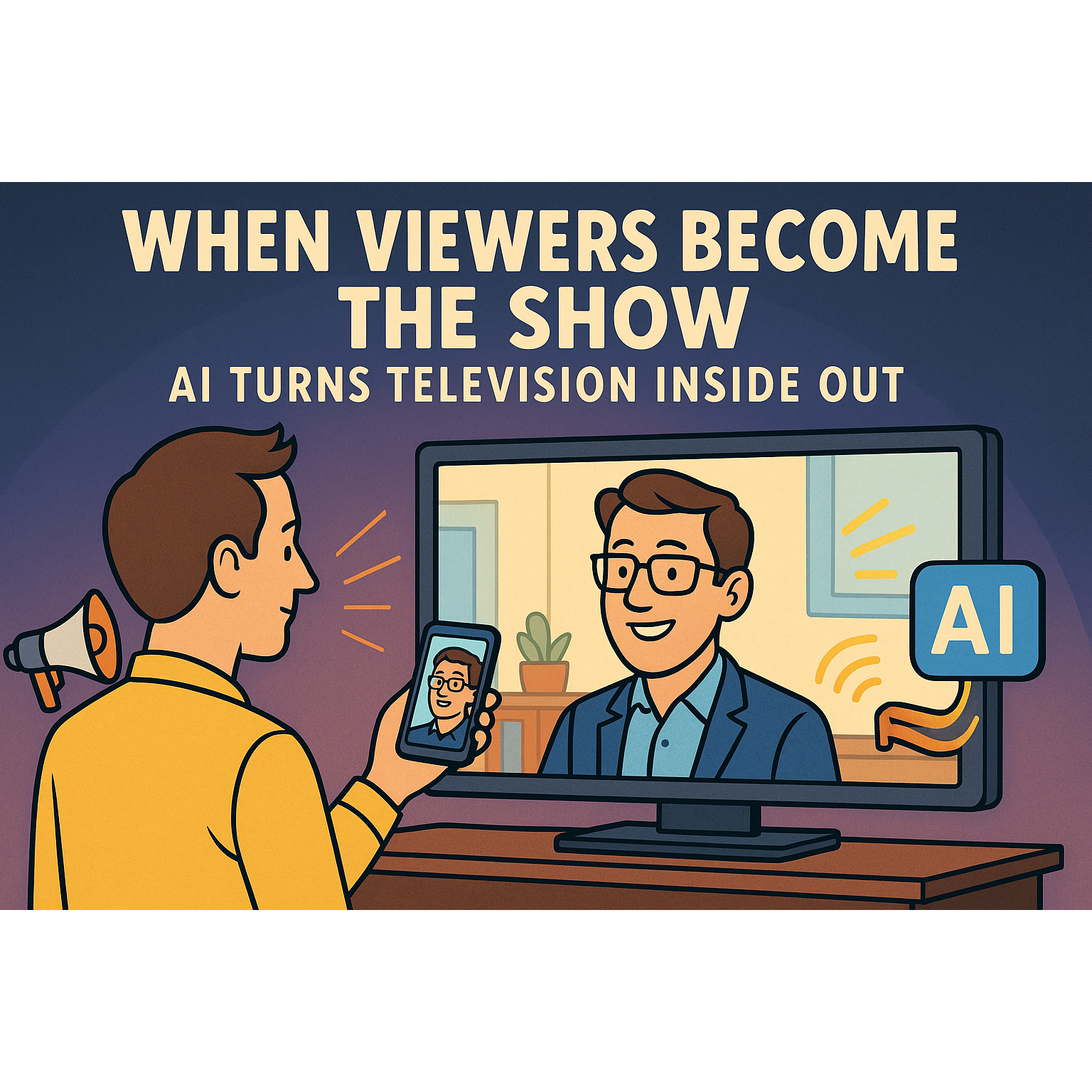
The launch of Showrunner, the Amazon‑backed AI platform from Edward Saatchi’s Fable Studio, is more than a quirky headline about “AI making TV shows.” It is a flashing beacon for the future of media, advertising, and entertainment. For decades, our industry thrived on a clear division: studios produced, networks distributed, audiences consumed, and advertisers funded the spectacle. Showrunner blurs all of it.

Playable Television for the Masses
Showrunner promises something radically new: playable television. In minutes, a viewer can generate an animated episode complete with scripts, voices, and editing by typing a prompt or uploading a selfie. You can not only watch Exit Valley,its inaugural Silicon Valley satire, but star in it, remix it, or spin off your own episodes.
The platform is primarily aimed at:
Everyday Fans Who Want to Star in Their Own Shows
- Upload a selfie, write a prompt, and the AI does the rest.
- The first wave of users will likely engage for personal amusement and social sharing, not professional storytelling.
- Subscriptions ($10–$40/month) let casual users generate and share content with friends or online communities.
Aspiring Creators and Hobbyists
- A secondary audience of creators can test ideas quickly in short, episodic formats.
- Fable offers a revenue‑share for popular creations, but early content lacks the narrative depth of traditional TV.
Professional studios and serious showrunners may experiment with audience engagement and IP extensions, but this is not yet a full‑scale production tool. It’s a fan‑first platform designed for self‑starring, participatory entertainment.
From Audience to Participant: A New Media Value Chain
In my upcoming book due in early 2026, I explore a future where intelligence is distributed across networks of humans and machines, and culture becomes a co‑created ecosystem. Showrunner is an early manifestation of that vision. It shifts us from passive viewing to active co‑creation, where every viewer is a potential creator, every episode is a prototype, and the line between content and community dissolves.
For advertisers and media strategists, the implications are both thrilling and unsettling:
Fragmented Attention, Infinite Inventory
- If millions of micro‑episodes are generated on‑demand, the concept of a “prime‑time audience” becomes meaningless. We are staring at a landscape where inventory is infinite, hyper‑personalized, and ephemeral -- more “blink of an eye” than appointment viewing.
Audience as Creative Collaborator
- Brands could integrate directly into AI‑driven narratives, not as pre‑rolls or product placements, but as co‑authored experiences. Imagine a Nike storyline that updates dynamically as fans generate their own sports sagas.
Ownership and IP in Flux
- Fable is already negotiating with studios for licensed IP. When fans can create the next Star Wars side‑story in their living room, traditional content pipelines and licensing models face an existential question: are we in the entertainment business or the experience business?
The Promise and the Peril
The media industry must avoid two extremes: premature dismissal or uncritical hype. Showrunner’s early output has been described as formulaic and emotionally thin. AI storytelling is not yet ready to replace nuanced human writers or long‑form character arcs. But the trajectory is what matters.
Showrunner’s early episodes have been called formulaic, flat, and soulless. AI storytelling struggles with long‑form arcs and emotional nuance. Yet the trajectory is the true story. Remember the first banner ads, the first YouTube videos, the first Netflix originals? All were rough prototypes that seeded transformation.
If Showrunner gains traction, it could become the TikTok of television; a cultural engine where users, algorithms, and brands cogenerate attention in real time.
The risk? A flood of mediocre content that dilutes brand value, disrupts licensing, and accelerates audience fragmentation. The reward? A new model of co‑intelligent media where engagement is participatory, personal, and persistent.
A Call to Radical Curiosity
If your instinct is to dismiss Showrunner as a gimmick, pause. The real question isn’t whether AI can make an Emmy‑worthy show today. It’s whether your company is prepared for a world where audiences are creators, inventory is infinite, and culture is self‑assembled by algorithmic participation.
Thriving in this future requires what I call Third Brain leadership:
- Humility to admit audiences will move faster than legacy systems.
- Curiosity to explore participatory storytelling and AI‑driven experiences.
- Purpose to ensure AI amplifies human creativity rather than erodes it.
This may not be the end of television as we know it, but it could be the beginning of a new cultural operating system for media, marketing, and entertainment. Whether we treat Showrunner as a novelty or a tool for transformation will determine which side of disruption we land on.
Jack Myers is a media ecologist, author of Your Third Brain: Powering a Future of Unimagined Possibilities, and founder of The Myers Report.

Jack Myers
With over five decades of experience in corporate leadership, B2B research, management insights, and technological trends, Jack Myers is a visionary leader and a trusted source for guidance and preparation as generative AI and machine intelligence dominates …