
Advertising Doesn’t Work in Parts. So Why Do We Optimize It That Way?
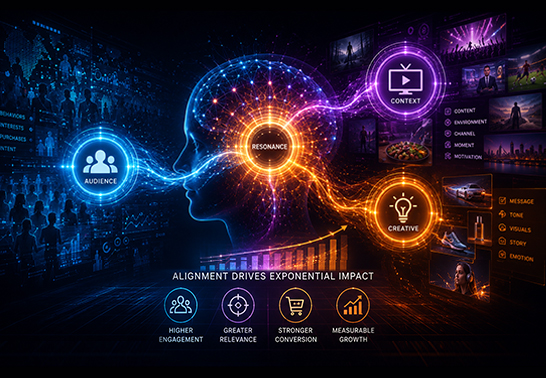
The industry continues to optimize advertising as if it were modular. Audience targeting is one discipline. Contextual targeting is another. Creative is something else entirely. Each is measured, optimized, and often managed independently.
That structure reflects how organizations operate. It does not reflect how people think.
At the moment of exposure, the brain does not separate message, environment, and individual. It processes them together. The effectiveness of any given impression is determined not by any single factor, but by how well those factors align.
Most advertising still operates as interruption. The message is disconnected from the context, and neither is particularly aligned with the viewer’s underlying motivations. The result is cognitive friction. Even when attention is achieved, persuasion is diminished.
Alignment changes that equation.
When the creative, the context, and the audience are all activating the same motivations, the experience becomes coherent rather than disruptive. Processing becomes easier. Resistance declines. Influence increases.
This is what we mean by resonance.
That concept has been tested in a variety of ways, including work conducted with RMT and subsequently examined in collaboration with Wharton Neuroscience and the ARF. In those analyses, the alignment between ad, context, and audience at the level of motivation proved to be highly predictive of real-world outcomes, including sales lift.
Resonance is not additive. It is multiplicative.
When alignment is achieved across all three dimensions, the gains are not incremental. They are exponential. In one case, the combination of motivationally aligned context, audiences, and creative produced a fivefold increase in the primary KPI.
That kind of result does not come from optimization at the margins. It comes from changing the system.
The reason the industry has not fully captured this opportunity is structural. Measurement systems tend to isolate variables rather than examine their interaction. Organizational silos separate the elements that need to be integrated. And until recently, there was no shared framework capable of connecting creative meaning, content environment, and audience motivation.
That limitation has begun to change. RMT’s work in the development of unified motivational taxonomies has made it possible to map creative, context, and audiences onto a common framework. That in turn allows alignment to be quantified and optimized.
For planners and platform designers, this shifts the nature of the task. The question is no longer which audience to target or which program to buy. It becomes which combinations of message, context, and audience are most likely to drive behavior.
In a marketplace where data is abundant and inventory is increasingly commoditized, advantage will come from the ability to answer that question more precisely than others.
The answer is not found in any one variable.
It is found in their alignment.
NEW: Balancing our internal & external worlds to improve satisfaction, well-being & performance. When seeking high performance, we can often be guilty of getting caught in a cycle of constant 'doing' or external achievement, sometimes to the detriment of our internal well-being and clarity. Peak performance is not about choosing between action and reflection, but about mastering the balance of both. By treating internal reflection as a necessary partner to external action, we can achieve a state of excellence and 'flow' that is both sustainable and deeply satisfying. Podcast length: 55 minutes. Watch the Video.
Posted at MediaVillage through the Thought Leadership self-publishing platform.
Click the social buttons to share this story with colleagues and friends.
The opinions expressed here are the author's views and do not necessarily represent the views of MediaVillage.org/MyersBizNet.

Bill Harvey
Bill Harvey, who won an Emmy® Award in 2022 for his invention of set top box data, has spent over 35 years leading the way in media research with pioneer thinking in New Media, set top box data, optimizers, measurement standards, privacy standards, the A…