
Are We Willing to Keep Sacrificing Reach?
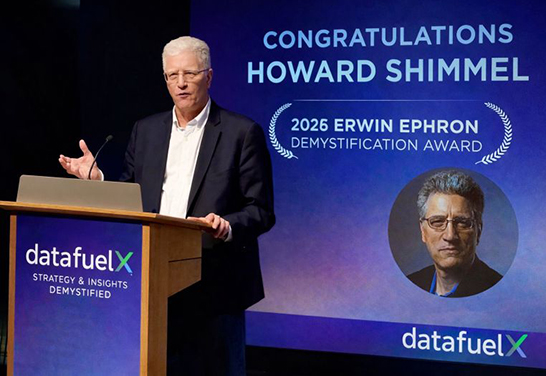
By Howard Shimmel (Intro by Bill Harvey)
In this column my readers have seen many articles about the apparently decreased abilities of many media experts to maximize target reach in the complex new media environment, and we have also seen that there are ways which a few of the best media minds have discovered to get terrific reach with remarkably modest GRP. All of this insight has come through Nielsen ONE which has been reporting on nearly a hundred thousand TV/CTV/digital campaigns per year since 2023. Here is a link to the prior collection of such articles in this column.
Erwin Ephron Award Winner Howard Shimmel needs no introduction here. Howard has contributed an astute analysis focusing on excess frequency – the stuff that gets in the way of reach the way crabgrass gets in the way of flowers, as Erwin himself had once jested. Howard also focuses on the two highest ROAS and brand-building media, linear and streaming television, the core storytelling media at the heart of every media plan aimed at growing brands by convincing new customers to give your brand a try.
It’s my pleasure to pass the mic to Howard here:
Reach matters!
I’m a giant disciple of Les Binet and Peter Field and the work that they’ve led on what drives the effectiveness of brand campaigns. In Effectiveness in Context, A Manual for Brand Building, they stated that reach against a broad category target is a key variable in driving the success of branding campaigns.
Nielsen and Bill Harvey were kind enough to share a database of thousands of Nielsen ONE campaigns that I’ll use for much of the analysis that follows.
A lot of the dialogue in the US market is that we have an issue with frequency management in streaming. That’s generally technology driven, due to campaigns being activated across multiple DSPs leveraging different identifiers. The Nielsen data clearly illustrates the CTV frequency issue. Among the 1,282 campaigns with 25 or more CTV GRPs:
- 154 campaigns, or 12% of all campaigns, had average frequency over 10; these campaigns accounted for 56% of total CTV GRPs across the 1,282 campaigns
- 51 campaigns, or 4% of all campaigns, had average frequency over 25; these campaigns accounted for over 43% of total CTV GRPs across the 1,282 campaigns
It’s important to remember that this is average frequency. Heavier CTV viewers are likely to have frequency 2 or 3 times higher than the average.
But at the same time, we need to be cognizant of linear TV’s frequency issue. Among the 514 campaigns with over 25 linear TV GRPs:
- 233 campaigns, or 45% of all campaigns, had average frequency over 10; these campaigns accounted for 88% of total linear GRPs across the 514 campaigns
- 68 campaigns, or 13% of all campaigns, had average frequency over 25; these campaigns accounted for over 60% of total linear GRPs across the 514 campaigns
I’ve been saying for some time that we don’t have a CTV frequency or a linear frequency problem; we have a TV screen frequency problem that impacts consumers, advertisers, and publishers. When a consumer gets 14 frequency on linear and 2 frequency on CTV, that’s annoying to the consumer, that’s wasted spend for the advertiser, and it’s a missed monetization opportunity for the publisher.
The industry has struggled with analytic approaches that can seamlessly, in a predictive fashion, activate across linear TV with its one-to-many distribution approach and all things addressable, including CTV. To be effective, the optimal approach needs to offer scale across all digital avails and needs to align with the way advertisers plan for reach- daily reach, weekly reach, monthly reach.
The need for this analytic approach is clearly evident in the Nielsen ONE data, especially when you remember Les Binet and Peter Field’s guidance about the importance of optimizing reach. For campaigns with linear TV reach above 40% and CTV campaigns over 5%, the Nielsen data shows on average that just about half (47%) of the CTV reach is duplicated with linear- so more frequency to people who already have high frequency. For campaigns with linear TV reach between 30% and 40% and CTV campaigns over 5%, there’s still a material overlap. 36% of the average schedule CTV reach is duplicated with linear TV.
Just remember- the greater the overlap, the more reach is missed.
datafuelX has a patented forecasting capability called PrecisionX. PrecisionX takes a set of digital IDs and forecasts expected reach and frequency of a linear TV plan against all those IDs. Those forecasts could be for tomorrow, for next week, for next month, depending upon the planning cycle for the campaign. PrecisionX forecasts can then drive incremental reach activation, targeting IDs forecasted to have zero frequency for the linear campaign.
Leveraging PrecisionX will provide far more scale than other methods used in market, like targeting cord-cutters for incremental reach.
PrecisionX can be used for a publisher selling across linear and their CTV and FAST assets; it can be used by an agency across their entire linear TV and CTV/FAST buy.
Think about what leveraging PrecisionX means from the perspective of missed reach, or achieving more reach without spending an additional media dollar.
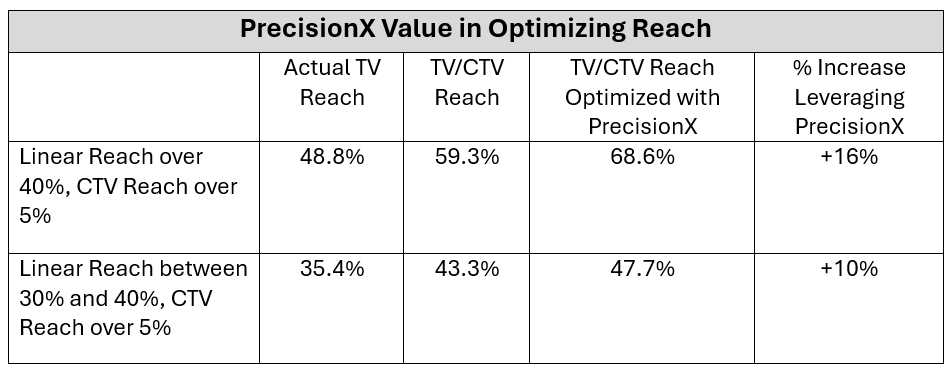
Also, think about this from the perspective of how much more money it would cost to achieve 4.4 reach points if an advertiser accepted the overlap and tried to achieve the incremental reach by spending more money- it would take about $8.7 million dollars to achieve those incremental reach points.
Now let’s think about this from a publisher's perspective. I’ve long advocated that all major publishers with linear TV and CTV assets should guarantee total cross-platform reach, not cross-platform impressions (age/sex or advanced audiences). Especially in a world where we’re taking heed of Binet and Fields. Assuming we move our pricing model to cost per reach point, taking the same pool of spots and impressions and driving 10% more reach means 10% increase in yield.
We have the necessary data and analytics to solve this and improve consumer experience, advertiser ROI, and publisher yield. What’s holding us back? We shouldn’t keep sacrificing reach.
Understanding the seasons of growth: why contraction & expansion are part of the process. This podcast discusses how growth is not a linear path but a series of seasons: from the 'winter' of shedding old identities and habits to the 'summer' of external expansion and aligned opportunities. It also addresses the common tendency to resist these cycles, explaining how fighting a contractive season only leads to further frustration and prolonged stagnation. Learn more about the power of curiosity: how asking questions can help pull you out of apathy and move you toward progress during difficult times; the art of detachment - Bill explains the hidden switch of letting go, to better enjoy the process of living. Podcast length: 55 minutes. Watch the Video.
Posted at MediaVillage through the Thought Leadership self-publishing platform.
Click the social buttons to share this story with colleagues and friends.
The opinions expressed here are the author's views and do not necessarily represent the views of MediaVillage.org/MyersBizNet.

Bill Harvey
Bill Harvey, who won an Emmy® Award in 2022 for his invention of set top box data, has spent over 35 years leading the way in media research with pioneer thinking in New Media, set top box data, optimizers, measurement standards, privacy standards, the A…