
At ARF, Marketers Are Pointed Back by AI to Reach and Frequency
At The Advertising Research Foundation’s (ARF’s) 2025 Marketing Effectiveness Accelerator Conference, the number of times that reach and frequency were mentioned by expert presenters was noticeable. This is the premier conference of every year focusing on the measurement of the sales effects of advertising. Up until this conference, for several years, the concept of reach and frequency has been held up by self-interested parties to be “vanity metrics” as compared with the all-important outcome metrics. This conference sets the record straight: outcomes depend to a very large degree upon the pillars of reach and frequency. The new measurement systems, largely driven by AI, make these facts inescapable.
Erwin Ephron, looking down from above, is surely relieved at this correction.
The kickoff session, with Google’s Senior Director of Data Science & Engineering Harikesh Nair and TransUnion’s Senior Vice President Marketing Solutions Services Mike Finnerty, showed how reach and frequency can replace dollars or gross rating points (GRPs) in marketing mix modeling (MMM), resulting in better understanding of results, more prescriptive guidance regarding how much reach and frequency is needed, better out of sample prediction of future results, further reduction in the effects of collinearity1, and remarkable improvements in the sensitivity of response curves for different media types.
“This is a huge innovation,” commented Mike Finnerty, “MMM generally has static response curves,” meaning that all media types come out looking the same, and do not change across very different media mixes, making them essentially useless. “Reach frequency gives us net new signal which changes the response curves.”
Many of us in the business have been talking about the need to go this way for years. Jim Spaeth, Alice Sylvester, and Leslie Wood come to mind as leading exponents. My own 2023 CIMM report on the future of ROImeasurement pointed out that reach saturation curves are highly correlated with ROI dose-response curves for the same media type, and the wide range of differences in how early (i.e., how low a reach) certain media types, e.g., digital advertising via computers, saturate (top out).
Pete Doe, Chief Research Officer, and Shweta Shah, Vice President of Data Science at Nielsen, co-presented Nielsen’s approach to outcome measurement, which uses AI and a synthesis of proven methods to provide a holistic perspective via an all-inclusive dashboard. As you can see, reach and frequency by media types across TV and digital are shown side by side with full funnel outcome measures of branding and sales.
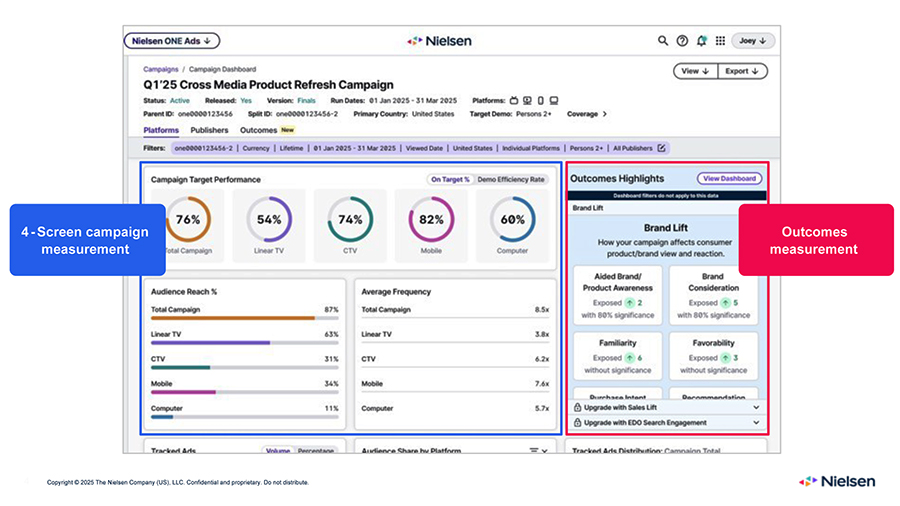
Pete emphasized that audience and outcome measures must be seamlessly connected, collaboration is essential, context is key, third-party independent measurement is crucial for transparency and comparability, and methodology matters.
Molson Coors’ Michelle Wojnowski, Senior Manager, Marketing Analytics and Optimization, Google’s Madison McDonough, Food & Beverage Analytical Lead, Big Box Retail, and Circana’s Yeimy Garcia Smith, Senior Vice President of Global Measurement, found that adjusting YouTube reach and frequency improves ROAS (return on ad spend). The study highlights a scalable, data-driven method for optimizing digital media investment, based on the solid ground of century-old reach frequency knowledge and careful experimentation.
Rex Du, Professor of Marketing at the University of Texas at Austin, analyzed the ordering of home food delivery based on ads in 1.4 million LG TV homes. 53,618 homes ordered food delivery during the 4-month study. Analysis determined that the best strategy is to use addressability to target homes that have ordered home food delivery before, and to wait 3 to 5 days after the last order before running the next ad for home delivery. This is an example of reach-frequency-timing in intelligent practice.
As Erwin Ephron pointed out, if you do not reach someone, you cannot expect any outcome from that person.2 As he also famously said, whatever improvement in likelihood of buying is created by a second exposure, it must be a smaller increment than the zero-to-something increment of the first exposure. This is why reach is such an important metric, quite the opposite of whatever a vanity metric might be.
Erwin did not ignore frequency or consider it to be unimportant. His experience with media optimizers was that if he gave any value to frequency at all, the optimizer would give him too much frequency and not enough reach. Mind you, he was using the first generation of media optimizers; more recent generations can optimize for both reach and frequency without sacrificing reach.
Erwin was also the world’s leading champion of recency – meaning to reach someone while they are in the buying window. Like the home delivery case cited above, where the 3-to-5-day interval is the predictor of the next buying window. Joel Rubinson, a mentee of Erwin’s, brilliantly used this in an NCS study which increased ROAS dramatically by predicting the next shopping trip using household longitudinal data.3
Leslie Wood, in a ScanAmerica study in the closing years of the 20th Century, found that two ad exposures within the 48-hour window before a shopping trip increased sales +14%, a strong measure of the recency aspect of reach/frequency. Looked at from a new vantage point after a hundred years of reach frequency, this lens is actually a combination of four factors: reach, frequency, timing (recency), and sequence interactions. Ed Papazian, btw, has been saying this for years.
The more technically-oriented readers will also appreciate a couple of other reports below on the ARF Accelerator 2025.
Bharath Gaddam, CEO & Founder of DATA POEM, presented a case study for one of the world’s largest advertisers, which had been using five siloed MMM models (marketing, trade, pricing, product innovation, eCom), that became integrated as one through the DATA POEM Large Causal AI model. Including not only reach/frequency but also the synergy of each combination of media types to provide a brand revenue growth optimizer. The basic innovation of DATA POEM is to shift from correlation to causation, operationalizing the theories of Judea Pearl into the world’s most advanced Causal AI platform.
Sequence-based phenomena can also be measured using AI Transformer technology, as presented by in4mation insights’ Senior Director, Marketing Science Client Services, Grant West, and Memorial Sloan Kettering Cancer Center Senior Director, Marketing Measurement, Analytics & Insights Adam Graves. Traditional multi-touch attribution (MTA) models struggle with dependencies among sequences of touchpoints (this equates to duplication patterns within the reach frequency lens) and fail to integrate marketing channel attribution with on-site clickstream behavior. This makes MTA more predictive of a larger number of discrete variables, including lifetime value, variance confidence intervals (degree of risk), who to target, and their likelihood of conversion. Technically, their model uses a multi-head self-attention matrix where different variables are focused on by different neural heads whose findings are collaborated together in real time.
1 The difficulty of separating out effects by media types when all of them are generally running at the same times.
2 It is true, of course, that an unreached-by-advertising person might hear about the ad from someone else. This secondary exposure has value, especially if it is a positive endorsement of the brand from a trusted third party. However, many of these secondary exposures might not be positive or might only relate to irrelevant but amusing aspects of the ad.
3 As written about in recent posts one of my new passion projects, UltiMedia, will be using this method along with RMT and other proven ROAS optimization strategies.
Cover Image Source: The ARF.org
Posted at MediaVillage through the Thought Leadership self-publishing platform.
Click the social buttons to share this story with colleagues and friends.
The opinions expressed here are the author's views and do not necessarily represent the views of MediaVillage.org/MyersBizNet.

Bill Harvey
Bill Harvey, who won an Emmy® Award in 2022 for his invention of set top box data, has spent over 35 years leading the way in media research with pioneer thinking in New Media, set top box data, optimizers, measurement standards, privacy standards, the A…