
Beyond Attention: What Makes an Ad Impression Work Best?
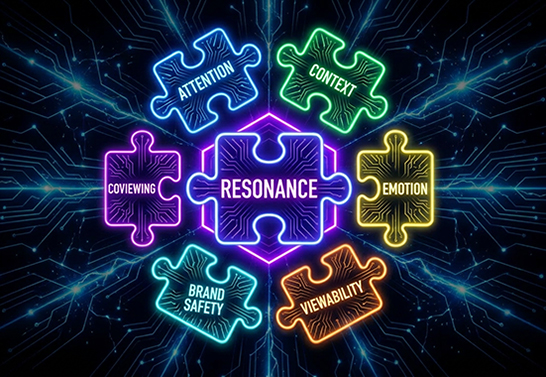
Hapu the weaver may have been the first advertiser, around 3000 BC in Thebes. His notice offered a gold reward for a runaway slave, then casually added that his shop made “the most beautiful canvases in all of Thebes.” His genius was not just the line but the placement: he put his message inside something people were already motivated to read. Long before attention, viewability, or brand safety became separate metrics, Hapu was solving the larger problem of Impression Quality: getting the right message into the right moment.
Much later, media people called this “editorial environment.” Magazines and newspapers could charge higher CPMs when appearing in their pages felt like a quiet endorsement from a trusted host. Early radio and television leaned on novelty, but fully sponsored programs soon made context impossible to ignore: the sponsor, the program, and the sales pitch were intertwined.
Then the scientists arrived. Horace Schwerin found that food and beverage ads performed worse in fear-producing environments: same ad, different setting, different result. Daniel Starch brought measurement into the living room, tracking which ads were noticed and “read most,” then slicing results by category, celebrity, placement, size, and color. Impression Quality was already becoming a crowded concept.
By the 1960s and 1970s, researchers studied room-leaving and channel switching. In the 1980s and 1990s, panels found that many TVs were on without anyone truly watching, even as thousands of studies showed that primetime tended to outperform other dayparts for brand and sales impact.
In the 1990s, when I introduced set-top box data to the market through Next Century Media, we expected to see rampant channel switching. Instead, commercials approached 90% completion from the device’s point of view. Useful, but misleading: the box could confirm that an ad aired, not that a human was watching or engaged. That gap later helped give rise to today’s attention measurement.
Attention, fueled by cameras in billions of devices, has become ubiquitous—and so prominent that it is often mistaken for the whole story rather than one part of Impression Quality.
Digital media added viewability, invalid traffic, brand safety, and the question of whether the “viewer” is even human. Soon, impressions may need to be categorized as human, agent, or bot. The IQ family keeps growing.
Advertisers, accordingly, are all over the map. Some prioritize attention. Others are satisfied with viewability, SIVT, and brand safety. Still others ask what comes after attention. The answer is not a single metric but a better framework.
Emotion measurement adds another layer. Facial coding uses the same cameras embedded in phones and computers, but visible emotion is absent during most normal media consumption. Biometric and neuro methods go deeper, tracking physiological response, attention, memory encoding, emotional attraction or avoidance, and synchrony, a strong predictor of incremental sales effects. These are all part of IQ, though most are captured in forced-viewing lab environments rather than natural exposure.
The ARF’s Horst Stipp offers a useful simplification:
- Type 1 IQ: environments that are generally good or bad for ads, such as the Super Bowl versus low-attention scrolling media.
- Type 2 IQ: the degree of fit between the ad and the context, which has been shown to increase advertising effectiveness.
Type 1 matters, but it is often expensive. Type 2 is the sharper opportunity: it does not require buying the biggest stage, but matching each ad to the contexts most likely to amplify it.
RMT uses the only empirically-derived battery of dimensions (a total of 265 psychological characteristics distilled by machine learning and passively observed choice behavior from over 13,000 candidate qualifiers) for applying Type 2 Impression Quality.
Thousands of tests have been done using the battery of IQ measurements we have discussed so far. 99% of them measure success in terms other than sales effects. Uniquely, RMT’s validations are focused on sales effects. The reason why RMT’s Type 2 method reliably drives sales lifts is because it involves empirically derived predictors based on millions of observations of choice behavior. As our partner, Wharton Neuroscience has taught us, all choice behavior is the same computation in the brain. Even though RMT’s machine learning experiment with over a million adults for several months involved program choice behavior, Simmons proved that it works for all brands in all product and service categories, just as Wharton said it would because it is all the same choice computation.
The practical lesson is straightforward: no single IQ metric deserves the crown. All IQ metrics should be used together. There is still much to learn. Human beings are incredibly complicated. Advertising communicates to human beings and attempts to persuade them. Persuasion occurs most strongly when the ad resonates with the person, and the context aids that resonance. The most useful Impression Quality concepts are the ones that help explain and improve real business outcomes. This is Type 2 IQ.
Understanding the seasons of growth: why contraction & expansion are part of the process. This podcast discusses how growth is not a linear path but a series of seasons: from the 'winter' of shedding old identities and habits to the 'summer' of external expansion and aligned opportunities. It also addresses the common tendency to resist these cycles, explaining how fighting a contractive season only leads to further frustration and prolonged stagnation. Learn more about the power of curiosity: how asking questions can help pull you out of apathy and move you toward progress during difficult times; the art of detachment - Bill explains the hidden switch of letting go, to better enjoy the process of living. Podcast length: 55 minutes. Watch the Video.
Posted at MediaVillage through the Thought Leadership self-publishing platform.
Click the social buttons to share this story with colleagues and friends.
The opinions expressed here are the author's views and do not necessarily represent the views of MediaVillage.org/MyersBizNet.

Bill Harvey
Bill Harvey, who won an Emmy® Award in 2022 for his invention of set top box data, has spent over 35 years leading the way in media research with pioneer thinking in New Media, set top box data, optimizers, measurement standards, privacy standards, the A…