What do Bob Dylan, vinyl records, workplace authenticity, and one unexpectedly provocative leadership phrase have in common?
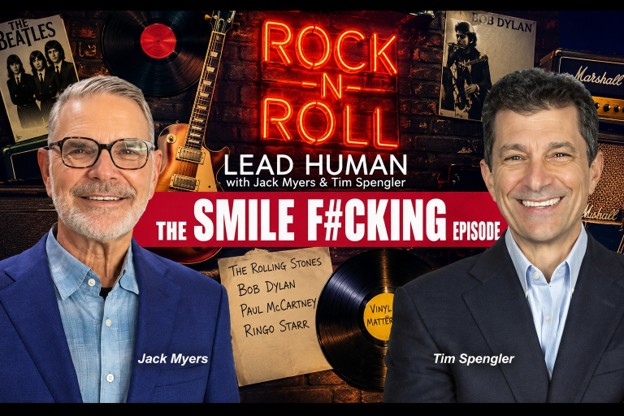
In this unusually candid episode of Lead Human, Jack Myers and Tim Spengler prove that sometimes the most revealing conversations happen when there is no guest in the room.
Most business podcasts rely on structure. A guest. A theme. A predictable arc.
This episode of Lead Human does something more interesting.
Jack Myers and Tim Spengler take the microphones for themselves and spend the episode doing what strong co-hosts do best: wandering into subjects that seem disconnected, then discovering that they are deeply related.
You can listen to the full conversation with Jack and Tim on Lead Human with Jack Myers and Tim Spengler at your favorite podcast platform and view at YouTube. Link to the full archive and all podcast platforms at www.lead-human.com. It is worth engaging with in full because what Jack and Tim go into unchartered territory with unexpected topics.
The conversation begins with music, specifically Jack’s enduring passion for classic rock and the remarkable longevity of artists who continue to create well into their eighties. Ringo Starr has new music. Paul McCartney continues to record. The Rolling Stones are still producing. Bob Dylan remains on the road.
For Jack, this is not merely nostalgia. It is evidence of something larger.
These artists are living proof that creative relevance does not expire with age, and that human originality retains its power even in an era increasingly shaped by artificial intelligence and machine-generated imitation.
Jack’s personal stories make this portion of the episode especially engaging. He recalls watching The Beatles on The Ed Sullivan Show when it first aired, listening to late-night radio on a transistor hidden beneath his pillow, and even building a crystal radio as a boy to pull in distant New York stations.
The anecdotes are charming, but they also serve a purpose. They remind listeners that music was once an immersive experience, not background noise.
That leads to one of the more thoughtful exchanges in the episode: the return of vinyl.
Jack talks about buying albums in vinyl, encouraging his grandchildren to experience music as a complete artistic journey rather than a playlist of disconnected singles. The ritual matters. Listening from beginning to end matters. Holding the album matters.
His point extends beyond music. In a fragmented digital culture, intentional experiences matter more than ever. That observation also aligns directly with the broader Lead Human mission. Technology can accelerate access, but it does not automatically deepen meaning.
Jack frames the point succinctly: some institutions remain irreplaceably human.
Bob Dylan cannot be replicated because what makes Dylan matter is not simply lyrics or melody. It is context, history, imperfection, and emotional truth. AI may be able to imitate style, but imitation is not authorship. That could have been the central theme of the episode.
Then Tim introduces “smile-f*cking.” The tonal pivot is abrupt and hilarious. Yet it works.
Tim defines smile-f*cking as a workplace behavior in which someone appears supportive in the moment, smiling, nodding, affirming an idea, only to later undermine it, reject it, or reveal they never intended to support it in the first place.
It is passive aggression disguised as positivity. Corporate insincerity wrapped in charm. Conflict avoidance masquerading as leadership.
If the phrase makes you laugh, that is part of its appeal. If it makes you uncomfortable, that may be even more revealing.
Tim’s critique is clear. He sees this behavior becoming increasingly normalized inside organizations, particularly among leaders who prioritize comfort over candor. The damage, in his view, is not simply emotional. It is operational.
When people do not know where they stand, trust erodes. Decisions slow. Politics increase. Relationships become performative rather than productive.
Jack responds the way experienced interviewers do, not by agreeing immediately, but by reframing the issue. “Isn’t that called relationship management in marketing?”
It is a line delivered with humor, but it opens a sharper question.
How much of modern business behavior has become performative? How often do leaders signal enthusiasm they do not genuinely feel? How often do brands present authenticity while behaving opportunistically?
Jack connects the concept to a broader cultural pattern he has referenced before: performative participation. Showing up to be seen. Posting to appear engaged. Projecting alignment without actual commitment.
Tim draws an important distinction. Brand performance is one thing. Human trust inside working relationships is another. That distinction is what makes this conversation more than banter.
Listeners will recognize these dynamics immediately. The executive who says, “Let’s absolutely do lunch,” with no intention of scheduling it. The manager who smiles through a meeting only to dismantle the idea privately afterward. The colleague who approves with body language, then objects in Slack.
Most professionals have encountered some version of this behavior. Some may recognize it in themselves.
What makes this episode especially effective is that neither Jack nor Tim tries to package the discussion into neat leadership clichés. The exchange remains conversational, occasionally messy, and recognizably human.
That authenticity is precisely what gives the episode its appeal.
There are lighter moments throughout. Desert-island album choices. Favorite songs. Tim’s admiration for U2’s “Bad” from Live Aid. Jack’s instinct to bring Mozart into the conversation. Reflections on drummers, concerts, and the enduring physicality of performers like Mick Jagger.
The chemistry between the hosts carries the episode. More importantly, the conversation reinforces a larger truth. Leadership is not only about strategy. It is about presence.
It is about whether we communicate honestly. Whether we preserve the human experiences technology cannot replace. Whether we create trust rather than theater.
And whether we can recognize the difference between genuine diplomacy and manipulative avoidance.
So now the conversation belongs to listeners. What are the three albums you would take to a desert island?
What is your all-time favorite song?
Have you encountered smile-f*cking in your professional life?
Have you practiced it yourself?
And if so, did anyone believe you?
This is one of Lead Human’s most entertaining episodes because it never tries too hard to be profound.
Instead, it lets two experienced voices talk honestly about culture, leadership, music, and behavior.
Sometimes that is exactly where the best conversations begin.
You can listen to the full conversation with Jack and Tim on Lead Human with Jack Myers and Tim Spengler at your favorite podcast platform and view at YouTube. Link to the full archive and all podcast platforms at www.lead-human.com. It is worth engaging with in full because what Jack and Tim go into unchartered territory with unexpected topics.