
Context and Strategy: The Missing Multipliers in Campaign Performance
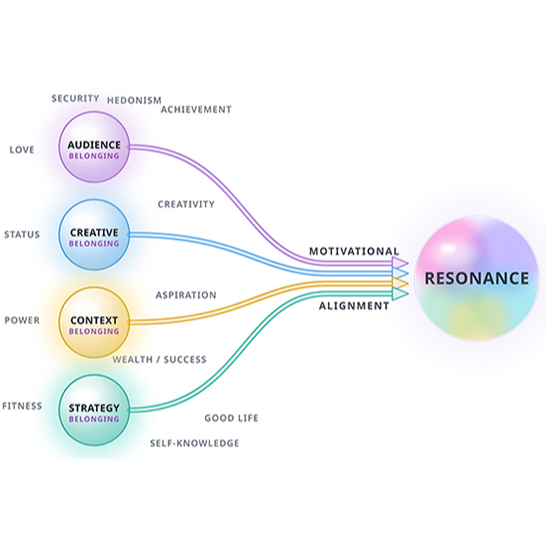
In Part 1 of this series, I introduced the concept of the Resonance Stack: the interaction between Audience, Creative, Context and Strategy as an integrated system of persuasion rather than a collection of independent variables.
The central idea is straightforward.
Consumers do not experience advertising one dimension at a time. The brain processes all four simultaneously. And increasingly, the evidence suggests that campaign performance is driven less by isolated optimization and more by the alignment between these variables.
That alignment is what we call Resonance.
Of the four dimensions within the Resonance Stack, Context and Strategy may be the least fully understood and perhaps the most underestimated.
For years, context was treated largely as a brand safety issue. The industry focused appropriately on avoiding unsuitable adjacency and maintaining advertiser protections. That work mattered and continues to matter.
But context is not merely defensive; it is neurological. That is, the environment surrounding a message changes how the message itself is processed by the brain.
The advertising industry still tends to treat media placement as primarily a delivery mechanism rather than a psychological amplifier.
But environments influence receptivity.
This is where many contextual companies have helped move the market forward meaningfully. The evolution from simplistic keyword adjacency toward semantic understanding, emotional interpretation, and contextual intelligence has unquestionably improved media quality and targeting sophistication.
But contextual relevance alone is not enough.
The real challenge is not simply understanding the environment. The challenge is understanding the relationship between the motivations embedded within the content, the motivations embedded within the creative, the motivations driving the audience, and the strategic role the exposure serves within the campaign system.
At the neurological level, persuasion is fundamentally about coherence.
When the motivations embedded within Audience, Creative, Context, and Strategy align, the brain experiences reduced friction and increased receptivity. When those dimensions conflict, performance deteriorates, often invisibly.
The same principle applies to media strategy itself.
Historically, strategy has often been viewed as a planning discipline built around budget allocation, reach optimization and platform mix. Those functions remain essential. But increasingly, strategy must consider not just “how many impressions should we buy?”, but “what sequence of experiences most effectively aligns with human motivational response?”
The critical question is whether the advertising experience resonates motivationally.
This is where neuroscience becomes particularly important.
At RMT, our work alongside organizations including the Advertising Research Foundation and the Wharton Neuroscience Initiative has increasingly focused on understanding the neurological conditions associated with persuasion and sales effectiveness, not merely exposure.
One particularly important finding from Wharton Neuroscience research was that NeuroMotivational Resonance showed a strong relationship with EEG synchrony, which itself has been associated with advertising effectiveness and sales outcomes.
This matters because it begins moving the industry beyond observational proxies and closer toward predictive persuasion modeling.
The companies best positioned for the next era of advertising effectiveness will likely be those capable of connecting neuroscience, AI, audience intelligence, creative understanding, contextual interpretation, and strategic orchestration into unified predictive systems.
We are entering the first period in advertising history where this may finally be achievable at scale. Technology, neuroscience, and computational power have finally advanced enough to model persuasion more closely to how the human brain actually works.
That may ultimately become the defining transition of the next generation of advertising effectiveness.
Not the optimization of impressions.
The optimization of human response.

Understanding the seasons of growth: why contraction & expansion are part of the process. This podcast discusses how growth is not a linear path but a series of seasons: from the 'winter' of shedding old identities and habits to the 'summer' of external expansion and aligned opportunities. It also addresses the common tendency to resist these cycles, explaining how fighting a contractive season only leads to further frustration and prolonged stagnation. Learn more about the power of curiosity: how asking questions can help pull you out of apathy and move you toward progress during difficult times; the art of detachment - Bill explains the hidden switch of letting go, to better enjoy the process of living. Podcast length: 55 minutes. Watch the Video.
Posted at MediaVillage through the Thought Leadership self-publishing platform.
Click the social buttons to share this story with colleagues and friends.
The opinions expressed here are the author's views and do not necessarily represent the views of MediaVillage.org/MyersBizNet.

Bill Harvey
Bill Harvey, who won an Emmy® Award in 2022 for his invention of set top box data, has spent over 35 years leading the way in media research with pioneer thinking in New Media, set top box data, optimizers, measurement standards, privacy standards, the A…