
Creative and Media Are Abstractions: The Viewer Sees Both As One Thing

The problem with abstractions is that we eventually fool ourselves into thinking of them as real things.
This causes us to make big mistakes, such as assuming that a good piece of creative will work equally well in whatever media context we place it.
Here is how differently the same creative works depending on the media context:
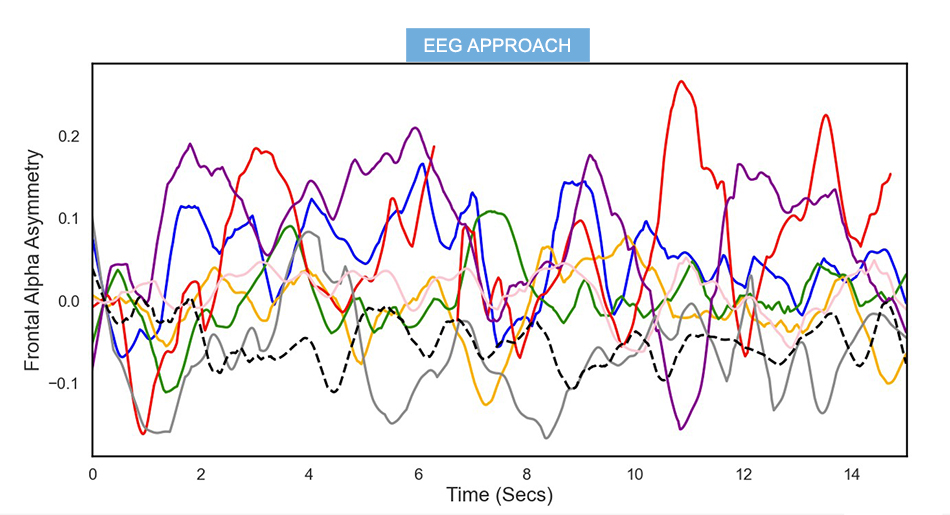 Graph courtesy of FOX BHC Wharton Neuroscience 2024 study.
Each curve in the above graph is the same creative in 7 different TV contexts. EEG Approach is the emotional quotient of the brain experience of an ad or any stimulus as measured by the electroencephalograph.
What this reveals is that context effect is a massive effect. The industry has always been cognizant of context effect, but it has generally been disregarded as a minor variable. A few years ago, NCS presented to an annual Advertising Research Foundation (ARF) conference the estimate that context effect has only a 3% effect on sales and branding outcomes. Of course, they were defining context effect based on an oversimplified metric: program genre. How you define context classifications makes all the difference to how powerful or weak context effect will appear to you.
The same Wharton study found that the RMT method (full disclosure: I am the inventor and chairman of the company that is implementing the method) is the best proxy for EEG in classifying contexts and ads so as to be able to estimate the degree of alignment/resonance between the ad and the context. A proxy is essential because marketing today demands scalability and low latency, and EEG measurements take substantial time and money, even to measure only a few ads.
Obviously, all other things being equal, you want to put your ad into the contexts in which it will have the greatest positive effect. In the RMT method, you make all other things equal by using the ad-context resonance score as another variable in the CPM equation. So, you are not ignoring CPM, reach of the target audience, brand safety, or any other valid media selection criterion.
You can also combine attention into the same equation, or EDO scores, or anything else that you have validated increases your success.
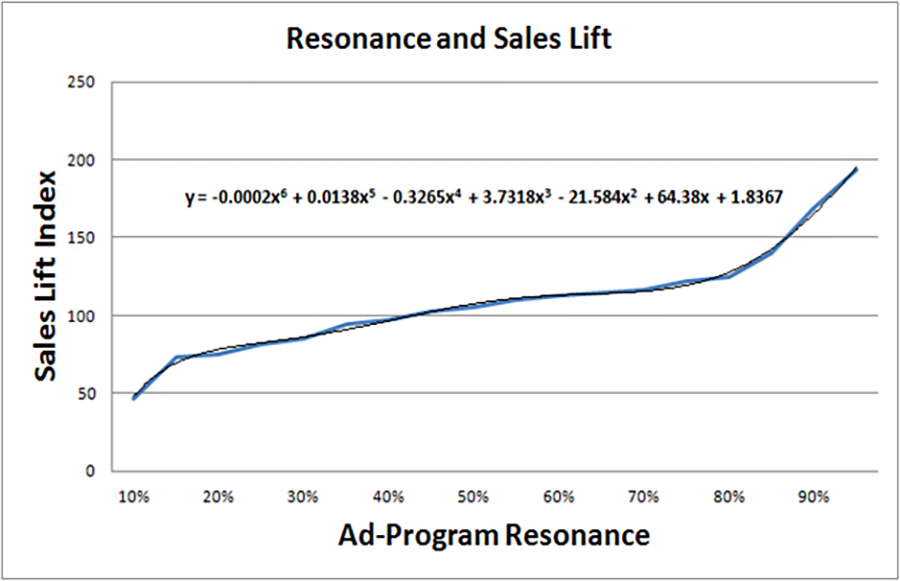
Seven different studies by respected researchers have validated that the RMT method increases sales and branding effects. NCS data enabled the construction of this curve by which the sales lift index can be predicted from the RMT Resonance score:
 Source: NCS
Resonance scores can be calculated two ways:
- How well does the media context resonate with the ad?
- How well does the addressable advanced audience ID resonate with the ad?
In addition to RMT, other companies such as Wurl are doing type 1 above, whereas so far, only RMT with partner Semasio is doing type 2.
Most of the companies doing resonance are basing it on the emotions in the ad and the emotions in the context.
RMT’s method, which was empirically derived by machine learning (ML), reflects not only emotions and moods, but also motivations, values, character and personality traits, mindsets, need states, and all other psychological dimensions.
Analyses I have done so far show that RMT and other new measures are orthogonal, that is, they do not duplicate each other, but instead they supplement one another. Therefore, they are good candidates for combining for the greatest positive impact on brand growth.
When measured econometrically, for example, against the ROAS metric, adding the modest costs of these new impact metrics actually save you money. For example, this study done by 605 for one of the world’s largest advertisers shows that using predictive success metrics such as RMT enables you to use less frequency while still getting better full funnel outcomes. From that study:
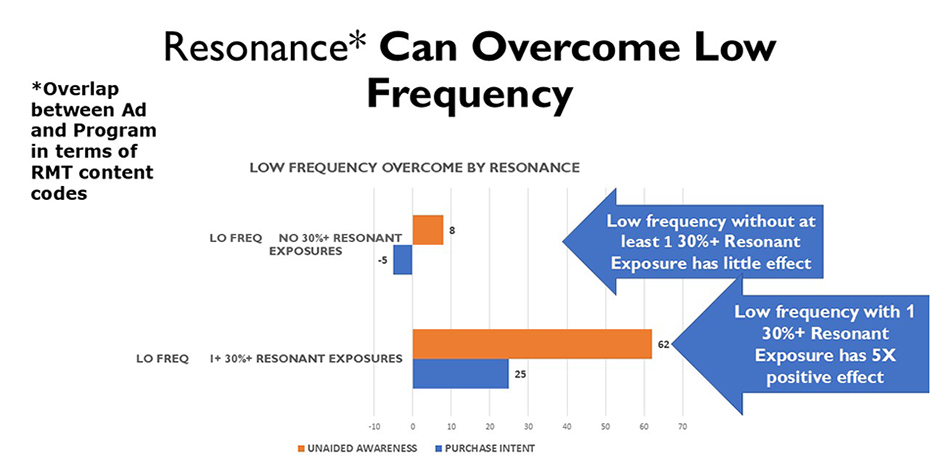 See the complete ARF RMT 605 white paper at rmt.solutions/branding-lift/
It often takes a long time for the industry to change its methods, and many have never changed in all my time in the business. This creates an exceptional opportunity for the bold marketer to make use of the new predictive metrics, including resonance, EDO, attention, and emotion. Holdout groups enable the ability to see what really works and what doesn’t. Almost insignificant risk and very high upside reward. And your competitors stuck in the old ways will probably take a long time to figure out why you are suddenly spiking and to follow in your footsteps.
Posted at MediaVillage through the Thought Leadership self-publishing platform.
Click the social buttons to share this story with colleagues and friends.
The opinions expressed here are the author's views and do not necessarily represent the views of MediaVillage.org/MyersBizNet.

Bill Harvey
Bill Harvey, who won an Emmy® Award in 2022 for his invention of set top box data, has spent over 35 years leading the way in media research with pioneer thinking in New Media, set top box data, optimizers, measurement standards, privacy standards, the A…