Doug’s name is synonymous with digital media and technology sales. For the past 14 years, he’s hosted Seller Forum, the industry’s only peer‐to‐peer networking and content event just for digital sales leaders. And each week he writes The Drift, a provocative industry blog that directly reaches nearly five thousand executives.
JAY SEARS: What do you read to keep up with politics, art and culture?
DOUG WEAVER: NPR’s political coverage and specifically the NPR Politics podcast. That plus The New York Times and The Washington Post coverage and the audio feed of MSNBC on satellite radio. (Seeing a pattern here?) With regard to art and culture, the Sunday New York Times Book Review (non-fiction titles mostly) plus NPR’s Pop Culture Happy Hour podcast and every film review I can get my hands on. And friends who know music: I count on them for recommendations as I’m pretty much stuck in the ‘80s.
SEARS: What do you read to keep up with friends?
WEAVER: I’m addicted to the LinkedIn app. That probably says something about how much my friendships are woven into the industry. I’ve never lived in the same area code as most of my best friends.
SEARS: What do you read to keep up with the advertising technology industry?
WEAVER: AdExchanger and Digiday are sort of the daily left and right brain feeds of the biz for me. Pretty much everything hits my inbox or LinkedIn feed so I graze for names I recognize or themes that pique my curiosity.
SEARS: What’s your favorite commercial of all time?
WEAVER: My favorite commercial is fictional. It’s the one Don Draper described in the pitch meeting to Kodak for “the Carousel.” That was the perfect synthesis of artist and art. He presented the dark side of that vision in the famously disastrous Hershey pitch.
SEARS: With regards to advertising automation, what are the three biggest trends you expect to impact companies in 2016?
WEAVER:
- The authenticity premium continues to grow. Native, influencer marketing, content marketing all flourish. It will be messy and profits will be questionable, but it’s the Corsican twin of programmatic automation. Whoever can scale, wins big.
- The Democratization of Mobile Video. No question Facebook and YouTube are still the superpowers, but the measurement issues and more will cause a thousand more flowers to bloom. Game ain’t over yet.
- Cross dressing. We used to have a solid idea where the agency ended and the tech company began. For that matter, we used to know the difference between media companies and telcos. Look at WPP’s acquisitions and the proposed AT&T/Time Warner acquisition. Like that.
SEARS: With regards to advertising automation, what are the three most overblown topics that you wish would just go away?
WEAVER:
- Header bidding. I get why it’s truly important, but it’s an adjustment not a paradigm shift. And it’s just one more thing to confuse marketers who still don’t understand us.
- Attribution. Just the most depressing conversation. I feel like we’re trapped watching a game show where only accountants and procurement people get to play.
- Tie between ad-blocking, viewability and fraud. We’ve been addicted to an infinite supply of ad impressions, and this is the wreckage our addiction has created.
SEARS: Describe your firm and then tell us the three most common issues you help clients on with respect to advertising automation and programmatic trading.
WEAVER: Upstream Group serves a wide range of sales leaders and sellers in our industry, from ad tech companies on one side to high touch content marketing players on the other. If they work with us, they feel connected and empowered for the difficult and confusing work of sales in today’s asymmetrical environment. CROs attend our peer-to-peer Seller Forum events; individual sellers take part in the company-specific sales workshops I conduct; and a few thousand people in our industry read and pass along our blog, The Drift. We’ve been at this for 19 years and it seems like we’re starting to get pretty good at it.
SEARS: Tell us more about your firm:
WEAVER:
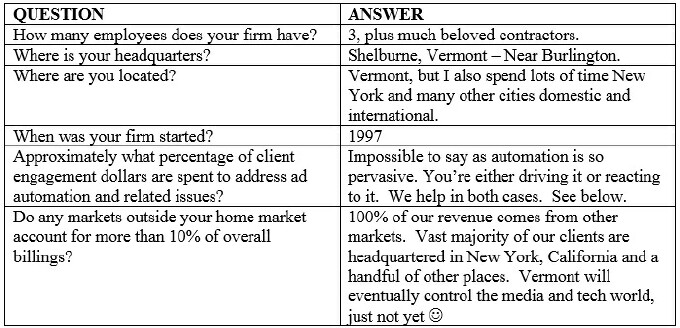
SEARS: What are the most common issues you help clients on regarding automation?
WEAVER:
- We help ad tech companies clearly communicate their value and urgency to buyers, get better levels of commitment and drive actual usage of their products.
- For those on the creative and media sides of the business, we help them form and execute sales strategies to avoid the commoditization that automation has brought on.
- We humanize the ad technology sale. Of course this is after the company has realized that it’s not all about the tech.
SEARS: The majority of ad technology companies have struggled (relatively small, unprofitable or both). Of the poor performers, what are the commonalities between them that have contributed to this weakness?
WEAVER:Insularity: They talk to themselves too much. Staying with a charismatic founder as CEO for too long: Even if you think you’re Zuck, you need to turn over a bunch of control. Unimaginative hiring: You’re overvaluing direct experience and you’re note freshening the gene pool.
SEARS: A smaller handful of ad technology companies has achieved scale and performed better than the rest. What are the commonalities between them that have contributed to this relative strength?
WEAVER: They assume their own mortality and are appropriately paranoid and curious about what’s next.
SEARS: Do we live in a “tale of two cities” where Google and Facebook win almost everything, advertisers are dictated to and other media companies fight for the scraps?
WEAVER: Yes, but only if that’s the only book you read. It’s just one volume on one shelf in a great big library. I think AT&T/Time Warner, IBM/Weather, WPP, Verizon/AOL/Yahoo and a few others will have a say. And I’m just old enough to remember when we were saying “Well, game over: Netscape won!”
SEARS: Please answer the following statements yes or no.
WEAVER: