
How To Turn Tune-In Into a Performance Medium
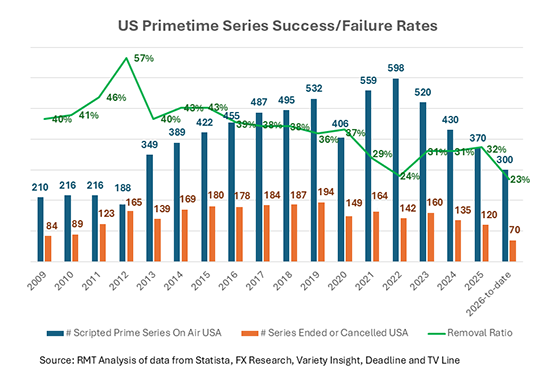
The focus on performance is rewriting how every aspect of the advertising industry is valued and structured, from closed-loop technology stacks to agency compensation models. So why would the entertainment industry exempt tune‑in advertising—the asset that fuels its product—from the same performance expectations?
Tune-in is entering a new era. A new category of advertising science is emerging, and it has as much relevance for content marketing as for brand marketing: Neuro-Motivational Targeting. It identifies and activates on the deep psychological/emotional values that influence what we watch, buy, and choose. Here is why the industry needs it—and what’s at stake.
In the last few years, roughly one‑third of programming investment—about $58B in 2025—was lost due to new‑show failure. Even when networks use their own airtime for promotion, tune‑in placements often fail to recover the ad sales revenue they displace. Paid tune‑in performs worse still. And in streaming, long availability windows do little to offset weak launches. The industry faces two seminal problems: how shows are developed, and how they are marketed. We’ll address the first problem in a later post; today we’ll focus on the breakthrough in tune-in.
The prevailing strategy for tune-in relies on audience duplication: placing promos in programs with a high degree of actual or projected overlapping viewership. This approach worked decades ago when it was first introduced, but it is ineffective today when the average rating hovers at 0.02%, and the chance for growth lies in the other >99% of the population. Broad demographic targeting cannot solve a problem driven by narrow, psychological drivers of choice.
Advanced methods have already proven what’s possible. In my early tests, these approaches doubled a CBS show’s initial rating and sustained a 51% lift post-campaign. In the work that won me a technology Emmy, we showed hundreds of cases of an 18% new show adoption rate at a time when the industry norm was 1-2%. We showed this again at TRA (which became TiVo Research) and with Simmons, which found the uplift our methods produced for TV shows was +251%.
What is this long-proven method? Neuro-Motivational Targeting. It infers the psychological motivations of a viewing audience based on the cumulative pattern of programs they view, as analyzed through a lens developed using AI and Machine Learning (ML). The system identifies semantic markers of neurological Value Signals that drive all choice behavior, according to Michael Platt, Director of Wharton Neuroscience/AI, which has become an RMT partner because of this discovery. “RMT Ad-Content Resonance is the only statistically significant predictor of EEG Synchrony,” he says in this academic paper. EEG Synchrony was proven by Wharton to correlate 91% with incremental sales in market across a number of countries.
How does it apply to tune-in? In any given footprint where TV usage data are available, RMT analyzes the RMT Value Signals of the viewers using set-top box, smart TV, or server data and scores each ID (household, TV set, individual viewer) by each of 265 neuro-motivational dimensions. Programs are scored the same way, with signals refreshed on a rolling 30-day basis. This empowers RMT and its partners to (1) determine the IDs that comprise the most responsive audience for any new TV show, (2) measure the degree to which each TV episode environment increases the efficacy of a specific tune-in ad, and (3) help program owners/distributors create tune-in ads for the distinct segments of predicted adopters.
For programmers seeking to maximize new‑show success, Neuro‑Motivational Targeting offers a proven path to higher adoption, more efficient spend, and materially better ROI. It transforms tune‑in from a cost center into a measurable performance medium.
In the coming weeks, we will introduce RMTLabs, the world’s first purpose-built platform for Neuro-Motivational Targeting across all forms of media, including Linear TV, Social, and Streaming. Early partners are already in motion.
1 $57.6 billion is calculated from the 32% program removal rate for 2025 applied to the $180B invested in program development per Ampere Analytics and Luminate.
NEW: Our newest podcast, Preparation - The Phase That Transforms Us, explores the powerful role preparation plays in our personal evolution. So often, we rush toward execution and visible results, overlooking the quiet phase where confidence, clarity, and capability are built. We unpack why preparation isn’t a delay in our progress, but instead the very process that transforms us into the person who's ready to sustain what we're working toward. • Why preparation is the actual process of transformation, not just a delay. • The tendency to use "busy-ness" and execution as a form of escapism. • Applying the athlete’s mindset to find a "flow state" in everyday life.
This month’s podcast length is ≈56 minutes. Watch the Video
Posted at MediaVillage through the Thought Leadership self-publishing platform.
Click the social buttons to share this story with colleagues and friends.
The opinions expressed here are the author's views and do not necessarily represent the views of MediaVillage.org/MyersBizNet.

Bill Harvey
Bill Harvey, who won an Emmy® Award in 2022 for his invention of set top box data, has spent over 35 years leading the way in media research with pioneer thinking in New Media, set top box data, optimizers, measurement standards, privacy standards, the A…