
N1 Finds Too Many Campaigns Have Unnecessarily Low Reach

As you know I’ve been consulting for Nielsen and have published a number of articles sharing what I’ve learned from meta-analyses of over 127,000 cross-platform campaigns measured by Nielsen ONE covering linear, CTV, mobile, and computer, and covering all the major walled gardens as well as streaming and the open web.
There are two main reasons why I am harping on reach these days:
- Ad dollars have virtually zero effect on the people not reached.
- Ad dollars and GRP are highly correlated, and it hurts me to see high GRP and low reach, but that is what I am seeing in too many cases.
Here is a taste of my latest findings, covering 402 recent campaigns from a dozen of the world’s largest advertisers across nine major verticals. I have grouped the 402 campaigns into quintiles by GRP. And I’ve compared these campaigns to norms from 7648 campaigns. As you will see, there is a lot to be concerned about in terms of high spending on GRPs resulting in high frequency but low reach, especially when compared to “role model” campaigns:
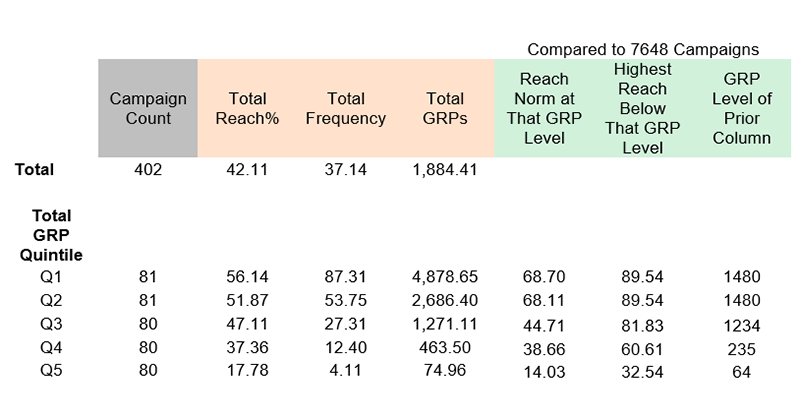
Note the Quintile1 line grouping 81 campaigns whose average GRP was 4879 (I will be rounding). The average reach attained by these 81 campaigns was 56%. The norm across 7648 campaigns for that GRP level is 69% reach. And the highest reach attained across 7648 campaigns at that GRP level or below was 90% - and that was achieved by a campaign which spent only for 1480 GRPs – 70% fewer GRPs (and dollars) to achieve 61% more reach.
What was it about this campaign that achieved reach so efficiently? This champion campaign utilized what I call 30/30/30/10 allocation to linear, CTV, mobile, and computer – which is my way of oversimplifying the pattern of approximately even allocation across the three device types that lend themselves to high reach, and a smaller but significant allocation to computers.
The campaign utilized dispersion across many publishers and platforms within each of the four device types.
In the new cross-platform reality, these are the two sacred keys to efficient reach.
There is still a lot of gold left in them thar hills – a lot more to learn about how to attain efficient reach. For example, note also in Quintile4 that there was a campaign with only 235 GRP which achieved a 61% reach – higher than the average reach of all the campaigns in the three Quintiles above it! 5% of the GRPs (and probably around 5% of the dollar investment) and 8% higher reach than the average of the 81 campaigns in Quintile1!
This campaign followed the dispersion rule but broke the 30/30/30/10 rule – it was mostly mobile with a smattering of the others – yet it achieved exceptional reach at very low investment. How? I suspect it was with a sophisticated optimizer that was able to find audiences that had not yet been reached, as it built the campaign in the optimizer itself. TRA used this incremental optimization technique, and Howard Shimmel at DataFuelX is using that approach.
Here is a collection of prior articles with more details on the vast array of data Nielsen ONE brings together, and the sophisticated ways they combine all that data, and more granular documentation on how to achieve maximum reach with fewest dollars across all forms of video and digital, although it all boils down to those two easily remembered keys to the kingdom.
There is more to be learned, however. Let’s take another look at the same data brick as we looked at above, but this time let’s look at frequency.
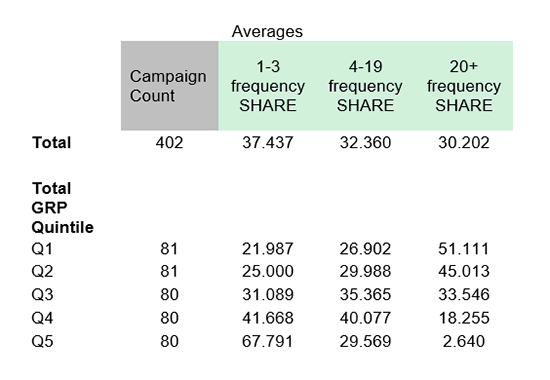
What the table above shows is the normal pattern of very high frequency escalating in relationship with the size of the campaign, and very low frequency decreasing as the size of the campaign grows. For example, in the bottom Quintile, in which the average GRP is 75, the average reach is 18%, and the average frequency is 4.1, 68% of people reached received only 1-3 opportunities to see, which most marketers might consider to be insufficient frequency.
Yet in Quintile1, where the averages are 4879 GRP, 56% reach, and 87.3 average frequency, only 22% of people reached received 1-3 frequency. If those people reached only 1-3 times are left out, the reach goes down from 56% to 44%.
As we build out our AI agentic tech stacks, wouldn’t it make sense to use addressable media to fill in those targets reached with insufficient frequency?
Looking at the problem of excessive frequency, this is scarcely a problem to be overly concerned about in Quintiles 4 and 5. But as campaigns get larger than that, the problem rapidly increases. In the top quintile, more than half of those reached are receiving more than 50 frequency. Of course, the degree to which this high level of frequency can be regarded as a problem depends on the length of the campaign (number of weeks), and also on the specifics of how closely together people tended to see the same ad.
It is time for all of us to get back to basics. We spend a vast percentage of our time passionately talking about new things but, as Erwin Ephron warned us, we are losing sight of the fundamentals.
The problem of excessive frequency can be solved by a combination of three methods:
- Use of an incremental optimizer.
- Use of addressable media to reach only unreached targets and targets reached with insufficient frequency, in the course of optimization and reoptimization inflight.
- Pooling media inventory together within a single ad insertion system so as to be able to actually implement frequency capping effectively. My colleagues and I have created the UltiMedia platform with tvbeat to make this an easy button to press. Currently available within the U.S. Spectrum, and through tvbeat in eight other countries.
Our podcast explores the topic of Being in the In-between Phase, a liminal stage of growth when we can feel disoriented, lonely, or frustrated, and why it’s also a powerful indicator that real growth is happening. Rather than rushing to “fix” the discomfort, this episode invites listeners to slow down, listen more deeply to themselves, and learn how to navigate uncertainty with trust, patience, and self-awareness.
This month’s podcast length is ≈46 minutes. Watch the Video
Posted at MediaVillage through the Thought Leadership self-publishing platform.
Click the social buttons to share this story with colleagues and friends.
The opinions expressed here are the author's views and do not necessarily represent the views of MediaVillage.org/MyersBizNet.

Bill Harvey
Bill Harvey, who won an Emmy® Award in 2022 for his invention of set top box data, has spent over 35 years leading the way in media research with pioneer thinking in New Media, set top box data, optimizers, measurement standards, privacy standards, the A…