
Reach and CPM Guarantees Work Against Brand Growth

Agencies did not put reach and sex/age CPM guarantees into their own contracts until the late 1990s, under pressure from the procurement function advertisers had introduced earlier that decade.
Thirty years later, advertisers fire agencies for failing to produce year-over-year brand sales growth.
Yet the contracts still pay agencies for delivering guaranteed reach and CPM, neither of which produces growth on its own. The agency hits both numbers, collects, and keeps the account — and the brand can still go nowhere. We are paying for the thing we can measure and firing over the thing we apparently think we can’t.
Change comes slowly to marketing. Possibly because the C-suite has long regarded it as tax-deductible gambling — a cost you book, a bet you place, and rarely a line you can trace to a return.
Marketing Science never quite earned its name. That is finally changing, through neuroscience, biometrics, big data, agentic AI, data science, RMT’s findings on motivation, clean rooms, addressable advertising, optimization, better econometric modeling and identity graphs. The tools to connect spend to outcome now exist. The contracts have not caught up.
In a previous article, I drew on company annual reports to argue that brand growth over the past 15 years has become somewhat like teenage sex once was: everyone talks about it, very little of it goes on.
Here is the underlying data, compiled by Dr. Augustine Fou from earlier work he credits to Michael Farmer. Fou notes that anything under 2.7% is not growth at all, because inflation ran 2.7% across the period.
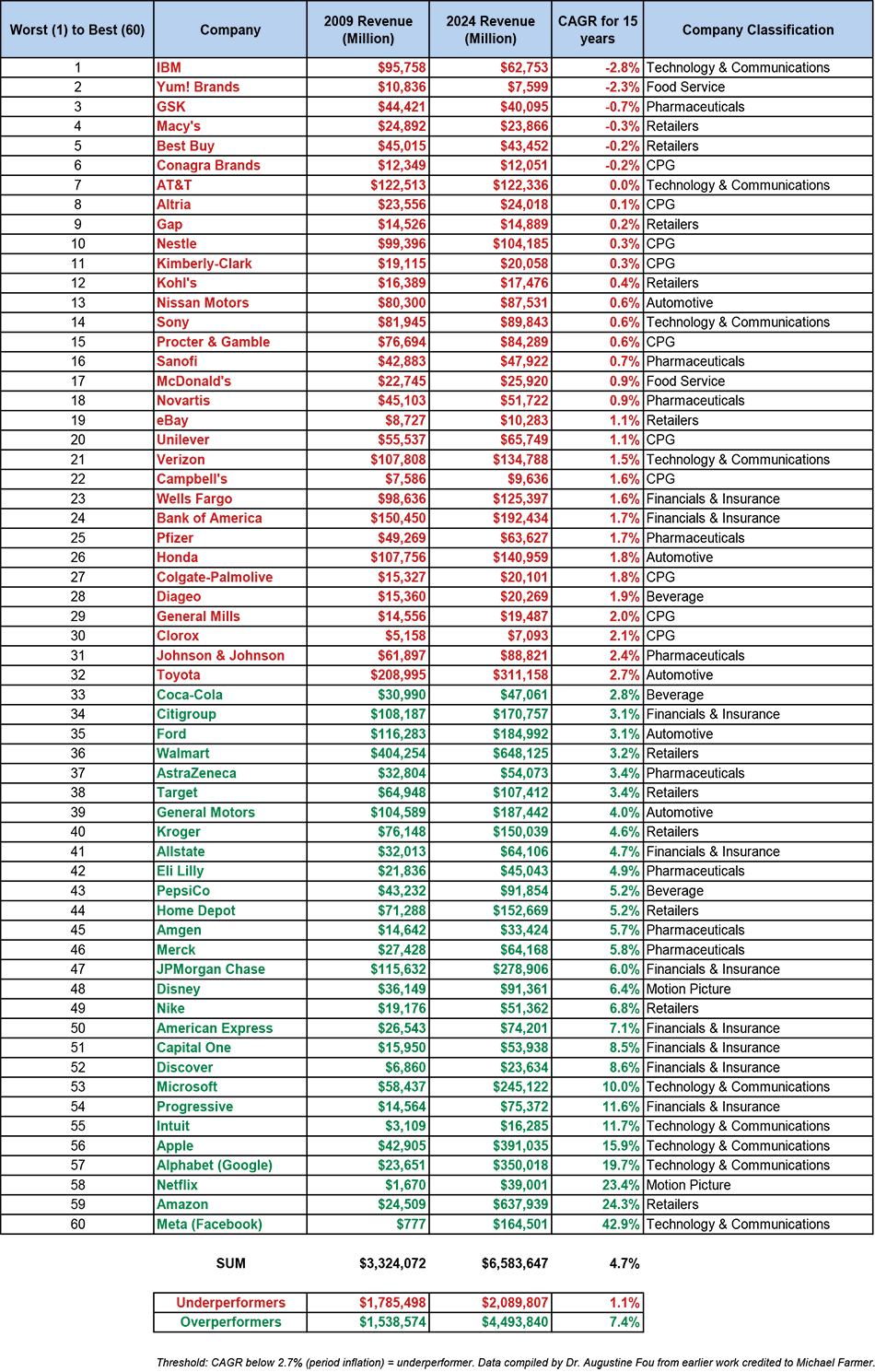
Over 15 years, real organic brand growth ought to run at least 5%–7.7% in the table above, once inflation is added back.
Only two kinds of companies clear that bar. Tech: Meta, Amazon, Netflix, Google, Apple, Intuit, Microsoft. Finance and insurance: Capital One, Discover, Progressive. Two categories, out of sixty companies — and neither got there on the strength of a reach guarantee.
Why?
The reasons are undoubtedly many. Two seem central: an overshift to digital, and agency contracts that incentivize the wrong things.
The first is a longer argument. The second can be fixed now.
Step One: Remove the CPM guarantees.
The reach guarantee already functions as one. Overpay on CPM and reach suffers. Should an agency somehow pay higher CPMs and still hit its reach number, what drops is frequency — and that may be a good thing.
With a supertarget agreed to above the reach guarantee, the agency optimizes for reach and for whatever else the client names. Year-over-year brand sales growth, for instance. Name the outcome, and the agency’s best efforts follow it.
Step Two: Put teeth in it.
The advertiser pays a bonus scaled to growth delivered: 0.1–1%, 1.1–2%, and upward from there. The better the growth, the better the agency does. Incentive and objective, finally pointing the same way.
Combine the two steps, or take them a year apart.
Either way, pay for the outcome you fire agencies for missing.
Understanding the seasons of growth: why contraction & expansion are part of the process. This podcast discusses how growth is not a linear path but a series of seasons: from the 'winter' of shedding old identities and habits to the 'summer' of external expansion and aligned opportunities. It also addresses the common tendency to resist these cycles, explaining how fighting a contractive season only leads to further frustration and prolonged stagnation. Learn more about the power of curiosity: how asking questions can help pull you out of apathy and move you toward progress during difficult times; the art of detachment - Bill explains the hidden switch of letting go, to better enjoy the process of living. Podcast length: 55 minutes. Watch the Video.
Posted at MediaVillage through the Thought Leadership self-publishing platform.
Click the social buttons to share this story with colleagues and friends.
The opinions expressed here are the author's views and do not necessarily represent the views of MediaVillage.org/MyersBizNet.

Bill Harvey
Bill Harvey, who won an Emmy® Award in 2022 for his invention of set top box data, has spent over 35 years leading the way in media research with pioneer thinking in New Media, set top box data, optimizers, measurement standards, privacy standards, the A…