
The Gracenote Census of World Video Content Fuels AI

In my September 10 post, I reported using Nielsen data that “Looking at Magna numbers for 2025, total U.S. ad spend in 2025 on all video combined will be $111.1 billion out of a total of $397.7 billion, making video only about 27.9% of total ad spend. This seems somewhat absurd when compared with the data above, which shows that video captures 57.7% of time spent with electronic media.”
Video usage is even far more popular in the world than romance on a time spent basis, although I was unable to find any data on that. Glamourdid survey women and found that if they had their druthers they would spend 106 minutes a day on romance, which would still fall far short of video’s 318 minutes per day for the average US adult which Nielsen found in my earlier article (Q2 2025).
Given the dominant affection of 8 billion people for this attention-seizing, emotion-causing, immersive medium, it was inevitable that someone would take up the cudgel of trying to maintain a census of all the video content in the world, to append intelligent metadata to it all, to analyze and trend it. Gracenote stood up, volunteered, and is doing this.
I’ve occasionally reported useful findings from Gracenote (to which I have access through my consulting for Nielsen, which owns Gracenote). A lot of new findings and developments to be reported here today. More complete reporting from Gracenote is here.
First question: how much video content is there? 40+ million titles in 260+ streaming catalogs in 35 languages and 80+ countries. That’s what’s in Gracenote’s database. There’s a bit more, which Gracenote will one day uncover and add, not to mention the great volume created every day.
The biggest, most obvious change in the marketplace today is the shift to streaming as the preferred method of distribution. Preferred by whom? Well, certainly preferred by those who are offering streaming channels, but also the general viewing public has fallen in love with streaming, so that the future of the video medium is indeed glowing with guaranteed opportunity.
Gracenote’s latest six-country survey (2025) finds that 73% of respondents who use streaming services strongly or somewhat agree with the statement that they “love their experience with their streaming services”. There’s a catch, though: more than 46% of streaming viewers agree that it‘s getting harder to find the content they want to watch because there are too many streaming services. 49% say they would consider cancelling a service because they can’t find something to watch.
This has been a problem for some time. In 2019, Ericsson conducted a 24-country study and found that it was taking people an average of 23 minutes a day to consult program sources. Their report commented that this is 1.3 years out of a person’s life who dies at 80.
Gracenote’s latest study in 6 countries finds that the average is 14 minutes. The one outlier is France, where the average is still up at 26 minutes. Could it be that they’re not using the Gracenote metadata enough? In the U.S., the number in 2025 is 12 minutes, up from 10.5 in Gracenote’s mid-2023 study.
A related finding from LG is that when viewers turn on their TV set, they stay on the home page deciding what to watch for an average of just under 10 minutes. This compares with a mid-1990s stat from the TV Guide Channel, which reported that viewers stayed on their channel an average of four minutes before deciding what to watch. The obvious difference, of course, is the far greater range of choice today. Less obvious is that the 1990s environment was self-contained, vs. one today that is not. There is not one single environment to house everything, which has massively complicated content discovery.
Because people tend to stick to what they know, just 6% of streaming content accounted for over 75% of streaming viewing minutes in April 2025. (Nielsen Gauge and Gracenote) Obviously, content marketers need to provide mechanisms for getting users to fan out and use more of the content territory within each streaming service. Otherwise, they increase the risk of churn, as people become saturated with the content they know.
In order to help the industry deal with these challenges, Gracenote has invested in Model Context Protocol (MCP) database servers, built to ground AIs seeking hard data with which to respond to user prompts, so that the AIs deliver accurate guidance to viewers, saving them perhaps the majority of time they now spend deciding what to view next. Gracenote provides these examples of easy ways viewers can use AI to greatly shorten the amount of time they spend deciding what to watch, so they can spend more time watching what they want to watch.
Here are three key use cases where the MCP server can deliver more robust video experiences:
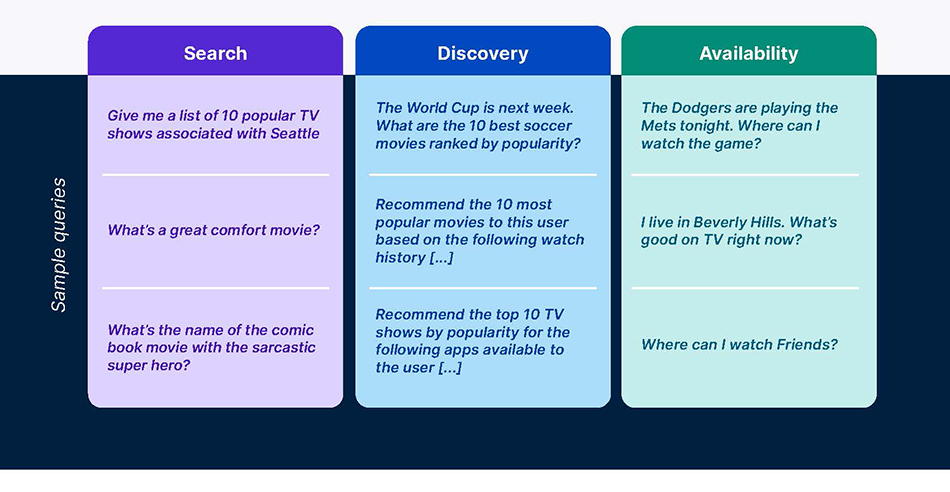
As viewers become used to using AI in this particular use case, we might see less time spent searching and increased overall enjoyment of the beloved video medium.
Posted at MediaVillage through the Thought Leadership self-publishing platform.
Click the social buttons to share this story with colleagues and friends.
The opinions expressed here are the author's views and do not necessarily represent the views of MediaVillage.org/MyersBizNet.

Bill Harvey
Bill Harvey, who won an Emmy® Award in 2022 for his invention of set top box data, has spent over 35 years leading the way in media research with pioneer thinking in New Media, set top box data, optimizers, measurement standards, privacy standards, the A…