
The Industry Optimizes Campaigns in Pieces. Consumers Experience Them as Systems.
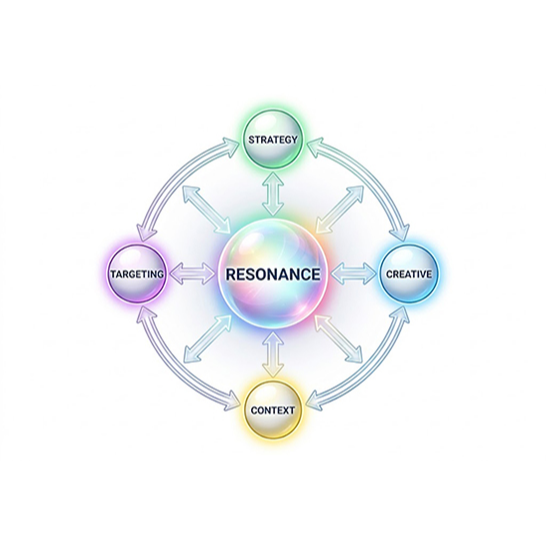
For decades, the advertising industry has worked diligently to improve campaign performance by refining one variable at a time.
Audience targeting became more precise. Creative testing became more sophisticated. Contextual targeting became more intelligent. Attention measurement became more granular. Attribution systems became more complex.
Each advancement moved the industry forward.
And yet, despite all this innovation, one uncomfortable truth remains:
Most campaigns are still being optimized in fragments, while consumers experience them as integrated systems.
A human being does not separate an ad into independent components while watching television, streaming video, browsing digital content or scrolling social feeds. The brain does not isolate audience from creative, creative from context, or context from strategy. It processes them simultaneously, emotionally and subconsciously, as a unified experience.
That distinction matters far more than our industry has historically acknowledged.
Today’s advertising ecosystem is filled with highly capable companies that each solve important pieces of the puzzle. Some specialize in attention. Others in contextual intelligence. Others in audience segmentation, attribution, media mix modeling or creative scoring. Many of these firms provide meaningful value and have advanced the state of measurement considerably.
But most are still fundamentally optimizing one or perhaps two dimensions of campaign effectiveness at a time.
That creates a structural limitation, because persuasion itself is not created by isolated variables. It emerges from alignment.
At RMT, we refer to this alignment framework as the Resonance Stack: the integrated dynamic interaction between Audience, Creative, Context and Strategy.
The industry has traditionally treated these variables as adjacent disciplines. In reality, they are interdependent neurological inputs contributing to a single subconscious response system.
And when those inputs align motivationally, performance changes materially.
Years of work within RMT on Neuro-Motivational Resonance have led us toward a simple conclusion:
The future of advertising effectiveness lies less in optimizing isolated signals and more in optimizing motivational alignment across the entire Resonance Stack - audience, creative context, and strategy.
This has particular importance for creative.
Historically, creative effectiveness has often been evaluated through recall, stated preference, emotional response or post-exposure surveys. Those methodologies can absolutely provide useful directional insight. But they also tend to measure conscious reaction after the fact.
The brain’s persuasive processing largely occurs before conscious articulation.
A consumer frequently cannot fully explain why one message resonates and another does not. Yet the neurological response difference can be substantial.
This helps explain why campaigns with similar media weights, similar targeting, and similar attention levels can produce radically different business outcomes.
The missing variable is often motivational resonance.
Not whether the ad was seen or whether the audience technically matched, but whether the total experience aligned with subconscious motivational architecture.
Importantly, this does not mean every campaign should seek the same type of resonance.
Different products, categories, and objectives activate different motivational systems.
Historically, integrating Audience, Creative, Context and Strategy simultaneously was extraordinarily difficult operationally. The industry, therefore, evolved specialized point solutions around each domain independently.
That evolution made sense.
But advances in AI, computational modeling, and neuroscience-informed systems are now making integrated optimization increasingly achievable.
This is where the next era of advertising effectiveness may begin to emerge.
The companies that thrive in the next phase of advertising effectiveness will likely not be those that optimize one signal best in isolation.
They will be the companies capable of orchestrating the full Resonance Stack together.
Because consumers never experienced advertising in fragments to begin with.
Only the industry did.
Understanding the seasons of growth: why contraction & expansion are part of the process. This podcast discusses how growth is not a linear path but a series of seasons: from the 'winter' of shedding old identities and habits to the 'summer' of external expansion and aligned opportunities. It also addresses the common tendency to resist these cycles, explaining how fighting a contractive season only leads to further frustration and prolonged stagnation. Learn more about the power of curiosity: how asking questions can help pull you out of apathy and move you toward progress during difficult times; the art of detachment - Bill explains the hidden switch of letting go, to better enjoy the process of living. Podcast length: 55 minutes. Watch the Video.
Posted at MediaVillage through the Thought Leadership self-publishing platform.
Click the social buttons to share this story with colleagues and friends.
The opinions expressed here are the author's views and do not necessarily represent the views of MediaVillage.org/MyersBizNet.

Bill Harvey
Bill Harvey, who won an Emmy® Award in 2022 for his invention of set top box data, has spent over 35 years leading the way in media research with pioneer thinking in New Media, set top box data, optimizers, measurement standards, privacy standards, the A…