What happens when a podcast co-host becomes the interviewer, the other becomes the guest, and the subject is a book that challenges both of them to reconsider what it means to lead, learn, and create?
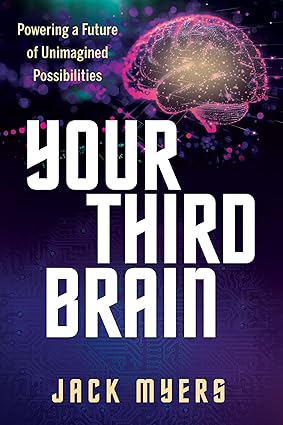
In this special episode of Lead Human, Tim Spengler interviews Jack Myers about his new book, Your Third Brain: Powering a Future of Unimagined Possibilities. Tim came to the conversation not simply as Jack’s co-host, but as a thoughtful reader. He had spent a month with the book, highlighting passages, questioning its ideas, and identifying the concepts that remained with him after he finished.
His conclusion is direct: “I recommend the book. It will open your mind.”
Watch the full conversation at youtube.com/@leadhuman, listen on all major podcast platforms, or find direct links at Lead-Human.com. Then read the book Tim says will open your mind and join the urgent conversation about how we become more human alongside intelligent machines.
Tim begins with the question every reader is likely to ask: What exactly is the third brain?
Jack explains that the first brain is our biological intelligence, shaped by memory, emotion, intuition, experience, and imagination. The second brain is the connectivity created by social media, digital networks, information, communities, and culture. The third brain is the next stage: the co-intelligence that emerges when human intention, judgment, and emotion work collaboratively with AI’s speed, scale, and generative power.
The third brain is not an app, device, or implant. It is a human capability we must consciously develop.
Tim then focuses on the three principles he considers central to the book: presence, discernment, and the pause. Jack describes presence as becoming conscious of what is happening before reacting. Discernment is the ability to decide what deserves our attention, what we should believe, and how we should respond. The pause creates the space for both.
“The pause may become the most important human technology of the AI age,” Jack tells him. As machines accelerate, our responsibility is to slow down when judgment, verification, or emotional restraint is required. Tim relates this insight to his own experiences with AI, especially the need to stop and question answers that sound convincing but may be wrong. Their exchange reveals that the pause is both intellectual and emotional.
Another of Tim’s questions explores Jack’s distinction between AI as a mirror and as a reflector. A reflector can redirect our thinking, reveal a contradiction, challenge an assumption, or surface a possibility we had not considered. The danger is mistaking a flattering reflection for truth. The opportunity is allowing AI to help us see ourselves more honestly.
The conversation becomes especially urgent when Tim asks how leadership must change. Jack argues that leadership with AI is not primarily about mastering another tool. It is about deciding which human qualities we refuse to surrender. AI can analyze options, summarize research, and recommend decisions, but it cannot accept moral consequences, look at an employee or client in the eye, or assume accountability.
Tim was particularly drawn to Jack’s description of the leader as a “Harmonizer,” someone capable of integrating competing human and machine voices into balanced, purposeful direction. He also presses Jack on “knowing and unknowing.” Jack’s provocative response is that experience can become a prison: 30 years of experience may sometimes be one year repeated 30 times. Learning fills the mind; unlearning opens it.
Their discussion moves from leadership to creativity and Jack’s belief that “AI creator” must become a recognized identity. Authorship cannot be judged only by examining a finished work. The more important questions are who originated the idea, supplied the intention, challenged the output, made the consequential choices, and accepted responsibility.
Your Third Brain reached #6 on Amazon’s AI technology bestseller list because it speaks directly to today’s deepest uncertainty. It does not ask whether machines will become more intelligent than humans. It asks whether our relationship with them will make us more intelligent, humane, and capable, or simply more dependent.
Tim’s questions offer an engaging entry point. Jack’s answers provide only the beginning.
Watch the full conversation at youtube.com/@leadhuman, listen on all major podcast platforms, or find direct links at Lead-Human.com. Then read the book Tim says will open your mind and join the urgent conversation about how we become more human alongside intelligent machines.