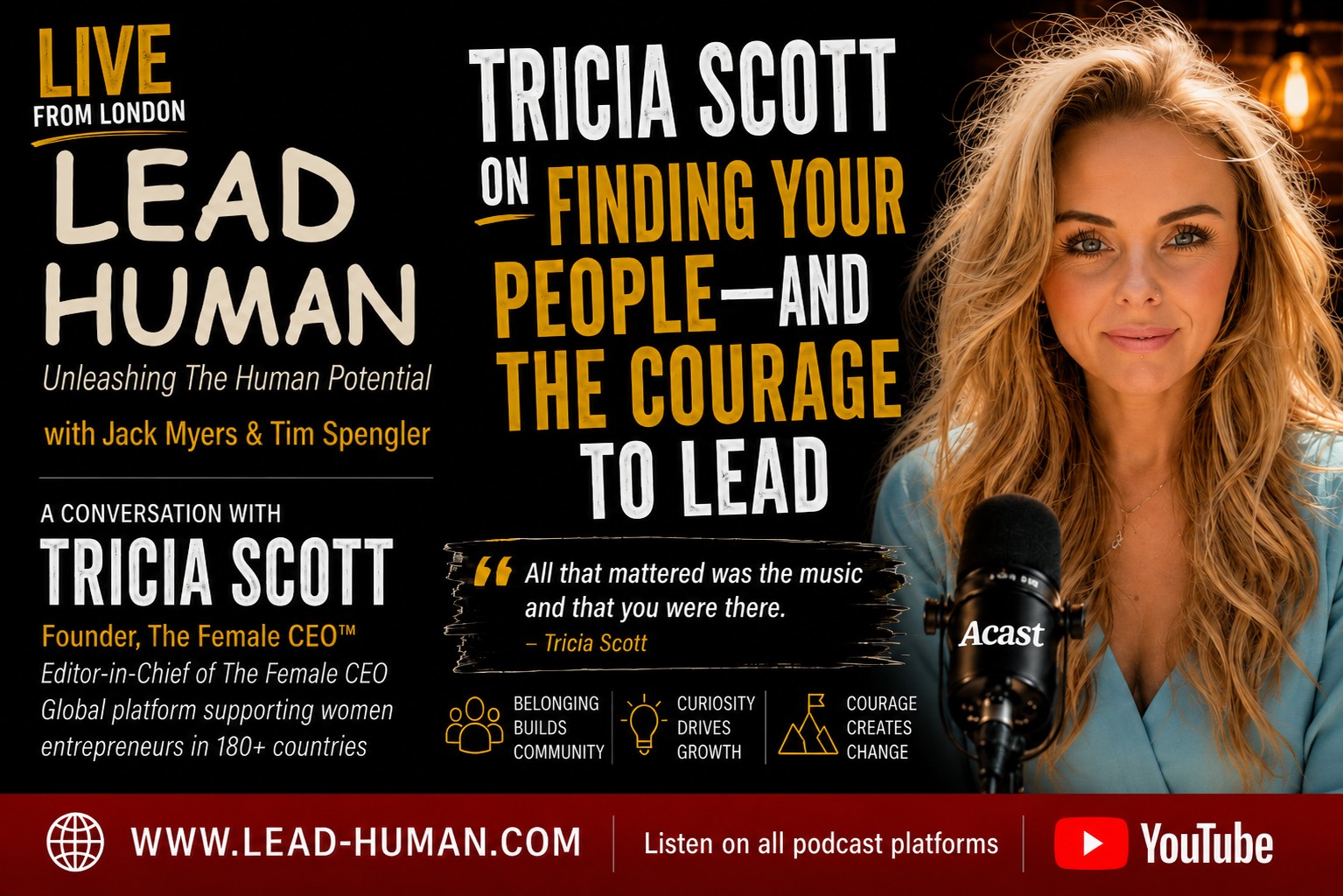
Asked what heavy metal taught her about being human, Tricia Scott never talked about the music itself. She talked about belonging. View and listen at your preferred platform.
Leadership conversations rarely begin with heavy metal music. Yet in the latest episode of Lead Human with Jack Myers and Tim Spengler, taped at the London Acast studio, that unexpected opening reveals far more than a discussion about musical taste. It becomes the thread that ties together Tricia Scott's journey from corporate executive to founder of The Female CEO™, a global platform that now reaches women entrepreneurs in more than 180 countries.
Asked what heavy metal taught her about being human, Tricia never talked about the music itself. She talked about belonging. View the full video at www.lead-human.com, Lead Human - YouTube, and listen at your preferred podcast platform.
Growing up, she described herself as the proverbial square peg in a round hole. School never fit. Rules rarely made sense. Like many entrepreneurs, she wasn't driven by rebellion as much as curiosity, constantly asking why things had to be done a particular way. It wasn't until she walked into a Newcastle rock club as a young woman that she discovered something she hadn't expected.
"I'd found a place," she recalled. "Everybody was so accepting. It didn't matter what you wore or how much you earned or what you did. All that mattered was the music and that you were there."
Jack Myers observed that the absence of rules seemed to define the culture she loved. Tricia agreed, explaining that what attracted her wasn't chaos but the freedom to stop performing and simply be herself. Looking back, it becomes clear that this search for belonging eventually became the foundation of her life's work.
The Female CEO did not begin with a business plan. It began with vulnerability.
After spending two decades directing a successful property company, Tricia launched a small side business to solve an operational problem she encountered every day. Creating the solution was easy. Building the business was not. For the first time in years, she found herself feeling anything but competent.
"I went from feeling like a really capable person to feeling ridiculous all of the time," she told Jack and Tim. "I kept thinking, why can't I figure this out?"
Unable to admit those doubts publicly, she started an anonymous blog. She intentionally buried it deep on the internet, convinced no one would ever read it. Instead of presenting herself as an expert, she wrote honestly -- and often humorously -- about the mistakes she was making while trying to become an entrepreneur.
Then one woman in America found it.
Her comment changed everything.
"I thought I was the only one," the reader wrote before sharing her own story of uncertainty.
Soon other women joined the conversation. What Tricia thought was a personal journal became a place where women could admit what few were willing to say aloud: none of them had everything figured out. The community that grew from those conversations eventually evolved into today's Female CEO platform, which includes a digital magazine, a thriving entrepreneurial community, and resources that help thousands of women build businesses with greater confidence and authenticity.
Perhaps the most important lesson from Tricia's story is that leadership often begins when we stop pretending we have all the answers.
That theme surfaced repeatedly throughout the conversation. When Tim described her as restless, she gently corrected him.
"I'd say curious," she replied. "I've got a constant curiosity for what could be."
That distinction says everything. Curiosity keeps leaders learning. It creates room for better questions, stronger relationships, and continuous growth. Confidence has value, but curiosity keeps confidence from becoming certainty. In an era shaped by rapid technological change and artificial intelligence, that mindset may be one of the most valuable leadership qualities we can develop.
It also explains why Tricia chose a different meaning for the letters CEO.
For her, CEO stands for Create. Evolve. Overcome. Entrepreneurship is never a destination, she explained. We create something, evolve as circumstances change, overcome the inevitable obstacles, and then begin creating again. It is a continuous cycle rather than a finish line, a philosophy that reflects both business and life.
The emotional heart of the conversation arrives when Tricia reflects on the sudden loss of her father. What began as a routine phone call became an eleven-day hospital journey that ended with his death at just sixty-four years old. During those difficult days she watched Brené Brown's The Call to Courage and heard a sentence that permanently changed her perspective.
"Every day you must choose courage over comfort."
When she returned to work after his death, she looked around the office she had spent two decades helping to build and experienced what she describes as complete clarity. Life was too short not to pursue the work that mattered most. Leaving a secure executive career to devote herself fully to The Female CEO was not an impulsive decision. It was the result of recognizing that purpose cannot indefinitely wait for the perfect moment.
The conversation concludes by turning toward a challenge many leaders now face: how to remain relevant in a world increasingly shaped by AI and accelerating technological change. Jack asked what advice she would give to someone in their fifties or sixties who suddenly feels left behind.
Her answer reflected everything she had shared throughout the discussion.
"Get yourself into a community," she said. "Don't be afraid to ask. I guarantee you people are waiting to help you."
It is deceptively simple advice. Communities create confidence. Curiosity creates learning. Honest questions create opportunity. Those same principles transformed an anonymous blog into an international movement.
Tim Spengler captured the essence of Tricia's leadership in his closing observation. Every significant moment in her story began with action. Rather than waiting until she felt fully prepared, she took what he called a consistently proactive approach to life. Tricia smiled and offered what may be the episode's lasting takeaway.
"Messy action every time. Just do it. You'll be fine."
For leaders navigating uncertainty, that message may be exactly what is needed today. We spend enormous energy trying to appear capable when what people often need most is permission to learn, to ask, to evolve, and to belong. Tricia Scott reminds us that leadership is not about projecting certainty. It is about creating spaces where others feel safe enough to discover their own potential.
View the full Lead Human video at www.lead-human.com, Lead Human - YouTube, and listen at your preferred podcast platform.