
Wharton AI/Neuroscience: A Large Part of the Power of the Creative Comes from the Context
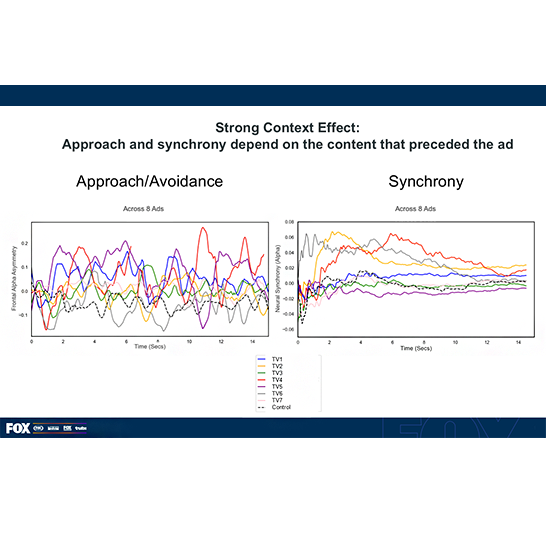
Wharton has merged its Neuroscience Department into its AI Department for maximum cross-fertilization between these two related cognition sciences. “My” company RMT is in a long-range partnership with these teams to bring new marketing platforms to marketers, aimed at a major infusion of science to increase year over year (YOY) brand sales revenues which have slowed for many major brands in the past dozen years or so.
The two line graphs above came out of the FOX BHC Wharton study reported here earlier. Each line is an average of 8 ads across 8 major verticals, and each color represents a different television program environment. What these graphs show is the two key EEG (electroencephalograph) brain measures most predictive of an ad’s sales effects. If context had zero impact on the sales effect of a creative execution, each of the graphs above would seem to have a single multi-colored line, because all of the environments would have the same scores. Instead, what we see is that context has a very major sway on the sales effect of the same creative execution.
But we didn’t know just how major that effect really is. The latest findings fresh from the lab, reported here today, clarify the size of the influence. It appears that the creative’s power is truly unlocked by the total experience of the creative in the specific context.
The study was conducted by Xiangyu Jiang, a research specialist with Wharton Neuroscience Initiative, under the supervision of Dr. Michael Platt, Director of the Wharton Neuroscience Initiative, building on foundational work performed by Jin Ho Yun, a former postdoctoral researcher with Wharton Neuroscience who is now an Assistant Professor of Marketing at New Mexico State University. An AI platform was created to take video and audio measurements of certain proprietary dimensions of video content so as to estimate the degree to which human brains will tend to produce positive neural response. This AI Agent is called HBDT, which stands for Human Being Digital Twin. It has been programmed and trained using data from 540 human subjects to give the same response as a human brain would give.
In a first trial of the HBDT, it was given the task of predicting the market stock price of the brand based on the ad. This is, of course, an ambitious target to aim for so early in the game. The ad first has to get into the mind, and then change brand value perceptions, cause behavior change resulting in sales increases, which then affect stock prices. A whole chain reaction where the ultimate endpoint of brand equity increase is attempted to be predicted based on advertising which is, of course, not the sole cause impinging upon sales nor upon stock price.
Why, then, was stock price used? Simply because the data are readily available. Many ads can be run through the HBDT and all of their stock prices are readily available to anyone.
This is only the beginning of a journey that will get a lot more complicated quickly enough. The purpose of this first trial was to dip the toe in the water to take its temperature. Would it work at all? How well would it work? What will we learn from it that can help us take the next baby steps?
The metric derived from the HBDT in this experiment was called Elasticity Value (EV), essentially a measure of the upward response of stock price.
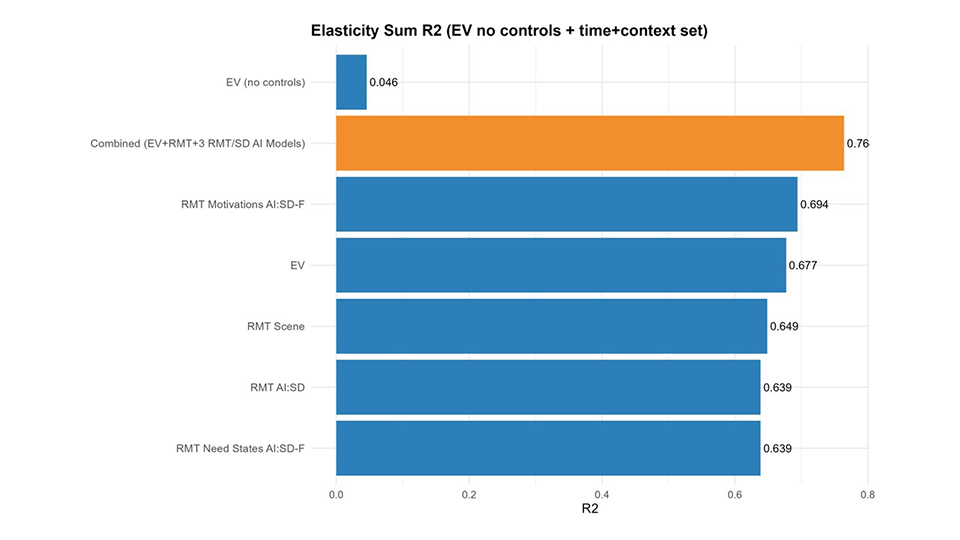
In the first pass, the ad itself was scanned by HBDT without any context. This showed a positive correlation with stock price, but a very weak one: an r2 of 0.046.
This was promising, but also a bit disappointing. It was then decided to bring in the context and the ad length as additional controls. This caused the HBDT EV score to shoot up more than an order of magnitude to 0.677.
The HBDT EV, having learned from the RMT context effects on the 540 human subjects, and adding more proprietary AI science on top of RMT, slightly surpassed the Human Intelligence-based RMT Resonance scoring which achieved 0.649 (“RMT Scene” in the chart below). Three other AI approaches developed based on RMT semantic structure by RMT and Wharton partner Source Digital clustered around the same range.
When all of these AIs were added together, the result was r2 of 0.760. This is a very high degree of predictive ability at such an early stage of development, suggesting that the combined platform could be introduced into alpha client usage soon.
What this tells us is that the context helps make the creative work to an even greater degree than suspected before.
The RMT basic premise is to start with the ad and select contexts that will maximize the sales effect of the specific ad because of having many of the same motivational value signals in the context as are in the ad.
RMT’s second premise is using addressable media to find people most likely to positively resonate with the specific ad based on the motivational value signals in the content they consume as measured by passive means (persistent anonymized ID browser, set top box, smart TV data).
All of the bars except the top one in the chart below have RMT in them in one form or another. The teams are working together to obtain the most powerful solution for marketers which can quickly and efficiently scale to cover all ads for advertisers of all sizes in all countries.
Our new podcast explores the topic of Being in the In-between Phase, a liminal stage of growth when we can feel disoriented, lonely, or frustrated, and why it’s also a powerful indicator that real growth is happening. Rather than rushing to “fix” the discomfort, this episode invites listeners to slow down, listen more deeply to themselves, and learn how to navigate uncertainty with trust, patience, and self-awareness.
This month’s podcast length is ≈46 minutes. Watch the Video

Bill Harvey
Bill Harvey, who won an Emmy® Award in 2022 for his invention of set top box data, has spent over 35 years leading the way in media research with pioneer thinking in New Media, set top box data, optimizers, measurement standards, privacy standards, the A…