
Wharton Neuroscience: RMT Is the Only Statistically Significant Predictor of EEG Synchrony
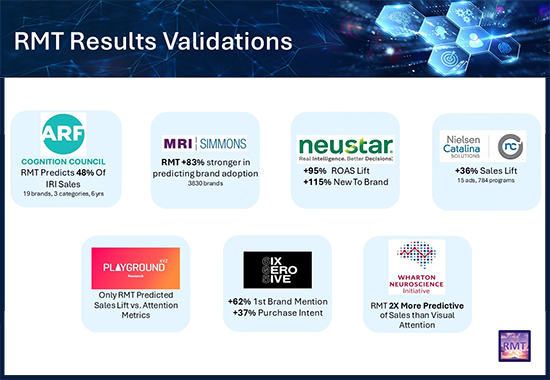
Electroencephalogram (EEG) Synchrony is when all the brains in the sample are moving in virtual lockstep millisecond by millisecond in the Alpha wave band. Wharton Neuroscience has, with major advertisers over several years, proven that EEG Synchrony is the most predictive brain measure of the in-market sales effect of an ad, with a correlation of 0.91.
Now, as part of a FOX-sponsored EEG study of context effects, Wharton Neuroscience has found that the best predictor of Synchrony is RMT ad-context Resonance scores. The RMT correlation with Synchrony in the study achieved statistical significance at 95% confidence. None of the other predictors tested achieved statistical significance.
RMT beat several other EEG metrics, including EEG Approach (Frontal Alpha Asymmetry), EEG Memory (Theta Power Spectral Density), and EEG Attention (Alpha Suppression).
RMT also beat eye-tracking attention with and without eye fixation measurement.
RMT also beat verbal measures of ad recall and persuasion.
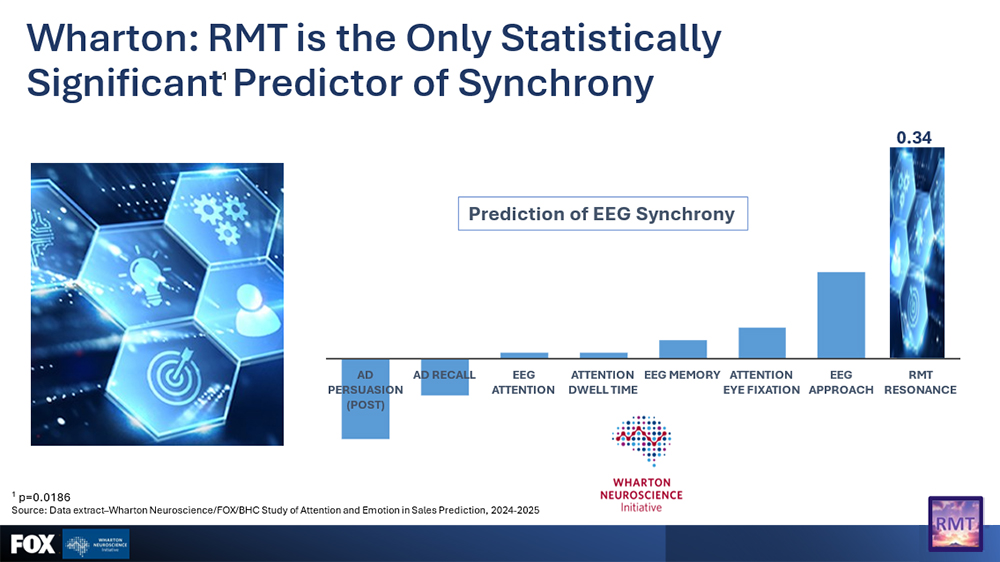
This did not come as a complete surprise, because earlier studies by NCS, 605, Neustar, and others had shown that RMT, when used in media selection to improve the resonance of your specific ad with the viewer and/or with the media context, the increase in sales lift was +36% to +95%, and the ARF Cognition Council’s study found that the Adjusted R Squared of RMT Motivations as a predictor of six years of IRI sales data for 19 brands was a hefty 0.48. Simmons found that adding RMT increased brand adoption predictivity +83% over demographics alone.
Why would RMT predictive metrics work so well? It was because the metrics were empirically derived.
Using a suggestion by the late, great Dr. Timothy Joyce, my colleagues and I started from every word in the English language, and, using semantic differential and factor analysis, empirically distilled the list down to 1562 words that when used as metadata on TV programs, enabled my 1990s company Next Century Media (NCM) to “paint people with the psychological attributes of the programs they watch”.
NCM then used a program recommender to recommend programs most similar to a person’s profile. The recommender used ML (machine learning) to reduce 1562 words down to the 265 that had all the power to predict program adoption, which increased 6X from 3% to 18%.
Simmons then found that the same 265 words also work for brand choice as well as program choice.
Wharton Neuroscience Director Dr. Michael Platt hypothesizes that these 265 words are actually the meanings of the electrochemical Value Signals (VS) found in the brain during choice behavior.
AI has been a central feature in the RMT adventure since 1997. The original AI was a rudimentary proprietary system I designed, far from the power of today’s LLMs. Machine learning is of course another form of AI. In RMT’s work with Semasio, now part of Samba, RMT comes through the Semasio semantic AI.
Wharton has now introduced an AI which RMT has been invited to fuel. Wharton’s AI uses computer vision and voice-to-text analysis to which RMT predictive metrics will be added. The AI scans video ads to predict their sales power.
These latest developments are only a week old and events in the RMT Wharton story seem to be accelerating, so watch this space for more.
Posted at MediaVillage through the Thought Leadership self-publishing platform.
Click the social buttons to share this story with colleagues and friends.
The opinions expressed here are the author's views and do not necessarily represent the views of MediaVillage.org/MyersBizNet.

Bill Harvey
Bill Harvey, who won an Emmy® Award in 2022 for his invention of set top box data, has spent over 35 years leading the way in media research with pioneer thinking in New Media, set top box data, optimizers, measurement standards, privacy standards, the A…