New data shows America's most influential financial planner may not have a license, an office or a book of clients. It may be YouTube.
YouTube Is Becoming the Front Door for Financial Research
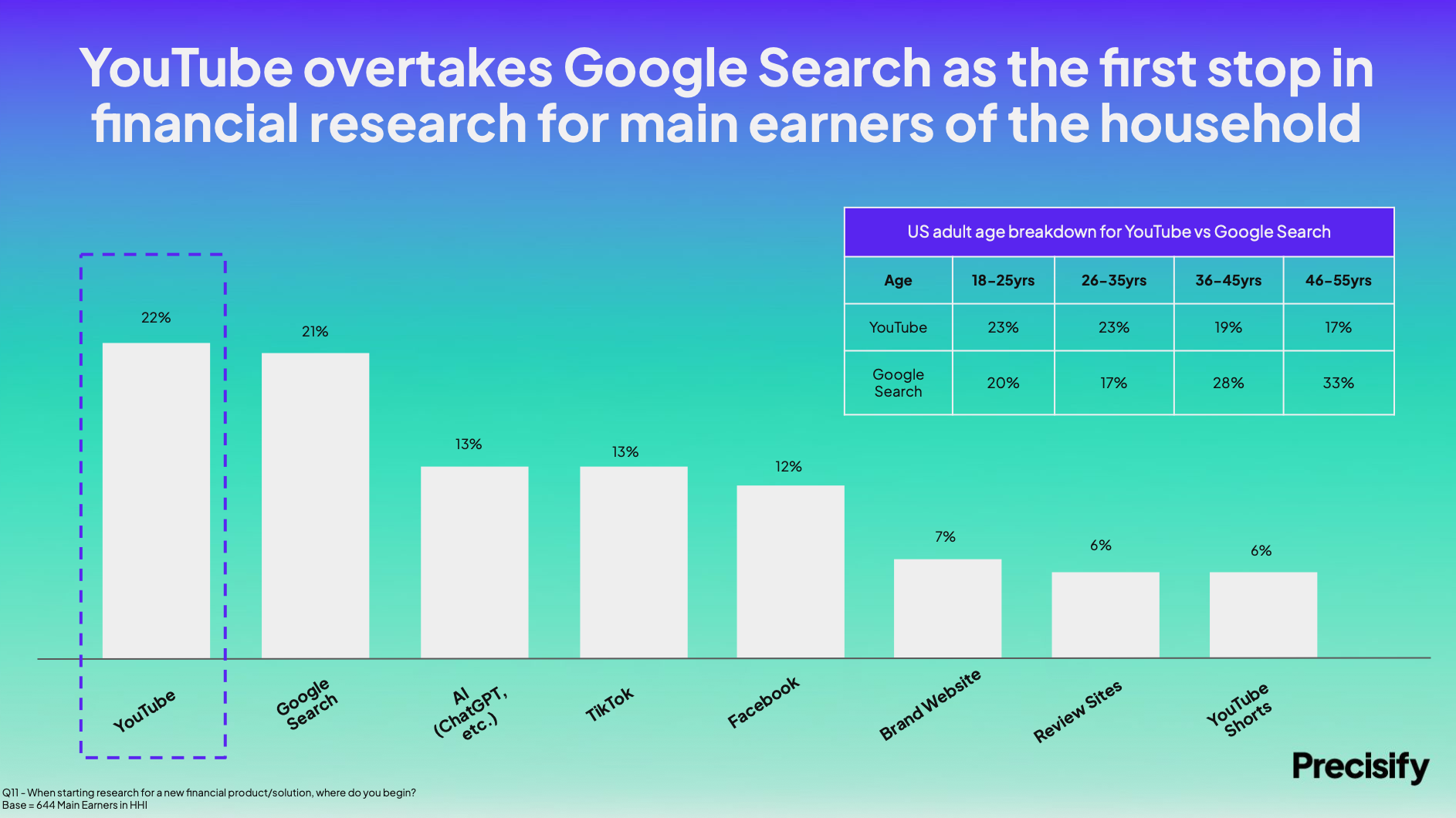
Ask a main household earner where they start researching a new financial product, and the most common answer is no longer a search box. It's YouTube. In Precisify's Finance 2026 study - a survey of 1,000 U.S. adults ages 18-55, with several questions focused on the 644 main household earners among them - 22% named YouTube as their starting point, edging out Google Search at 21%, with AI tools and TikTok at 13% each and brand websites trailing at just 7%.
One percentage point does not mean search is dead. But it means video has reached parity with the search box as the front door to a serious financial decision (and the brand's own website is nowhere near the front of the line).
This is not a fringe habit. More than half of U.S. adults (53%) watch YouTube weekly, more than Facebook, Instagram or TikTok. Among people who engage with finance content specifically, 29% watch daily and another 26% watch two to three times a week, mostly on weekday evenings. That last detail matters: financial content is not something people look up in a moment of crisis. It has become programming.
The Decision Happens Before the Website Visit
Seventy-two percent of main household earners have used YouTube to compare financial products, and the use cases tie directly to revenue: 35% for evaluating investments, 27% for credit cards, 22% each for opening accounts and researching insurance. Asked what would most likely influence a new financial decision, "doing my own research on YouTube" ranked first for nearly every age group—ahead of finance influencers, friends and financial experts. And when main earners were asked which source they trust most for financial advice, YouTube at 17% beat financial advisors at 15%.
By the time these consumers reach a bank's website, they have often already learned the category, compared the providers and built a shortlist. The website may be where the application happens, but YouTube is where the decision happens.
The Story Layer Is the New Battleground
The strategic implication is that financial brands need to show up where the story is being told—and right now, that means YouTube, video podcasts and creators. Half of all adults prefer YouTube for financial how-to content, a preference that holds from Gen Z (48%) through the 46-55 group (54%). The most influential formats are not polished brand spots; they are tutorials, comparisons, creator experiences and long-form conversations where trust gets built over time.
The brand-recall data shows who understands this. PayPal (29%), Chime (20%), Capital One, Credit Karma and Bank of America (16% each) lead the list of finance brands consumers remember seeing on YouTube.
Credit Karma's presence is the tell. It built its business sitting between financial intent and the providers competing for it, but when discovery starts with a creator or a comparison video, that position is exactly what gets skipped. So it is showing up early to defend its place in the decision chain.
Brands that are absent from that conversation are not staying neutral, they are letting an intermediary, a creator or a competitor set the terms.
The advertising follows the behavior, too: 37% of adults say YouTube is where they see the best ads, and 36% of main earners have contacted a financial firm because of a YouTube ad. After watching a finance video, 28% visited or considered visiting a brand's website and 19% opened or considered opening an account.
Precisify's own campaign work shows what happens when targeting meets this behavior— a campaign for a digital investing platform drove a 13.8% lift in awareness and came in 27% below its funded-account CPA goal.
Financial Brands Need to Rethink the Role of Measurement
Here is the part most financial brands have not yet built: if the decision journey now runs through video and creators, measurement has to run through it too—and in two directions.
First, brands need to measure their own content the way they measure media. It's not enough to just throw videos up on YouTube as a financial brand or blindly run influencer campaigns. The real questions are which videos, podcasts and creator integrations drive longer average watch times, higher completion rates, and additional branded search, site visits, app downloads and account openings. A 90% completion rate on a video explaining the benefits of a high-dollar financial product with a longer decision cycle may never get last-click credit, but is a major step in the path of the decision being made. If your attribution model cannot see that, your media plan is being graded on the wrong test.
Second, brands need to see the whole field. Financial creators, comparison platforms and competitors are publishing constantly, and their content is shaping the shortlists your prospects bring to your website. Knowing what other financial brands and creators are posting, what topics are breaking out, and where the whitespace sits is now competitive intelligence, not a nice-to-have. This is exactly the problem we built YouTube is not replacing America's financial institutions. But it is increasingly deciding which ones Americans consider. The brands that succeed will be the ones telling their story inside that environment too.