“Brands nowadays do not have a strategy,” Dave Morgan said to me at lunch, and I agreed. “It’s all tactics. They think that tactics are strategy,” he added.
Sun Tzu said, “Strategy without tactics is the slowest route to victory. Tactics without strategy is the noise before defeat.”
McKinsey said, “70% of CEOs say they want year-over-year brand sales dollar growth.”
David Ogilvy said, “It is the total personality of a brand rather than any trivial product difference which decides its ultimate position in the market.” And: “Unless your campaign is built around a great idea, it will flop.”
What should a brand’s strategy be in this time of great distrust and insecurity? How should a brand make the decision about strategy?
David Ogilvy also said, “The trouble with market research is that people don't think what they feel, they don't say what they think, and they don't do what they say.” He knew that observing and understanding the psychological and unconscious drivers of human behavior is more valuable than gathering direct verbal feedback.
Brands ought to set their strategy based on the total personality of the brand, and on the psychological and unconscious drivers of the brand’s current and most likely future customers.
A strategy based on reasoning which does not reach to the core of why that brand exists and what it represents will not be a Big Idea strategy.
The process for setting a brand strategy, therefore, ought to include stuffing the minds of the strategic team with information about the brand, going all the way back and up to the minute, its greatest advertising successes in history, and the observed behaviors of its customers and target customers. Then, as Ogilvy said, “Big ideas come from the unconscious. This is true in art, in science, and in advertising. But your unconscious has to be well informed, or your idea will be irrelevant. Stuff your conscious mind with information, then unhook your rational thought process.”
How does the brand strategic team know who the likely future customers will be? It will be people who:
- Have had some personal past experience with the brand – this is, as Joel Rubinson has named them, The Moveable Middle. They are probably identifiable from records showing them to be occasional buyers of the brand. The company I sold to TiVo, TRA, called them Swing Purchasers, but Joel’s name for them has captured the hearts and minds of today’s practitioners.
- Have many of the same unconscious motivations as the current customers. This is what my company RMT is all about.
Here’s an example of how a strategy might be set in terms of the expansion target audience.
In Canada, Vividata shows the following about the shampoo market:
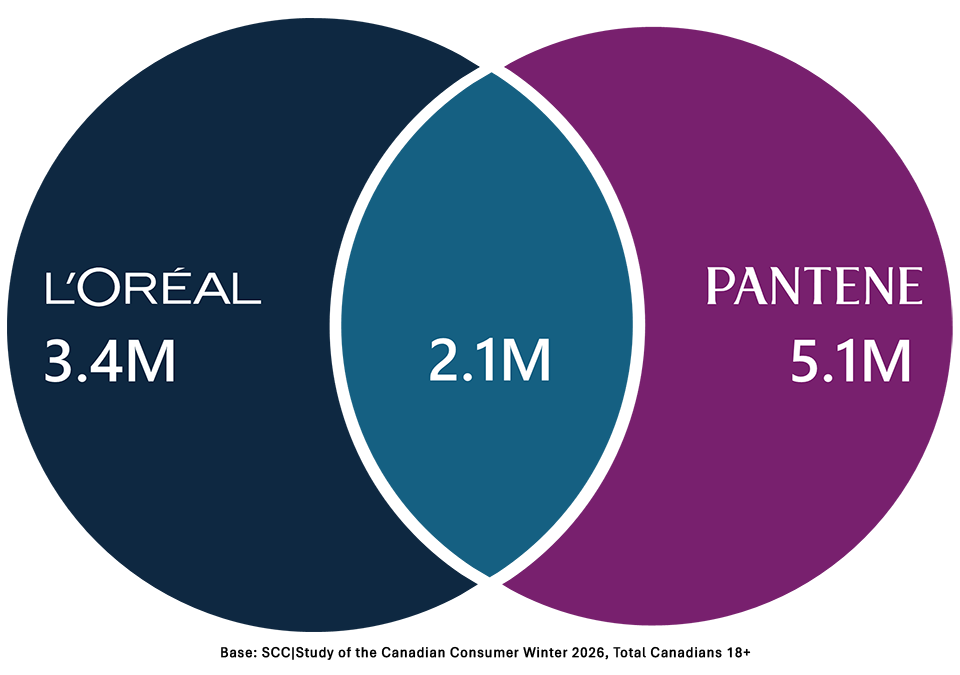
Notice that there are 2.1 million consumers who switch back and forth between L’Oreal and Pantene, or use them both all the time. They are the Moveable Middle for each of the two brands. They might be a sensible strategic target for both brands. Who are they and what are their motivations? What media reach them, these consumers in the middle? Vividata supplies these answers, with the motivation data coming from RMT. The RMT system has been proven able to extract motivations from media content consumption behavior, and to turn this into creative and media tactics which increase incremental sales and long-term brand love.
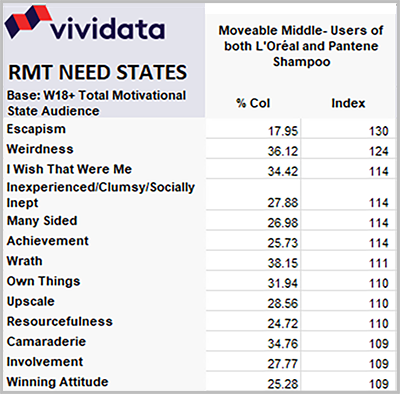
This is the way brand strategists ought to determine brand strategy and provide initial clues to agencies for creative development and media planning tactics. In-market testing as early as possible is worthwhile, which means sneak testing in out-of-the-way places. The latter recommendation is pure Ogilvy.
Strategy, as Dave Morgan says, has been overwritten by tactics. All we can think about nowadays is tactics, because we suddenly have such an abundance of miraculous tactical tools, including AI, big data, interactive media, addressable media, neuroscience and biometrics, cameras in the smartphones of 8 billion people, surveillance technology known as the Internet, brilliant mathematical inferencing techniques, computer vision, and millions of media choices measured by Nielsen ONE.
Remember what Sun Tzu and David Ogilvy said.
Dave Morgan Writes:
Think of brand building like equity investing. Online trading platforms now give everyone access to analytics, real-time buying and selling tools previously available only to stock brokers and fund managers. These tactical tools are powerful and launched the world of “day trading,” buying and selling depending on market momentum, a thesis for the day, real-time news, all the while glued to dashboard and with real time metrics.
Are they building businesses or wealth over time? No. Study after study shows that the majority of day-trading is unprofitable, certainly when you account for fees and taxes. And, while day-trading has been an on-ramp for some fund managers to begin their careers, virtually no large and high-performance fund has been driven by day trading. Because it is just a tactic.
Warren Buffett built Berkshire Hathaway with a strategy, not the mass execution of tactics, and marketers need to build brands the same way. It takes discipline and discernment in setting the strategy and confidence and commitment in its execution. Throwing things against the wall and trying to optimize for “stick rate” versus “bounce back” might sound logical…
Tactics without strategy are the noise before defeat.
Cover Image by rawpixel.com on Freepik
Our new podcast explores the topic of Being in the In-between Phase, a liminal stage of growth when we can feel disoriented, lonely, or frustrated, and why it’s also a powerful indicator that real growth is happening. Rather than rushing to “fix” the discomfort, this episode invites listeners to slow down, listen more deeply to themselves, and learn how to navigate uncertainty with trust, patience, and self-awareness.
This month’s podcast length is ≈46 minutes. Watch the Video
Posted at MediaVillage through the Thought Leadership self-publishing platform.
Click the social buttons to share this story with colleagues and friends.
The opinions expressed here are the author's views and do not necessarily represent the views of