The US now consists of two major subcultures that live in fear and loathing of one another, and a third heterogenous and less vocal segment.
Some marketers are starting to feel like they don’t understand US consumers as well as they thought they did.
Some wonder if maybe they don’t get all the insights they need from questionnaires and social media utterings.
Into this picture comes RMT (a company I co-founded), a team of people who have done good things for the industry before, who claim to have an empirically-derived method for reading people’s underlying deep motivations based on the media content they consume.
As proof of their claim, they offer evidence produced by the ARF Cognition Council, Wharton Neuroscience, Simmons, NCS, Neustar, 605, and other independent research companies. The proof shows that when RMT insights are used in media selection, branding and sales effects are significantly increased.
Others have also proven that the alignment of ad and context – one of the ways the RMT system is applied – results in increased advertising effectiveness. The ARF Journal of Advertising Research paper by Kwon et al references 77 such studies, all showing approximately 15% increases in ad recall when an ad aligns with its media context. There are other such studies happening every year among companies including IPG/TikTok, Neuro-Insight, TVision, Gracenote, Magid, Wurl, etc.
The difference between all these studies and RMT is that RMT empirically discovered which qualitative dimensions of ads and programs have the maximum effect when aligned (there are 265 of them, distilled from thousands tested). The other studies use obvious but less influential qualitative dimensions (funny, sad, etc.). RMT, therefore, can consistently show double-digit and triple-digit increases in sales effects, whereas most of the other studies show more modest increases in ad recall and other metrics, but not sales.
RMT also shows increases in attention, awareness, brand perception, consideration, preference, intention – every funnel metric in broad usage today.
Dr. Michael Platt, one of the founders of the new science of Neuroeconomics and Director of Wharton Neuroscience, hypothesizes that the RMT verbal markers likely correspond to the neurological Value Signals which appear in the brain during choice behavior. The number of observed Value Signals in the brain is close to the number of qualitative dimensions discovered by RMT using AI and Machine Learning.
His team at Wharton discovered that the brain pattern called “synchrony” is the best predictor of an ad’s impact on sales. Most recently, the same team discovered that RMT is the best predictor of synchrony, about 20X more predictive, for instance, than direction of gaze as measured by eye tracking.
Another proven use case of RMT is to send ads through addressable media to people whose motivations align with those subconsciously communicated by that ad. Neustar found that this tactic increased incremental sales effect +95%, and among new-to-brand customers, +115%. RMT, with its AI partner Semasio, has these motivations scored on 300 million Americans and the scores are updated continuously in real time based on their anonymized (but deterministically targetable) browser behavior.
Can this motivational data – not derived from surveys or social media statements – increase our ability to understand what drives a specific human being?
The answer is a definitive YES because, as Jerry Zaltman has explained and most neuroscientists agree, the vast preponderance of human decision making and choice behavior is not ruled by the conscious mind. Verbal methods tap only the conscious mind. Jerry invented the patented and widely acclaimed ZMET method – not dissimilar from psychology’s Thematic Apperception Test but pragmatically far ahead of it – in order to get beneath the conscious mind, where he has discovered that subconscious metaphors are often the main drivers of decisions. Not rational thought processes, but metaphors.
RMT’s method of subconscious discernment is the first to be based on big data – trillions of data points from hundreds of millions of people. RMT’s partner Semasio operates in over 20 other countries in addition to the US and tracks over 700 million privacy-protected people. RMT will soon be available in these other countries as well, and is already operational in Canada, where RMT partner Vividata (”the MRI/Simmons of Canada”) is already working in depth with RMT in analyzing the 45,000 respondents in each wave of its syndicated study.
An example of RMT/Vividata profiling is that Canadians who have recently moved out of their parents’ home are eight times as motivated by Belonging as Canadians who have recently retired. So, if you are targeting young Canadians, showing groups of friends in ads is a good move, whatever you are selling.
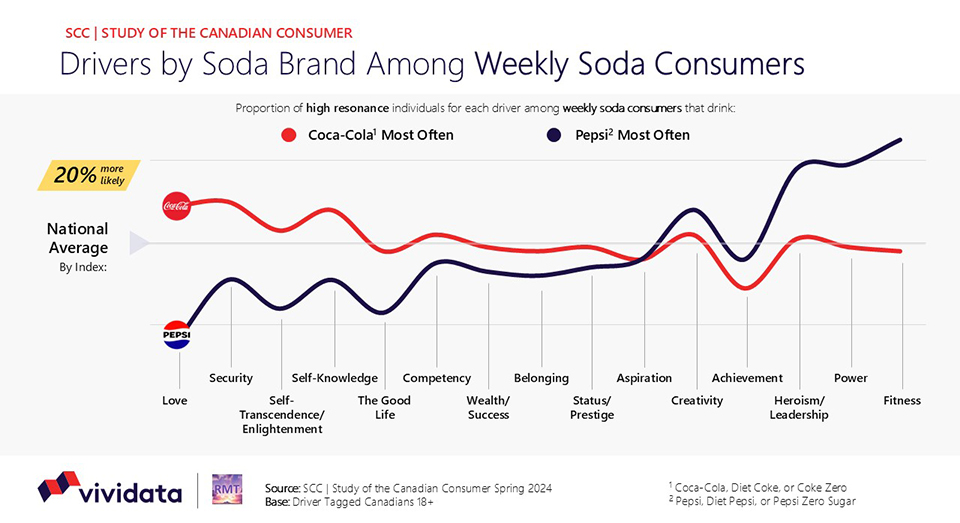
Syndicated services such as MRI/Simmons, Vividata, and TGI, collectively in over 40 countries around the world, have for the last several decades contained useful verbal questions about which product features are consciously desired by respondents. Now the industry is adding a wealth of subconscious drivers to that without revealing anything to others about a specific identifiable person. These additional insights will take time to be assimilated into the already complex marketing world, but they will increase marketing productivity and efficiency, shifting market shares to early adopters of these deeper insights.
Posted at MediaVillage through the Thought Leadership self-publishing platform.
Click the social buttons to share this story with colleagues and friends.
The opinions expressed here are the author's views and do not necessarily represent the views of