Each year in Cannes, two iconic events capture the artistry and craftmanship of the ultimate in storytelling. The Cannes Film Festival evaluates cinema as art -- its authorship, ambition, and cultural durability -- while the Cannes Lions International Festival of Creativity assesses creativity as a driver of attention, behavior, and economic return. Although these forums have historically represented different creative traditions, AI is forcing both to confront the same underlying question: how should work be designed when cognition and imagination itself become influenced by machines?
The Business Shift: From Finite Projects to Learning Story Systems
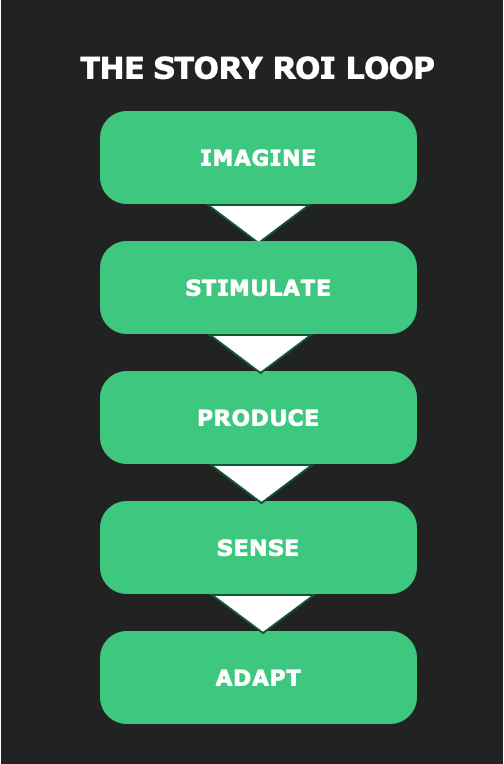
For most of the twentieth century, films and advertising campaigns were treated as bounded projects: capital was committed, execution followed a linear path, and learning occurred only after release. This structure concentrated risk upfront and limited adaptive response. AI introduces a fundamentally different economic model -- one in which stories operate as continuously learning systems rather than fixed deliverables.
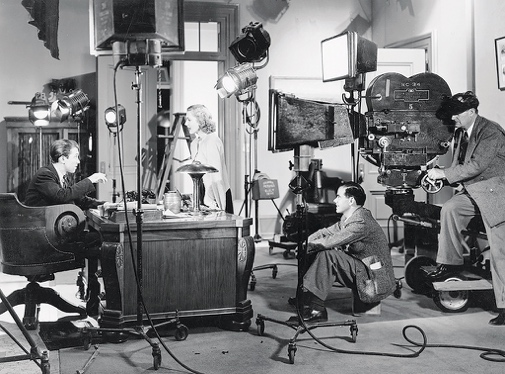
Jimmy Stewart, Jean Arthur, director Frank Capra and cinematographer Joseph Walker on a crowded set during the filming of Mr. Smith Goes to Washington from 1939.
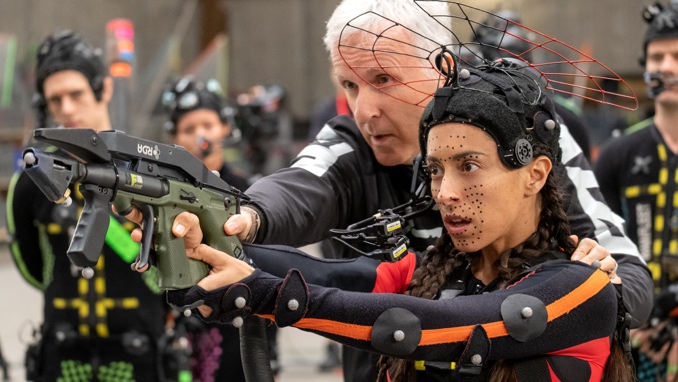
Director James Cameron and Oona Chaplin on the set of 20th Century Studios' Avatar: Fire and Ash, 2025.
In this model as illustrated above, simulation precedes production, sensing occurs in real time, and adaptation is built into the system rather than relegated to post-hoc analysis. For advertisers, this enables campaigns that improve while live; for filmmakers, it enables multiple coherent releases without creative dilution. Competitive advantage shifts from production scale to learning velocity with narrative control.
The Artistic Shift: From Singular Outputs to Directed Multiplicity
Public concern about AI in creative work often centers on authorship -- specifically, whether machine assistance erodes originality. History suggests the opposite. Each major technological inflection in film (from color to digital editing) and advertising has expanded creative agency by reducing executional friction. AI continues this pattern, but reframes originality around systems rather than artifacts.
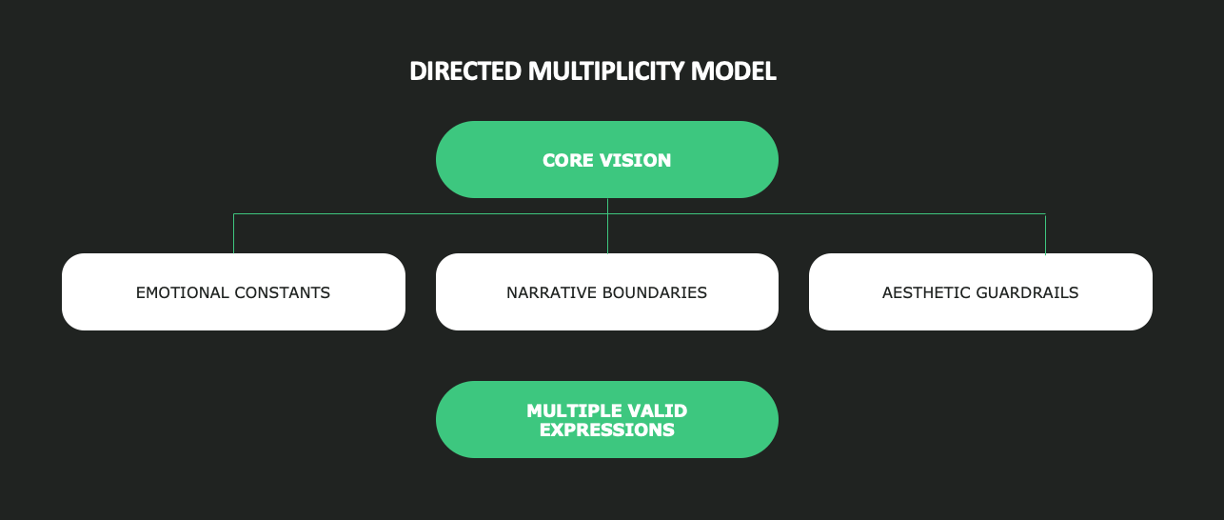
Here, the creator defines the governing logic of expression rather than each individual output. In cinema, this allows tonal and structural flexibility without loss of meaning. In advertising, it allows brand consistency across proliferating formats. Originality resides in the integrity of the system, not the uniqueness of a single execution. This comes to life in the Directed Multiplicity Model above.
The Craft Shift: From Execution Mastery to Judgment Architecture
Craft has traditionally been equated with technical excellence -- the ability to write, shoot, edit, or design at a high level. AI relocates craft from manual execution to decision design. The critical question becomes not “what can AI do?” but “where should human judgment remain authoritative?”
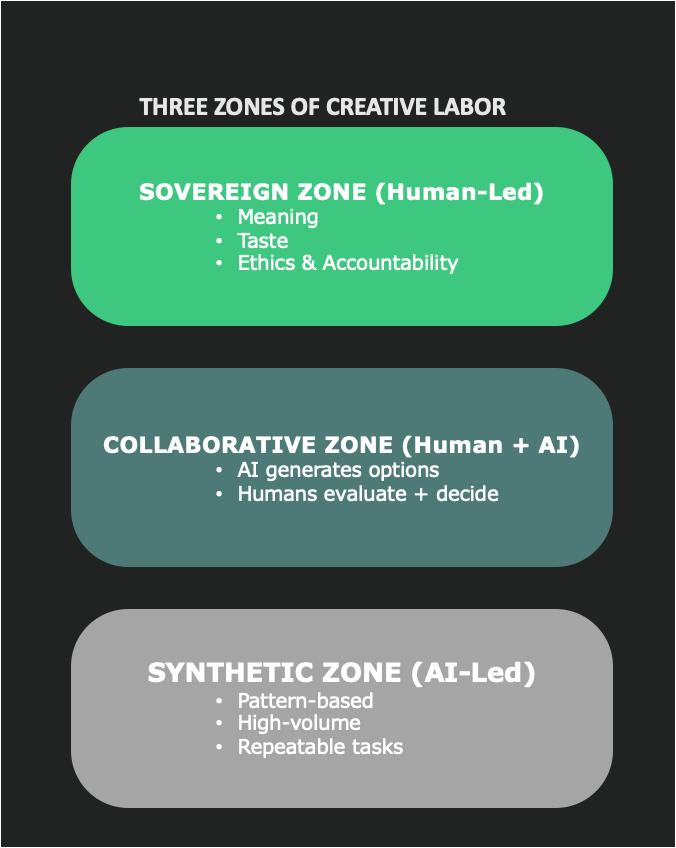
Excellence in AI-enabled creativity depends on maintaining clear boundaries between the 3 zones as shown above. Failures emerge not from AI usage itself, but from allowing automation to encroach upon areas requiring human accountability.
Industry Convergence: Film Learns Iteration; Advertising Learns Meaning
AI is eroding the historical divide between film and advertising. Cinema is becoming more iterative and feedback-aware, while advertising is increasingly narrative-driven and cinematic. This convergence elevates a new strategic property of storytelling: resilience under recomposition.
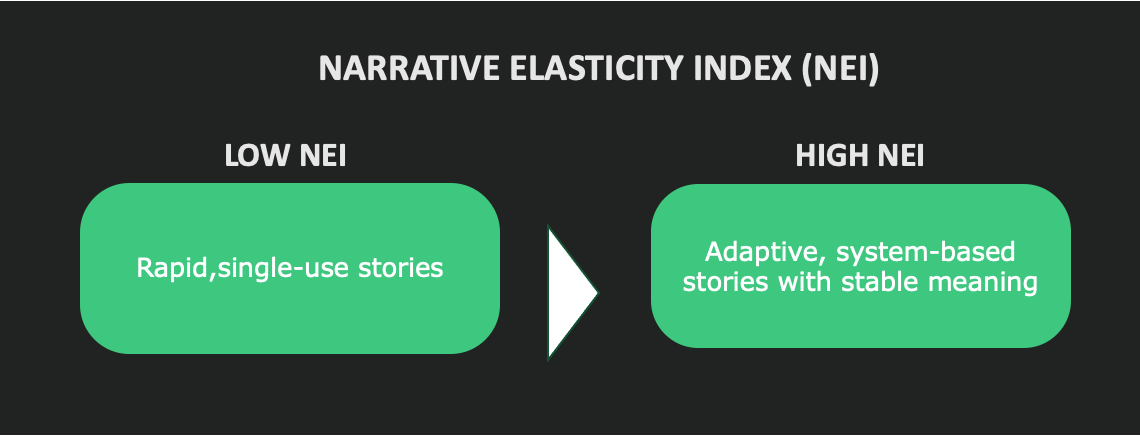
High-NEI stories can be localized, reformatted, and extended without losing identity. At Cannes Lions, this predicts brand durability beyond awards cycles; at Cannes Film Festival, it predicts cultural longevity.
Organizational Implications: From Functional Silos to Pods and Spines
As AI reduces the marginal cost of production, organizational advantage shifts toward workflow design and governance. Creative organizations increasingly adopt hybrid structures that balance autonomy with coherence.
This structure enables experimentation without fragmentation and scale without dilution. Authority migrates from production specialists to system architects -- leaders capable of integrating strategy, technology, and human behavior.
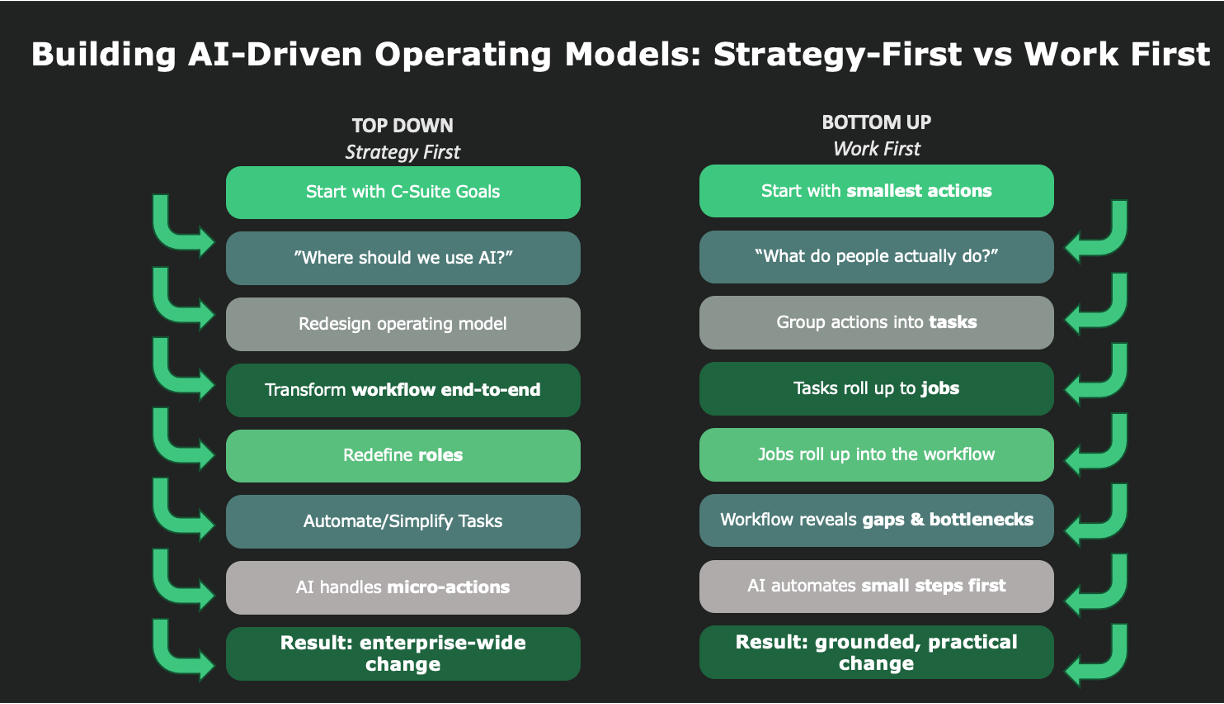
What the top-down pathway does well
The strategy-first approach is powerful because it begins with outcomes -- growth, cost, risk, experience -- and forces the organization to design workflows that serve those outcomes rather than merely digitizing existing habits. It is the pathway most consistent with how boards and C-suites allocate capital: by value pools and enterprise priorities, not by individual tasks. In the Cannes Lions context, “AXA – Three Words” can be interpreted as a strategy-first move: the creative idea became a contractual and operational redesign that required governance, policy, and delivery mechanisms—not just communications. The work succeeded because the story was embedded into the operating model, not simply broadcast through media.
Common failure mode: top-down programs can over-engineer a “perfect” future state that underestimates frontline variance, informal workarounds, and the emotional realities of adoption.
What the bottom-up pathway does well
The work-first approach is powerful because it starts with truth: what people actually do, where time is consumed, where handoffs break, and where tacit judgment hides. It tends to produce faster early wins because it targets small steps that can be automated or augmented immediately, building confidence and momentum. In film production terms, many of the most meaningful gains come from bottom-up improvements in coordination -- coverage planning, asset organization, continuity checks, rough cut exploration -- work that reduces downstream rework without threatening the sovereign zone of authorial intent.
Common failure mode: bottom-up programs can produce local productivity gains that never compound into enterprise value because they don’t reconcile into a coherent end-to-end workflow or operating model.
Design a “dual-track” transformation that converges
For work design leaders, the most reliable approach is not choosing one pathway, but running both deliberately and forcing convergence.
The Convergence Rule
Top-down defines: what must be true (outcomes, guardrails, governance).
Bottom-up reveals: what is true (actual work, friction, adoption realities).
Transformation succeeds when the two meet in a redesigned workflow with clear decision rights as reflected in the diagram above.
In practical terms, this convergence produces three artifacts that are reusable across functions and industries: (1) an enterprise-level work ontology that standardizes how work is described, (2) workflow templates that embed automate/augment/human-led boundaries, and (3) measurement systems that quantify cycle time, rework, quality, and risk.
These artifacts are what allow AI to become an operating model capability rather than a collection of tools.In this light, the most consequential leadership question of the AI era is not whether an organization will “adopt AI,” but how it will redesign work so that automation, augmentation, and human-led judgment can coexist without eroding coherence, trust, or accountability. Cannes makes this visible because both film and advertising are unusually exposed to coordination costs: in cinema, late discovery of narrative or continuity issues creates expensive downstream rework, and in advertising, fragmentation across channels can dilute meaning faster than media can amplify it. What separates durable excellence from short-lived experimentation is not simply the presence of sophisticated tools, but the presence of a deliberately designed operating model—one that clarifies where judgment sits, how decisions move, and how learning is reinvested into the system rather than trapped in post-mortems.
This redesign succeeds or fails based on the pathway organizations choose to get there, because AI-driven transformation typically follows either a strategy-first, top-down route or a work-first, bottom-up route, and each produces a different pattern of value and risk. Top-down redesign can create enterprise-wide coherence by starting with outcomes, governance, and end-to-end workflow intent, yet it often breaks at the point of adoption when it overlooks the lived realities and informal practices that actually sustain performance; bottom-up redesign can generate rapid traction by beginning with the smallest observable actions and bottlenecks people face each day, yet it often struggles to compound into lasting advantage when local optimizations never converge into an integrated workflow and decision architecture. The most reliable approach is to run both pathways deliberately -- using top-down clarity to define what must be true and bottom-up observation to reveal what is true—then forcing convergence into a coherent workflow, role architecture, and measurement system that demonstrates ROI while protecting the sovereign zone of human meaning.
Conclusion: Why Cannes Still Matters
Despite rapid technological change, Cannes remains a useful barometer of creative excellence. What is shifting is not the importance of storytelling, but the criteria beneath it. In an AI-enabled world, value accrues to coherence over volume, judgment over generation, and systems over stunts.
Artificial intelligence does not diminish the art and science or business of film and advertising. It raises the standard for all three. When generation becomes abundant, meaning becomes scarce again. The enduring winners at Cannes -- whether films or brands -- will be those whose stories succeed not because of the tools employed, but because the work behind them was intelligently designed.
Cannes will continue to reward stories that move people; increasingly, though, the decisive advantage will be invisible to the audience: whether the organization behind the work has redesigned itself well enough to learn faster without diluting the narrative spine. In an era where generation is abundant, the scarcest capability is not output but stewardship -- protecting creative DNA through clear judgment, principled constraints, and workflows that turn feedback into craft rather than noise. And that is the enduring continuity, from the first flicker of the moving image to today: tools evolve, formats multiply, but storytelling mastery—human insight shaped into meaning -- is what earns an enduring place in culture.
Posted at MediaVillage through the Thought Leadership self-publishing platform.
Click the social buttons to share this story with colleagues and friends.
The opinions expressed here are the author's views and do not necessarily represent the views of