A new report from Dr. Augustine Fou, one of the most respected anti-fraud experts in the digital world, brings earthshaking news. It deserves a bit of background first.
As a futurist writer, my Media Science Newsletter (1979-1999) laid down the blueprints for digital. And we reported on Compuserve and Prodigy, the early experiments in online advertising, for which I also consulted. At the formation meeting of the IAB, I was the Keynote Speaker. At the first meeting of the World Wide Web Consortium, I was there with Jim Spaeth, representing the ad industry. I’ve consulted for Google, Meta, and Amazon. I helped Andrew Susman create the great medium of digital branded content. I consulted for British Telecom on a project that anticipated the iPhone until Apple beat us to the finish line. I would be the last person to say that digital is not a great medium.
But we have gone too far in putting too many of our eggs in that one basket. I’m talking about advertising investments.
Advertising can serve as a reminder function to people who already buy your brand, and give them more reasons to keep buying your brand, but if you understand the vital importance of brand growth – Drucker’s imperative to gain new users for your brand – then you must use advertising properly in order to activate that conversion function, where you actually convert a non-user to a user of your brand.
The word “conversion” today is used to mean any sale (and sometimes used to mean any action at all), but the original meaning is limited to true conversions from non-user of the brand to user of the brand, period.
This is what causes brand growth.
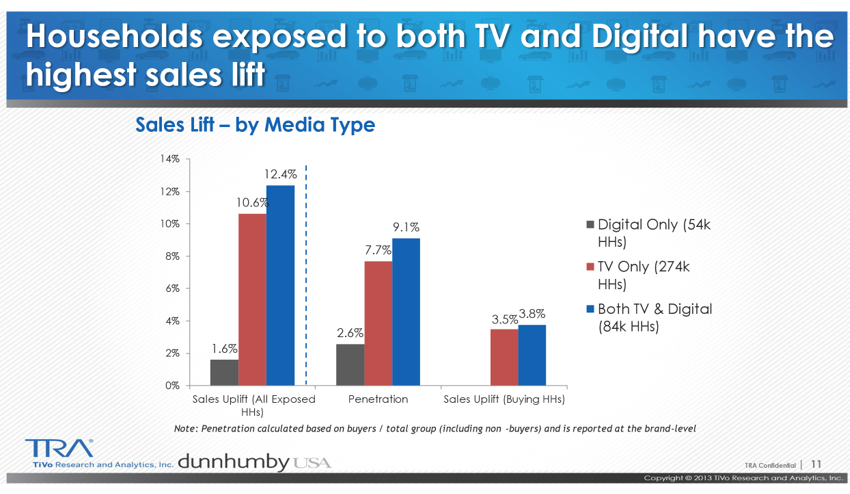
I first saw the deficiency of digital display and online video in a TRA study done for a CPG client, which revealed that TV had more than 6X the sales effect of digital. TV was 3X stronger in bringing in new-to-brand customers. Homes reached by both media types did about 20% better both in overall sales and in gaining new users than homes reached only by TV. Conclusion: Use both media types with more of TV than digital.
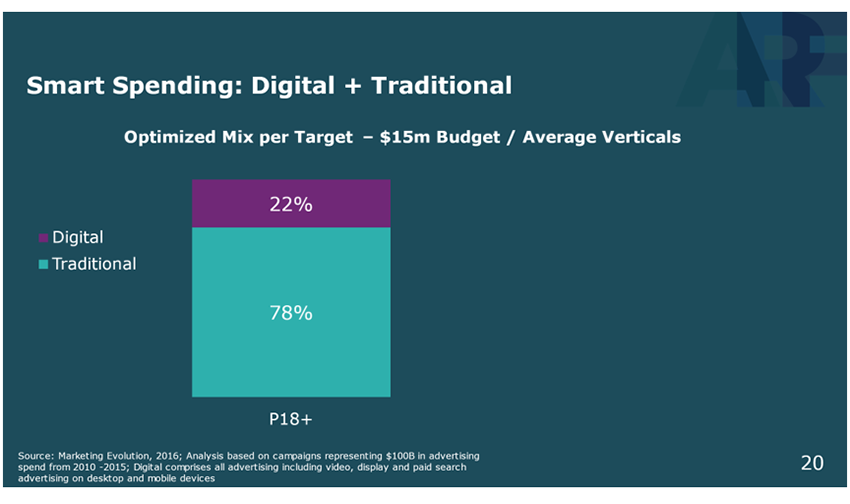
Soon thereafter, this was found to be the case by the ARF in its Ground Truth How Advertising Works study, based on ~5000 MMM studies around the world. In 2015, ARF announced that the optimal mix was 78% TV to 22% digital. Here is that ARF slide from 2015:
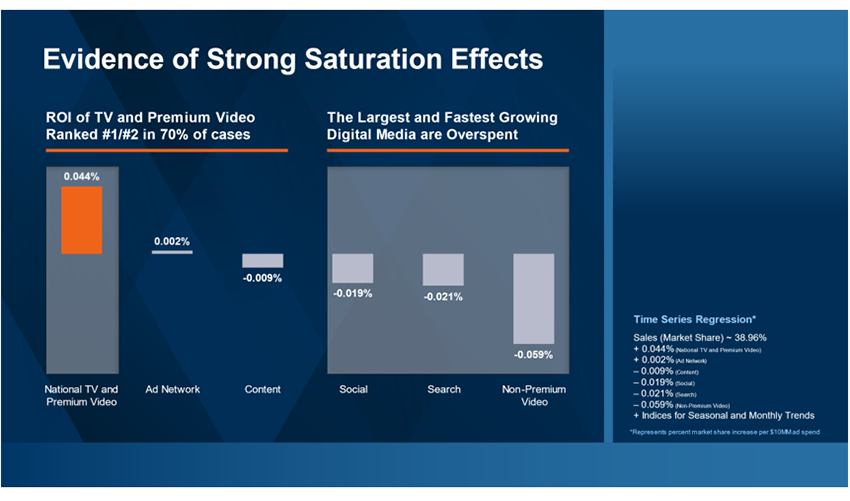
In 2023, then Executive Vice President FOX Corp. Audrey Steele and I presented to an ARF annual conference the results of a ten-year study, which covered $3 trillion in sales and $48 billion in adspend. The MMM part of the study showed that digital was overspent to the degree that the next million dollars invested would not have an ROI payback. The raw sales data (IRI, Polk, NPD) without any modeling whatsoever simply showed that brand growth was going down across the CPG, Auto, and QSR industries, during the period 2014-2023, and that the apparent cause was the shift to digital. This is what that looked like:
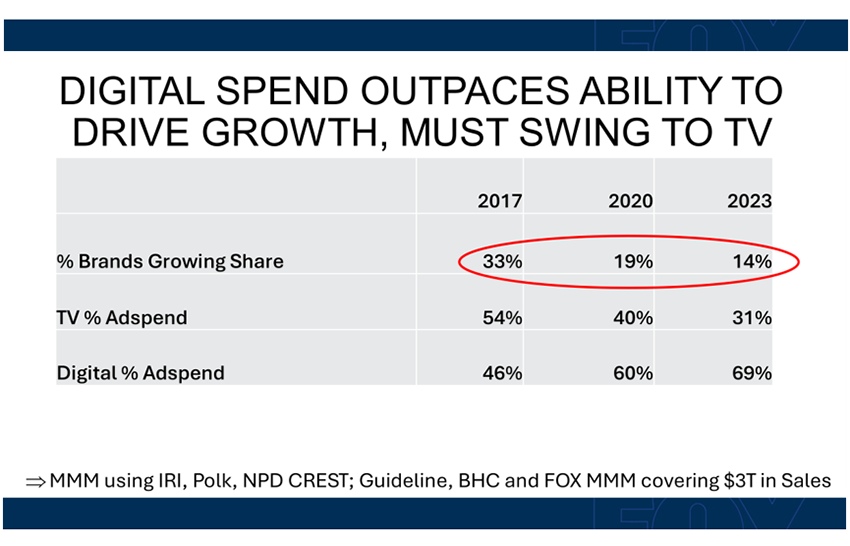
I had hoped the industry would see the urgency of shifting dollars back into television. But the industry was looking at the world through its oversimplification lens and could only see that linear TV usage was declining, everyone was proudly self-describing as Digital First, and everyone assumed that young people were not reachable at all by television, and that all impressions have about the same effect.
The main point is that all impressions do NOT have the same effect. 40+ companies measuring attention agree that most digital ad exposures last about a second or less, some of the better ones in the best environments get almost five seconds of screen time, with less than that of actual attention. OK for reminder ads for your current users, but not really a good use of money if you want brand growth, i.e., talking people who have never bought your brand before into buying it. Try doing that in less than five seconds.
Now, Dr. Augustine Fou has done a comprehensive study based on public SEC filings, released on LinkedIn just a few days ago on February 23, 2026, entitled “How Brands DIDN’T Grow – The Need For Digital Rebalancing”. His opening sentence reads: “We now have 15 years of revenue data that shows some of the largest advertisers in the U.S. simply didn’t grow (low to negative 15-year CAGR compound annual growth rate) despite breathlessly shifting ad budgets into digital.”
Aug (as Andrew Susman and I call him) credits a prior report by Michael Farmer as his inspiration for writing the article. He quotes Michael: “Thirty out of the top sixty advertisers in the U.S. grew, collectively, at only 0.7% per year for the past 15 years.” Michael then points out that these thirty advertisers all grew at a rate which was below the rate of GDP inflation growth over the same period, which was 2.1%.
In Aug’s article How Brands DIDN'T Grow -- The Need for Digital Rebalancing you will see comparisons within verticals of brands that grew vs. didn’t grow, and how the percent of adspend allocated to digital vs. TV lines up to prove his case.
If you have shifted spending out of television and into digital, and if you are not growing your brand as fast as the CEO and stockholders would like, this would be a good time to shift back a meaningful chunk. Use this link to maximize target reach at the least cost across all of your media types measured by Nielsen ONE (linear, CTV, mobile, computer). (You’ll recall that Nielsen is one of my consulting clients.)
In both TV and digital, use RMT (Resonance Mapping Technology) to increase sales effects by maximizing the harmony and synchrony of the media environments with the audiences targeted with the specific ads you are using. This simple HUMAN consideration will make the consumer’s experience with your ads far more pleasurable, and they will become more willing to watch and consider your messaging. Here are the proofs of the latter statement.
Within digital, the strongest plays are premium streaming, branded content, retail media networks (RMNs), carefully chosen Creators/Influencers, carefully chosen podcasts, and programmatic CTV aimed at people whose motivations line up with your ads (using RMT). Although it is tempting to get discounts for piling money into the big walled gardens, you will get the best brand growth per dollar by dispersing your campaigns across as many platforms and publishers as possible while maintaining efficiencies, reaching the right targets, and using specific content contexts that psychologically match your ads (another shameless plug for “my” company RMT because I strongly believe in it).
Here are a few slides going back a few years, which I referred to in my article above (the bottom slide was presented by FOX at the 2023 ARF AxS Conference):
Our new podcast explores the topic of Being in the In-between Phase, a liminal stage of growth when we can feel disoriented, lonely, or frustrated, and why it’s also a powerful indicator that real growth is happening. Rather than rushing to “fix” the discomfort, this episode invites listeners to slow down, listen more deeply to themselves, and learn how to navigate uncertainty with trust, patience, and self-awareness.
This month’s podcast length is ≈46 minutes. Watch the Video
Posted at MediaVillage through the Thought Leadership self-publishing platform.
Click the social buttons to share this story with colleagues and friends.
The opinions expressed here are the author's views and do not necessarily represent the views of