What is at the root of all marketing, that which causes all other variables to light up? What comes first before exposure, perception, attention, interest, communication, emotion, memory encoding, persuasion, consideration, preference, trial purchase, loyalty, recommendation, and brand love?
Since marketing consists of all the things we do to get and keep customers, all of whom are human beings, from a scientific perspective, marketing falls under psychology, where neuroscience also resides.
In psychology, the prime mover which sits at the entrance to the cognitive process is motivation. Everything we do traces back to what motivates us. Motivation is the stuff that causes attention and sales and causes everything else in the cascade listed in the first paragraph.
If an ad does not speak to our motivations, it can still catch our attention. David Ogilvy famously said, “I don’t create ads to get attention. I know how to get attention. I can show a picture of a gorilla wearing a jock strap.”
Many people believe that attention is, however, a necessary precondition for advertising to have an effect. Unfortunately, those people are forgetting the subconscious. Advertising can have an effect on people who are not looking at the screen through the audio track, which a Lumen study for Audacy has shown can have more advertising effect than the visual track. People who are zoned out and have no memory of the ad may still be influenced by it.
This is not to say that attention is irrelevant; research supports the notion that attention increases ad recall and brand awareness, both of which have value. And Mars has reported that pretesting AI-generated commercials using Realeyes AI attention prediction works to filter out ads, resulting in 3-5% sales lifts.
But attention is not in itself capable of changing hearts and minds and behaviors. The way to change those things is to make your ads resonate with the user’s motivations. And to ensure that the media content that leads into your carefully constructed ad does not detract from that resonance experience, but in fact adds to the resonance with the user’s motivations.
For the past 100 years, the closest that marketing has come to motivations is surveys about product features. Segmenting targets by whether they care more about breath freshening, tooth whitening, or decay prevention is one example of this. But this is far more superficial than motivations. Motivations lie far deeper in the individual than these petty considerations about which toothpaste they buy. Motivations are the things we strive for in life, and they permeate far beyond our conscious mind.
For this reason, motivations cannot be accurately measured based on questionnaires. We tried this with Simmons in 2017, and the questionnaire-based motivation data had no statistical significance in relation to the brand usage data.
“My” tech company RMT, however, is able to measure motivations based on an individual’s media content consumption patterns. Media content is coded by 265 empirically derived value signals, and the user is “painted with” the value signals that the user consumes in media. Simmons showed a statistically significant relationship between these signals and the use of the brand, for every brand in every vertical in the Simmons questionnaire. The average increase in the predictivity of brand adoption was +83% as compared with making such predictions with Simmons demographic data alone.
RMT clusters these 265 signals into 15 RMT Motivations. With AI partner Semasio, RMT scores these 15 Motivations for each of 300 million US IDs and 16 million Canadian IDs based on digital content consumption. The marketer’s agency sends RMT the link to the ad and RMT sends back the highest scoring RMT Motivations in the ad, and sends however many million IDs the campaign needs to the marketer’s DSP/SSP for programmatic delivery of the ads to the people most likely to be motivated by those specific creative executions. Neustar showed +95% increase in incremental offline+online sales as a result of this targeting versus what the marketer had been using before.
RMT also delivers rankings of TV/streaming programs and their resonance with the specific creative execution. Rotations are also ranked that way. Three-way resonance can be achieved between ad, person, and context.
In Canada, Vividata (“the MRI of Canada”) uses RMT Motivations in its system and calls them Drivers for short. Marketers in Canada can look up what motivates their loyal customers, their occasional customers, and their main competitor’s customers, and much more. Soon, it is hoped marketers in all major countries will have similar abilities. This will enable far more effective advertising creative strategy.
Until now, the state of the art in marketing has been the use of persona-based segmentation schemes using questionnaire-based data focused mainly on product features. The RMT/Semasio system is actually capable of merging these with the 15 RMT Motivations. In this study, that combination quintupled the KPI.
You know something is scientific when it can be validated by sales effects, branding effects, and especially by neuroscience. Very little in marketing has ever been triply validated this way. RMT has been validated in all three ways, as evidenced by the findings below.
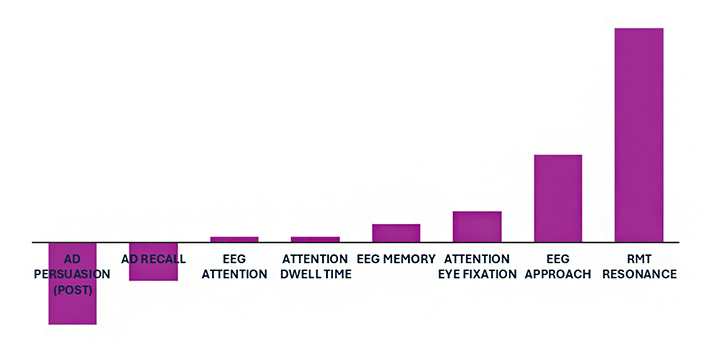
This is the beginning of a new era in marketing science. Because motivation underlies both branding and performance, it automatically ties those two outcomes together. Understanding the mission revolves around motivation makes all marketers more effective; they finally have their eye on the real ball.
Posted at MediaVillage through the Thought Leadership self-publishing platform.
Click the social buttons to share this story with colleagues and friends.
The opinions expressed here are the author's views and do not necessarily represent the views of