A new view of this upfront season’s most valuable channel
CTV’s 2026 Upfront negotiation season shows two different financial dynamics at play: a gold rush for dollars and a price war for inventory.
CTV is becoming a necessary media channel for advertisers. According to eMarketer [Digital Video Forecast and Trends Q2 2026], 2026 will be the year CTV secures more dollars in the Upfront market than primetime linear TV.
At the same time, the major CTV providers continue to expand their ad inventory offerings, even as average CTV CPMs, which ranged from $35 to $50 in 2023-2024 according to Adwave [What is the average CTV CPM? (Q1 2025)], have softened. CTV ad inventory supply and demand are both growing, but their growth rates are not aligned, which is causing the net CTV CPM floor to drift downward.
Brands want CTV on media plans for its reach and targeting; buyers want it for value. But in a market where similar prices can mask very different levels of media quality, CTV CPM alone is no longer a sufficiently discerning tool to help buyers decide where to invest their CTV dollars.
Today, Adelaide is publishing new US CTV channel and daypart ratings for AU, its attention-based media quality metric. AU scores ad placements on a 0–100 scale based on their probability of capturing attention and contributing to business outcomes. These data have not been previously published.
Adelaide AU Media Quality Ratings: US CTV, Jan-May 2026
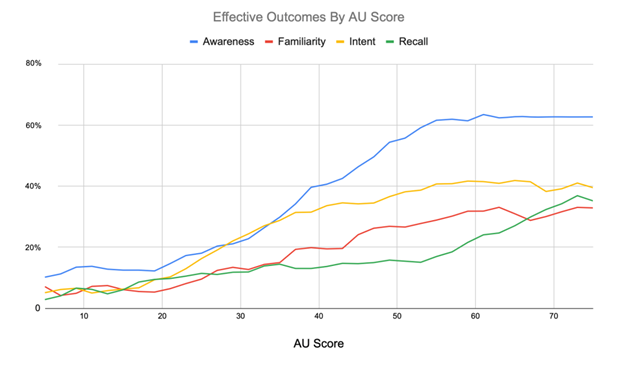
The data above clearly show the necessity of using a quality metric to evaluate media opportunities for outcomes. CPM can tell buyers what an impression costs, but not whether that impression sits above or below the quality threshold needed to move an outcome.
This is the central paradox of this Upfront season. Buyers have more CTV inventory options than ever. Every streamer has an ad-supported tier, FAST supply continues to expand, and the CTV unit price floor has dropped from past years. But the metric most often used to compare those media options–CPM–still treats CTV impressions as more or less interchangeable.
CTV viewers—and media buyers—can see with their eyes the ad load and frequency management differences between the highest- and lowest-quality CTV environments available for investment this Upfront season. Our clients deserve better options.
How to use AU to identify quality thresholds
One of AU’s most important advantages is its stability.
AU scores are deterministic at the placement level, meaning they do not move simply because marketplace supply and demand dynamics change. An AU score changes when an ad placement changes—its size, characteristics, position on a page or in a pod—or when its effectiveness correlations with third-party outcomes change for a particular advertiser or KPI.
For buyers, the practical application of AU is straightforward: determine the AU level your campaign needs to hit, then buy against that number. The required AU level will differ by advertiser, campaign, and objective. Once established, it becomes a media quality target. It tells you the AU threshold at which the inventory you are buying is more likely to contribute to the business outcomes you care about.
Below that threshold, you may be paying for impressions that won't move your KPI. Above it, you have room to negotiate and separate efficient pricing from overpriced supply—but only if you have visibility into those thresholds and what they mean for your clients’ goals. This approach does not require an omnichannel rate card because an AU floor is not a rate—it's a quality value.
For sellers, applying AU works the same way in reverse. The sell-side can assign a quality value to under-monetized media in their portfolios and use that inventory to “bring in the buy” on a quality basis.
Should we use Cost-Per-AU?
Given the AU-by-daypart chart above, and the materiality audit from MediaSense, some Adelaide clients have asked whether they should use AU data to calculate Cost-Per-AU, or CPAU.
CPAU can be a useful market marker. It can help buyers assess price and quality in a more disciplined way than using CPM alone. But CPAU is not a universal market pricing or broadly-applicable channel selection metric, and it shouldn’t be treated as one.
That’s because CPAU is client-specific. Advertisers should be most interested in the specific AU thresholds that correspond with their own business objectives. An advertiser whose media/KPI impact curve inflects at 65 AU has no use for CPAU benchmarks built around 55 AU. An advertiser whose media/KPI impact curve inflects at 55 AU does not need to pay 65 AU prices.
CPAU is a useful number, but it's a client-by-client number—not a single gauge the whole market should track or trade against.
Pricing in media quality
Considering AU as a measure of quality when evaluating CTV costs represents a new way of working. But what we’ll achieve by adopting this new way of working is what advertising has been needing: a shared understanding of the quality of the media we buy and sell. As CTV becomes a larger and more complex part of the plan, that shared understanding matters more. Buyers need to know what their investments are likely to deliver in business outcomes terms, and sellers need a consistent way to prove when their inventory is worth more than the CPM suggests. AU gives the market a new, common, outcome-driven basis for that conversation this Upfront year.
Posted at MediaVillage through the Thought Leadership self-publishing platform.
Click the social buttons to share this story with colleagues and friends.
The opinions expressed here are the author's views and do not necessarily represent the views of