1+1=3. Or sometimes 1+1=4. That is the meaning of synergy. You pay once but get paid back twice or more. Hence, it is efficient to set things up to benefit as much as possible from media synergy. Media synergy is a little-known phenomenon rarely leveraged in media optimization. It is also under-researched, given its economic promise. Here is what we know about media synergy today, and how to research and leverage it better in 2026.
My first personal experience measuring media synergy came in 2006-2012, when we started to observe the phenomenon at TRA, the company we later sold to TiVo. TRA was the first to come up with patented ways (later perfected by clean rooms) to protect privacy while deterministically matching ad exposure to sales using big data (we called it naturally occurring data).
NBCU presented at ARF annual conferences two years in a row (2014-2015), TRA tune-in advertising studies which showed a very strong media synergy effect, the same type of effect, although the program being advertised was different each year. What we saw was that paid tune-in had no effect on its own, but when combined with native tune-in, increased the effect of native +47%. “Native” in this context means when the program is advertised on the network group’s own airtime, including the network where the program will run, as well as its sister networks.
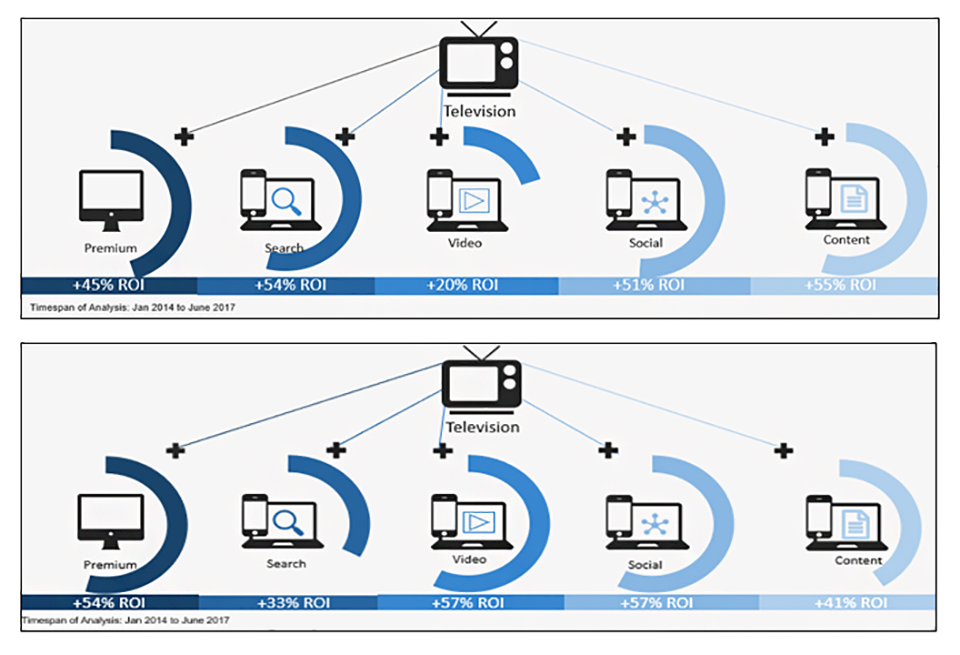
In these charts, “Premium” = Network TV Digital Streaming.
Although David Poltrack did not use the word “synergy,” he called out the statistic that 70% of search is driven by television, based on research he had done at CBS. This is probably the best-known type of media synergy, although it is usually not associated with the term.
More recently, the company DataPoem engaged me as a consultant, and through studying their work, I noted that their proprietary causal AI technology finds even greater levels of synergy than earlier non-AI forms of marketing mix modeling. I especially noted that they attribute much more synergy effect to television than I had seen before in my own work, based on the old-fashioned ways of doing MMM. To me, their most interesting finding is that television plus Retail Media Networks (RMNs) has a particularly high synergy effect.
Given the fact that synergy is “free,” a bonus effect that the advertiser does not pay for, it is well worth focusing much more of a research searchlight on the subject going forward, especially in these economically uncertain times.
I thought hard about how the industry was going to find the time, energy, and methodology to study synergy, on top of everything else that is happening which also demands attention to details.
I was happily surprised when I realized that a type of analytics never seen before, built into Nielsen ONE, is actually ideal for synergy analysis. That is the breakout of the reach and frequency of the parts of a cross-platform campaign by each of the segments defined by which combination of linear, CTV, mobile, and computer the person saw. There are 15 of these segments. For example, one segment is the people who only saw the campaign on linear, another is the segment that only saw it on linear and mobile, and so on.
There are already ∼127,000 ad campaigns in Nielsen ONE, each of them automatically broken out by these segments. The advertiser merely has to use the TRA-type method of linking the sales to each of these segments via an identity graph, with or without a clean room, in order to obtain definitive information about media synergy to a degree never before possible.
I have great interest in not only seeing those findings but also learning the empirical generalizations they reveal, which all marketers could benefit from.
I am also curious as to what neuro studies will show about media synergy effects. Back when TRA first stumbled across media synergy, the way I explained it to myself was that seeing ads across different media types could create more complex memory encoding networks in the brain. Visual media come in through the back of the brain, audio inputs through the left temporal cortex, print media also involve tactile experience, and experiential media come in through many senses, even smell and taste. There is much to be learned about media synergy and how to leverage its benefits to build brands.
Economists tell us that with national debts being so high, the only way to ensure a safe, happy future for all is to increase growth. There is both a self-serving benefit and a social benefit to growing your brand. It makes sense to use every trick in the trade, and to discover or invent new ones. Media synergy should be near the top of the list because if you know how to use it, it is essentially free money, more media effect without more media cost.
Posted at MediaVillage through the Thought Leadership self-publishing platform.
Click the social buttons to share this story with colleagues and friends.
The opinions expressed here are the author's views and do not necessarily represent the views of