There are fascinating revelations emerging from this mammoth meta-analysis made possible by my consulting relationship with Nielsen and their enormous cache of cross-platform audience data in Nielsen ONE. All of these campaigns ran since January 1, 2024.
The first thing that jumped out at me was the difference that linear makes. When linear is part of the campaign, the reach is generally much higher than when linear is excluded, as we can see from this table:

The comparisons are fair for the top two groups as the GRPs come out almost the same for campaigns with and without linear. For the two groups at lower GRP levels, the comparisons are blurred by the differences in GRP level.
What it says is that the more GRPs you are buying, the more you need to include linear in the buy. If you are buying a campaign above 400 GRP without linear, you are in trouble. If you don’t reach a person, you cannot cause that person to spend more money with you. Reach is table stakes. You have to get as much reach as you can among people who buy the product category to acquire new customers and to retain current customers.
You may also be in trouble if you are not buying linear even if your campaign is below 400 GRP. You can’t tell for sure from this set of numbers. Stay tuned as I will be investigating the smaller campaigns in future columns.
Looked at on an annual basis during which you may run multiple campaigns which collectively add up to over 400 GRPs, the above advisory is applicable. You need enough linear, or you will just be hitting a piece of the total market.
However, another implication of the table above is that marketers in general are definitely missing a lot of the market right now, even if they are using a lot of linear. Even at average levels of over 2000 GRPs, the average reach is coming out at a mere 64.2% - across linear plus CTV plus desktop plus mobile. That means that 35.8% of the market is not getting reached.
Hopefully, you are not an average marketer, and you perform high above these levels. The secret of getting reach even if you can’t afford to buy top-tier sports is dispersion. In an earlier article, I showed that two campaigns, both with very high GRP levels (≈3500), got very different reach levels (91.47% vs. 73.66%) just because of the number of different publishers that were used. (That meta-analysis was based on Adults 25-54.)
This can also be seen within specific media types. Let’s take CTV, for example. Here’s a table which shows how much of a reach difference the number of publishers used makes in CTV (Persons 2+):
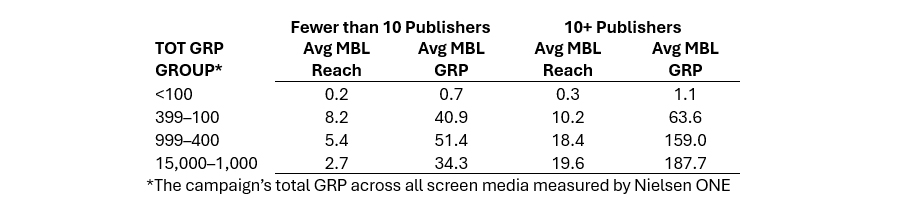
A very similar picture at far lower mobile GRP levels. With fewer than 10 mobile publishers, on average, you can’t get into double-digit reaches. With 10 or more mobile publishers, you can get close to a 20% mobile reach on average. And probably higher if you pour on the mobile GRPs. In an earlier article, we saw that with maximum GRPs (800) mobile can, on average, go as high as 31% based on Nielsen ONE meta-analysis, and with maximum dispersion as high as 70%. (That meta-analysis was based on Adults 25-54.)
Again, one would think that most marketers would have used 10 or more publishers in mobile; however, the actual number of campaigns in which mobile was used with fewer publishers was 70,275, while the number of campaigns in which more than 10 mobile publishers were used was only 2903.
In this brilliant atmosphere of 2026, we are doing all sorts of miraculous things, but we appear to have lost track of the fundamentals.
Get your reach right, right away. Total business growth depends on reaching all of your true potential customers with your compelling messaging.
NOTES: 1) The graph shown at the top of the article is from a different meta-analysis done by Audrey Steele when she was EVP of FOX Corp. 2) The aberration of campaigns without linear of 400-999 GRP having higher reach than those having higher GRP is because GRP is not the only determinant of reach; dispersion plays a huge role, and there are many other factors involved.
Building High-Performing Teams
Once a month in this column, I’m going to be adding links to my latest podcasts about how to nurture the talent under your management and bring forth its creativity for maximum success at both a business and personal level. For example, this month’s subject is Resistance. What to suggest to yourself and your direct reports when feeling resistance inside to something that is going on. How to turn that uneasy feeling into a learning experience and flow state performance.
This month’s podcast length is ≈49 minutes. Watch the Video
Posted at MediaVillage through the Thought Leadership self-publishing platform.
Click the social buttons to share this story with colleagues and friends.
The opinions expressed here are the author's views and do not necessarily represent the views of