Art rarely reveals itself all at once — it takes time to earn its meaning. No one understood that patience better than Picasso, who spent his last years immersed in the turquoise beauty of the Cannes harbor. It was here, at the 1953 Cannes Film Festival, that he was photographed beside Françoise Gilot — twenty-one, already a painter in her own right, already certain of her own eye. She gave him a decade and two children, then did what no woman before her had dared: she left, on her own terms, and painted for sixty more years. Picasso rendered her once as La Femme-Fleur. But the truer, more useful lesson is this — a muse becomes a master the moment she starts authoring her own presence. Gilot never let anyone, not even Picasso, forget she'd arrived already whole. That's the discipline Cannes Lions 2026 kept circling without ever quite naming it: how do you work beside a powerful technological force without disappearing into it? The comfortable answer is that AI plays the old, passive role of the muse — raw material, useful and then set aside. But a muse becomes a master the moment she starts authoring her own presence, deciding for herself what gets made and what doesn't.
Gilot did exactly that. She kept painting on her own terms throughout, and when the arrangement no longer served her work, she left. The craft of marketing now faces a consequential version of the same test, industry-wide. The work still has to be authored and directed by a human hand, deliberately, at every step — because the moment marketers settle for merely approving what a machine produces, they have already stopped doing the job.
Oprah Winfrey, accepting this year's LionHeart Award, made the identical case from an entirely different stage, built across decades rather than a single canvas. Three years into her own show, she recalled telling her producer something closer to a vow than a strategy note: "We're not going to let TV use us any more. We're going to use it as a force for good." "My legacy," she told the room, "is every life I touch. It's every life you touch." Intention came first, and the tool came a distant second — and it never, in three decades, worked the other way around.
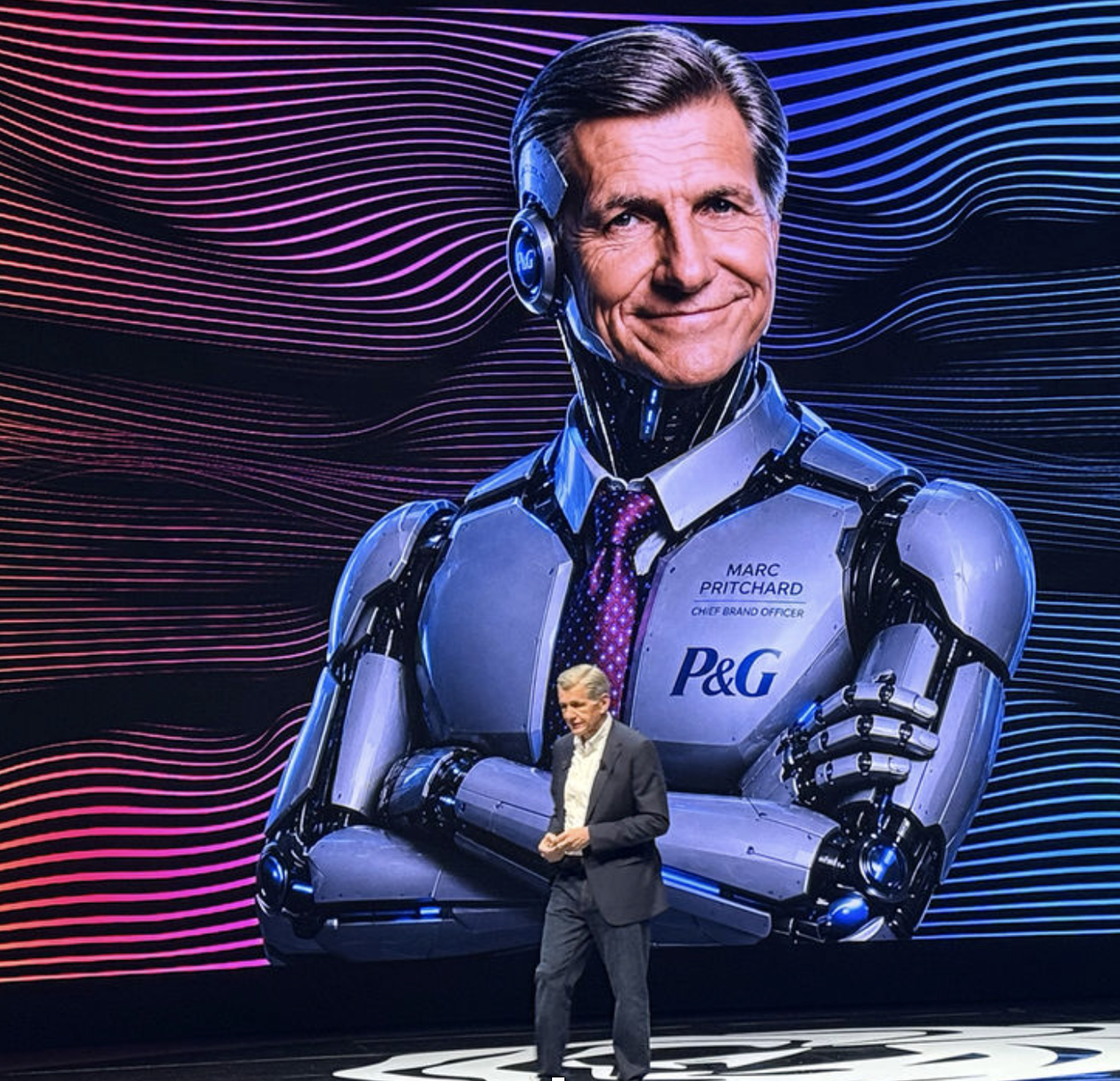
P&G's Chief Brand Officer, Marc Pritchard at Cannes Lions 2026. Photo courtesy of Getty Images for Cannes Lions.
Authoring the Machine
Last year, the festival spoke of artificial intelligence with a child's unguarded wonder. This year, that wonder had matured into a wariness laced with real respect. Sir Demis Hassabis of Google DeepMind, on his first Cannes stage, admitted that "true creativity" — the leap into something genuinely unheard of, not an elegant recombination of what already exists — remained one of the great unsolved problems in artificial intelligence. And for all its speed, it remains genuinely unpredictable — capable of brilliance and error within the same breath, with no reliable way to know, in advance, which one is coming. Sir John Hegarty offered a way to hold that admission close: AI was never meant to cut costs, but to think alongside us. "Humanity," he said, "is AI's greatest friend" — provided humanity never stops directing the work itself.
I tested that idea in person, moderating the P&G Alumni Network's Cannes panel, "Beyond AI: The Cognitive Revolution Is Here," with Chad Reynolds of Vurvey Labs, Laura Knebuschof Georgia-Pacific, Jim Stengel— founder of the Jim Stengel Company and this year's Cannes Lions Marketing Laureate — and Andrew Swinand of ITG. Stengel's warning still rings: "Where the large language models go is everywhere" — no filters left, and no playbook yet for how far AI's reach extends inside a company. "Nobody has the answer," he admitted. Reynolds is building the human half deliberately: Vurvey Labs' "people models" train on daily video conversation with millions of people, "grounded in humanity, as opposed to language, because we are more than language." P&G's Marc Pritchardoffered perhaps the truest sentence of the festival: "Robots don't build brands. You do."
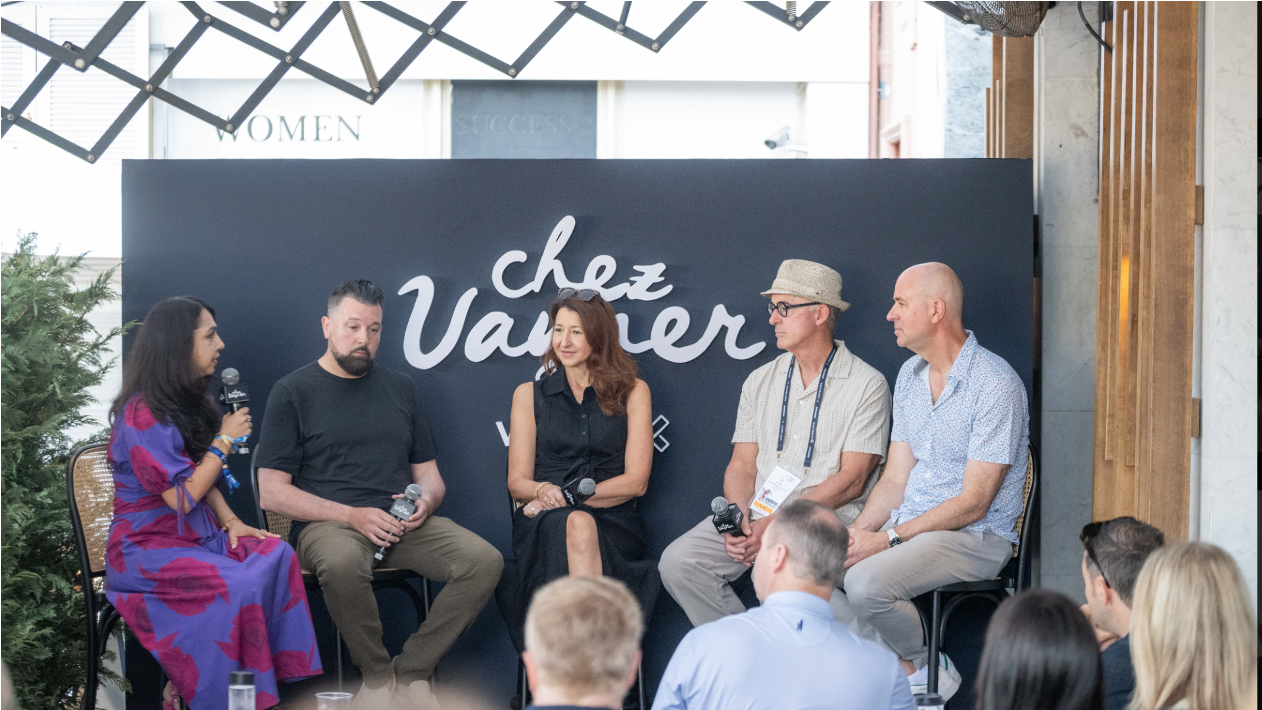
P&G Alumni Panel at Cannes Lions 2026, hosted by Vayner X, featuring Raquelle Zuzarte (moderator) and panelists, Chad Reynolds, Laura Knebusch, Jim Stengel and Andrew Swinand. Photo courtesy from Vayner X.
Approving Is Not Authoring
Andrew Swinand sees the coming risk plainly: an industry mistaking the tool for the strategy. "It's like saying we're going to be the leaders in using laptops." Laura Knebusch made it concrete: for Georgia-Pacific's Brawny relaunch, AI surfaced the cultural signals, but "it couldn't make the judgment or identify the risk profile. That's a decision that has to be made by people."
The rest of the festival reached a related conclusion by a more visceral path: the language of friction, reintroduced after years of chasing its opposite. Unilever's Leandro Barreto offered the week's most quoted diagnosis: "We've confused motion with meaning. We've become incredibly efficient in creating things that people ignore." Polaroid's Patricia Varella was blunter — don't let the technology make you dumb — arguing that real thought needs conditions worth protecting on purpose. This year's Grand Prix winners agreed with their actions: Heineken made people record a voice note before earning a free beer; Vacation shipped its sunscreen in dot-matrix receipts tucked into 1980s pharmacy bags. Both campaigns were wildly inefficient — and both worth millions of views, because the friction was what made people believe.
That same instinct built an entire culture at e.l.f. Beauty, twenty-nine consecutive quarters into growth. CEO Tarang Amindoesn't wait for an annual review to give it — he builds friction into the culture on purpose: "We promote healthy conflict — pinpointed, specific feedback in real time. Does this happen behind closed doors? No. It happens in the open."
Consistency, Not Compliance
Mark Ritson and Byron Sharp, famous for agreeing on almost nothing, agreed on this: consistency sustained over years, not optimized for a quarter, is what builds a brand. Barreto's version was the week's finest: "Consistency is not repetition. It's stewardship." Uber's Lucinda Barlow proved it with real evidence — eighteen months across nineteen markets, failures shown alongside successes — behavior change needs a real jolt, real tension, and years of patience. "Hard to replicate," she said, "and harder still to automate."
MarketCast CEO Lana Busignani made a related case against trusting any single lens: "Marketers have been forced to choose between creative testing and media analytics that focus on delivery and exposure. Too often, these approaches operate in silos." Her point, like Barreto's, was about judgment, not measurement: "It's not enough to know something worked. Marketers need to understand what made it a success" — and, just as importantly, how to build on it.
Navigating the cluttered pathways of the MarTech and AdTech ecosystem is never easy. Cartograph AIhas developed a novel approach for brands searching for the optimal partners, enabling them to assess fit based on criteria that is always transparent, seamless and timely.
And the machines themselves have quietly begun to reward this patience. A meaningful share of a brand's visibility inside large language models now traces back to equity built over years — third-party proof, real reviews, a reputation earned rather than bought — not campaigns launched last quarter. The tool is only getting better at noticing what was already true. It still isn't choosing what's true.
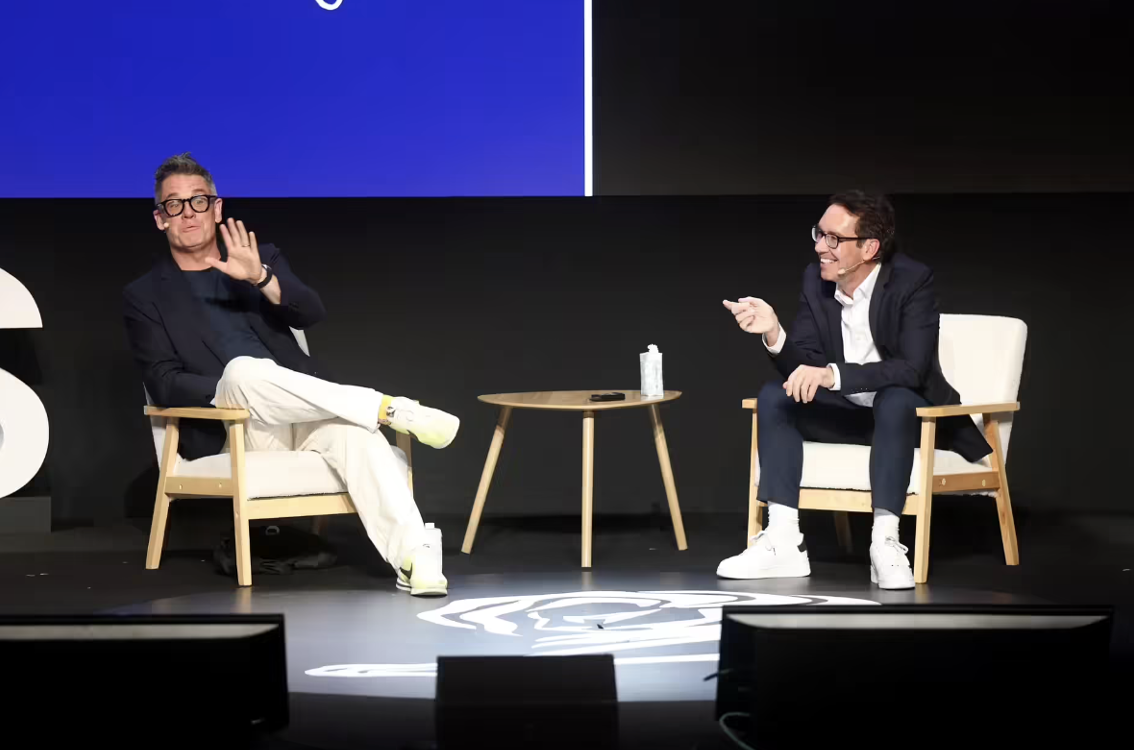
Mark Ritson and Byron Sharp exchanging ideas at Cannes Lions 2026. Photo courtesy by Getty Images for Cannes Lions.
The Test Ahead
Two separate panels of chief marketing officers closed their sessions with the same small ritual: finish the sentence, "the future of marketing is…" Six leaders answered, and not one reached for a word about technology. Relentless. Courage. Trust. Community. Heart. Human.
Susan Credle, accepting the Lion of St. Mark, distilled the week into one sentence: brands cannot automate their way into meaning. AI will carry an idea faster and farther than anything marketing has produced, but someone still has to have the idea, believe in it, and know when to trust their own hand over the machine's.
Françoise Gilot spent a decade beside the most famous artist of the century, and never once stopped being the author of her own work — which is precisely why, when the arrangement no longer served her, she was free to leave it, and free to build sixty more years of work entirely her own. That is the distinction marketing most needs to protect as this technology settles deeper into the work. Let artificial intelligence do what it does brilliantly; there is no wisdom in refusing a tool this capable. But never stop your brilliance in authoring the work and initiating that first spark of creative genius that drives it.