Marketing Is Entering a New Phase of Understanding and Mastering Its Own Complexity
Ever since the marketing industry began to use the term "optimization" it has helped us all think more deeply about our profession, even as its operational usage has improved our marketing results. We went through a long and slow evolution from optimizing reach and today some of us are already optimizing ROAS (return on ad spend) and ROI (latter includes promotion and other non-advertising levers).
The innovators and fast followers in the industry have in the past 30 years come to respect multiple regression analysis as providing a decent estimate of ROAS and ROI. Even though 99% of them could not accurately describe the math involved. Normally a practitioner would not use any method they did not feel comfortable explaining to bosses and clients. However, MMM (marketing mix modeling and its subset media mix modeling) by filling a void in helping to rationalize decisions involving millions of dollars per decision forced its way into near-universal usage.
In the same 30 years MMM was brought down to the household level from the geographic level by the use of small longitudinal panels (Behaviorscan, ScanAmerica, Apollo and earlier singlesource panels in US, UK, France, Germany) and by the use of big data by TRA in the US. TRA using big data provided greater granularity in tactical decision making and statistically significant findings for the thousands of smaller brands not well served by small panels.
As both MMM and household-level ROAS analytics matured, they began revealing an intriguing phenomenon: certain combinations of marketing activities produced effects greater than the sum of their parts. Two or more media types used together exhibited more than additive effects on sales and full funnel brand lifts. This synergy effect emerged repeatedly in different contexts.
The RMT Semasio study provided one of the most striking examples: combining two different psychographic targeting approaches quintupled the KPI, whereas each approach used alone only doubled effectiveness - a classic case where 2+2=5. Similarly, in tune-in advertising, homes receiving both paid tune-in ads and the same ads shown on network-owned channels showed a 47% higher ratings lift compared to homes receiving paid ads alone.
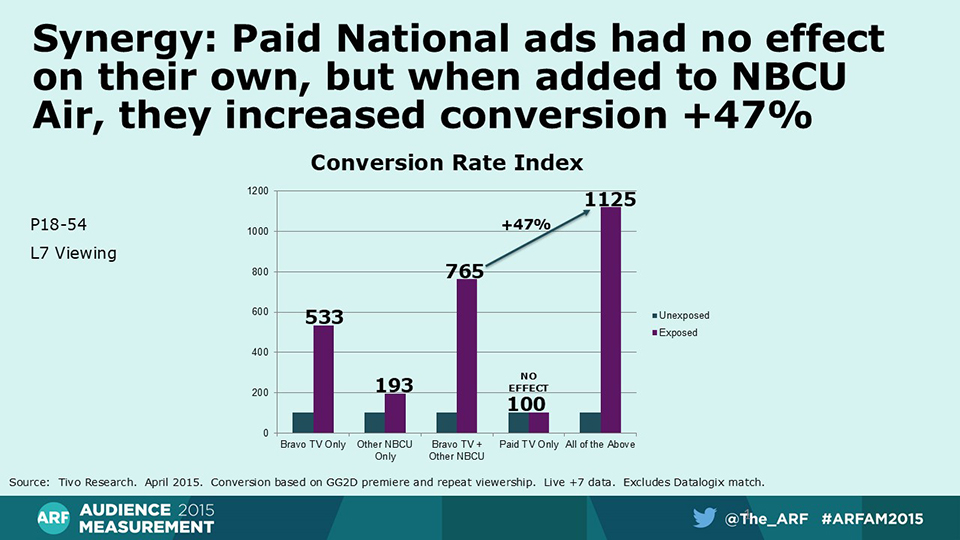
Even traditional multiple regression analysis caught glimpses of these synergy effects, though they proved difficult to measure consistently. FOX BHC's meta-analysis of ROAS revealed compelling evidence: when used alongside linear television advertising, automobile advertising on CTV saw a 45% ROAS increase, while YouTube performance jumped 85%. For food advertising, linear TV boosted social media ROAS by 51%.
These recurring hints of high-value synergy effects captured my attention. The evidence suggested that marketing's true impact was being systematically underestimated by examining channels in isolation. I became convinced that someday we would develop tools capable of measuring synergy effects at tactical, granular levels. Such tools would usher in a new age where much higher results in brand and sales effects, both short- and long-term, would be achievable through optimization. We would move beyond optimizing individual elements to understanding and leveraging the cross-synergies and net compound effects holistically.
That new age is now here.
You will probably not be surprised to find out that what has opened the door to this new quantum leap is — as you might have guessed by now — AI.
Human beings are not simple, nor is any part of reality. Non-scientists prefer to simplify and even to over-simplify. Einstein famously said that "scientific laws should be made as simple as possible, but not simpler." I have in the past railed at marketing's stubborn insistence on oversimplification. Now, new analytic methods made possible by AI are able to capture the complications rather than to oversimplify them.
Interestingly, at least in this case, the way AI is able to make this great leap is by mimicking the way the brain works. Before the innovation known as the Transformer which gave us Large Language Models (LLMs), the most advanced form of AI was known as neuronal networks. The way the neuronal network works is that it copies the way the brain is organized and the way information from anywhere in the brain is capable of connecting to information practically anywhere else in the brain. The recursive nature of the way our brains and minds work is that every microsecond we are experiencing updates based on new associations and predictions being made. The feedback loop is continuous as the brain looks at a situation from every possible perspective, prioritizing this survey based on all that it has learned in the past. This is how we can change our minds in a split second when conditions require it.
In the last decade, many academic researchers have brought up the idea of using neuronal networks to improve upon the measurement, analysis, and optimization of full-funnel, short- and long-term ROI. These include papers from MIT, Cornell, HBR, NYU, and other academics.
One research company, whose founders come out of the major agencies, has emerged to lead this charge into the future, and it's called DataPOEM. I reported on this company's appearance at the ARF Sequent Marketing Analytics Accelerator two months ago and have just been engaged as their consultant. I am busily assimilating their findings and will share them with you here as the process evolves. Staying for now within my normal article length here are a few of the most important findings so far:
- Synergy is a huge factor in ROI/ROAS. Because synergy has not been thoroughly included in ROI/ROAS estimates, the entire industry has been underestimating the ROI/ROAS effects of media all along by about 20%, and given the overemphasis on short term effects, the understatement of ROI/ROAS by the combination of these factors averages about 35%
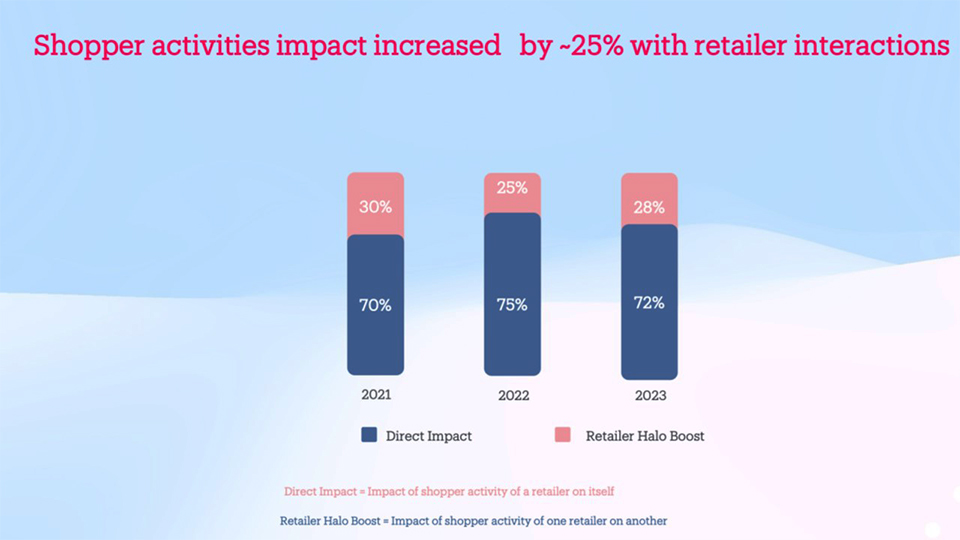
- The synergy effects between RMNs (retail media networks) and traditional channels are substantial. One client saw a +22% improvement in RMN ROI/ROAS through better integration with traditional channels. In return, traditional media channels showed a +24% halo effect from RMNs.
- Synergy relationships are constantly changing. DataPOEM currently recommends agile monthly reoptimization in order to take advantage of this. In a communique to ARF, DataPOEM reported: "A global automotive client implementation of this program demonstrated the crucial importance of measuring evolving marketing synergies. By capturing the dynamic relationship between influencer marketing and traditional channels, the brand achieved a 28% improvement in marketing efficiency. The system's frequent updates revealed that the effectiveness of marketing combinations varied significantly over time, enabling the brand to adjust its channel mix proactively and achieve a 31% increase in conversion rates."
More to come. The combination of neuronal network AI, tactical granularity, synergy, full-funnel brand and sales, all media and all marketing inputs, rapid frequent reoptimization on any weighting of short vs. long term goals, and forecasting accuracy is a potent combination of improvements available to marketers. DataPOEM reports that a typical client engagement starts with a few months of comparing results with their own data and validating the accuracy of DataPOEM's ability to forecast actual sales and brand results, after which the always-on integration into workflow becomes the standard process. I'm looking forward to adding RMT's Resonance ROI/ROAS enhancing system to DataPOEM's quiver in 2025. This will be an exciting year for marketers!
Posted at MediaVillage through the Thought Leadership self-publishing platform.
Click the social buttons to share this story with colleagues and friends.
The opinions expressed here are the author's views and do not necessarily represent the views of