News, and particularly local news publishing continues to face a gauntlet of challenges, many related to generating revenue. Considering the historic importance of the free press and responsible journalism, this is concerning. With social media, podcasts and user-generated content, anyone can produce and broadly distribute what passes for news. This is often opinion writing without the discipline of research, fact checking, and journalistic reporting standards, and without the costs of maintaining them.
Factors driving these challenges include:
- Consolidation and loss of independence due to the purchase of news publications by new owners with other business and/or political interests, which has sidelined the historic role of the free press.
- The laying off of journalists to maintain profits. Running articles written elsewhere without the attention to local government, news, politics, and even sports is often a way to replace reporter-created content. The smaller the market, the more common this is.
- Fragmented streams of low eCPM ad revenue driven by automated ad buying have compromised a once-thriving dual revenue stream.
- Subscriptions are important, but90 to 95% of visitors to subscription sites do not subscribeaccording to 2024 data extrapolated from Statista and self-reported data from The New York Times, Wall Street Journal, and the Washington Post.
- Advertisers are avoiding news environments due to “brand safety” concerns. A recent Prohaska Consulting study “The Rebranding of News” identified that one in three US advertisers have been told at some point to block the news category.
- Discontent with current subscription marketing efforts is high. A recent Turnstil Twitter/X poll showed that when asked "What would you do when you hit an internet paywall that asks you to subscribe?” 93.4% of respondents said they would rather have an advertiser pay their way in.
Current approaches where the offer to “subscribe”, often with a free week, by providing payment card information, with assurances that “you can cancel at any time” ends up costing consumers due to forgotten cancellation dates. It is a marketing game consumers would rather not play.
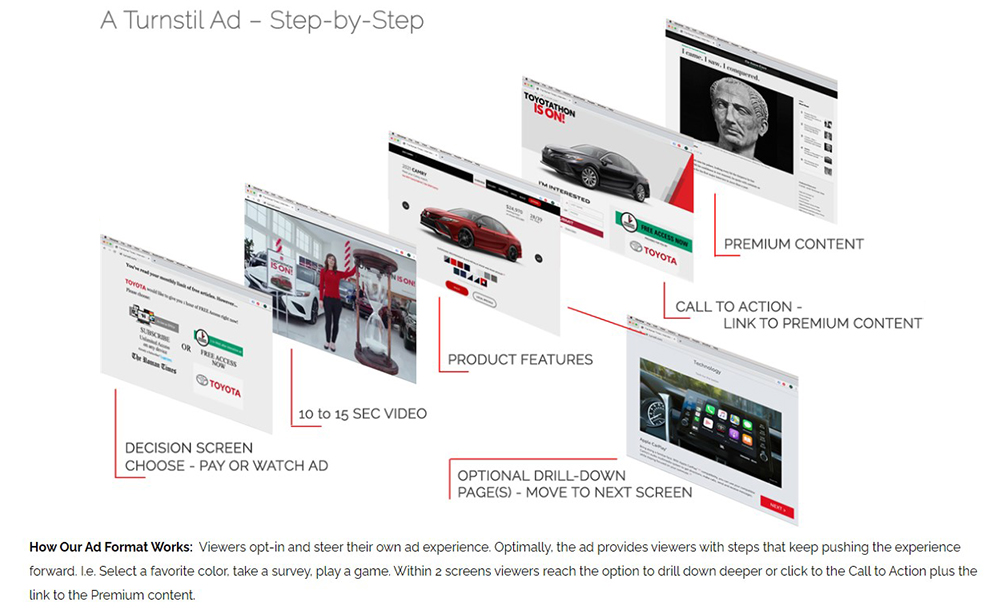
The Turnstil model operated successfully as Ultramercial before the 2008 financial crisis with over 700 campaigns, 170 advertisers on 44 sites including premium publishers.
This model strikes me as “True Sponsorship”, an approach I wrote about in a 2006 article in the Journal of Advertising Research entitled “Measuring The Effect of True Sponsorship”. My colleagues and I attempted to quantify the value of sponsorship by analyzing twenty-eight random control trial studies conducted for leading advertisers to measure the persuasion of sponsorship on the internet. We found that average lift in purchase intent/brand consideration was 29 percent, which compares to an average lift of 4 percent across all ARS Persuasion Tests (TV commercials).
The study showed that advertising appears to work by causing improvements directly in brand perception, whereas sponsorship appears to work by causing improvement directly in the perception of the sponsoring company and often indirectly by a halo effect in the brand perception. And even when brand perception is not affected, sponsorship can increase purchase intent, apparently as a result of gratitude toward the sponsor. In the summary of results, I wrote that “we might characterize this as Gratitude or Appreciation scales such as Trust, Liking, and Respect.”
We have a way of disregarding previously introduced methods and even new ideas as being outdated or too difficult to consider if they go outside current models and infrastructure. Yet innovation often comes in the form of successful ideas such as True Sponsorship being applied in new ways to solve new business problems. Re-establishing the value of True Sponsorship through Turnstil (in trial now) and other methods provides a real opportunity for responsible news publishers to increase revenue at the paywall and ultimately reverse the forces challenging the sector today. In my view, the importance of this on a societal level cannot be overstated.
Posted at MediaVillage through the Thought Leadership self-publishing platform.
Click the social buttons to share this story with colleagues and friends.
The opinions expressed here are the author's views and do not necessarily represent the views of