
Study the Motivations of Your Prospects
Not just the product benefits, but what motivates them in life. The best way to measure this is based not on what they say but on what they do.
Consumers don't think how they feel. They don't say what they think,
and they don't do what they say. – David Ogilvy
The most accessible way to see into people’s motivations at scale is to dissect their content consumption through a validated scientific lens specifically designed to reveal life motivations. Only one such lens exists today with enough scale to be relevant. That is the RMT system deployed through Semasio, which will soon be available for 700 million people in 22 countries. Today it is available in the US and Canada for 300 million IDs and 16 million IDs respectively.
First, Define Your Prospects
Work done by Ayala Cohen when she was at TRA showed that a brand can actually gain new customers who never even bought the product category before. However, that is rare, and therefore, the ROI on such captures takes a long time to pay back. Nevertheless, you should think about the probability of bringing in people new to the category as well as, of course, new to the brand. All the while remembering that people who bought your brand in the past but only sporadically are the most likely incremental sales you can get.
Right now in Canada, using Vividata, it is possible to study both the life motivations (Vividata calls them Drivers) and the attitudes toward specific product attributes. This can be done across the users of your brand and each competitor, and you can also break out the loyals of your brand and each other. This may reveal that certain groups owned by your competitors have the same motivations and product benefit desires as your current brand users. You might conclude that those other-brand segments matching your customers could be your prospects.
The RMT Semasio work has shown that new-to-brand and even new-to-category customers can be acquired by targeting people whose life motivations reflect the motivations in your current ad campaign. This is worth testing, and programmatic digital premium video, online video, and display can also be easily used with random control trials (RCTs), the most valid of all ROI measurement methods.
Don’t Assume You Know the Motivations that Are in Your Ads
Even the copywriter doesn’t know that. Even if you write a creative brief based on motivation data, there will be other motivation signals that creep into your ads either from the deep subconscious of your creative team or by sheer chance. The RMT method exposes the motivational underpinnings of each of your ads and from this is able to create custom IDs at scale in a heartbeat. Neustar shows that these IDs can double ROAS.
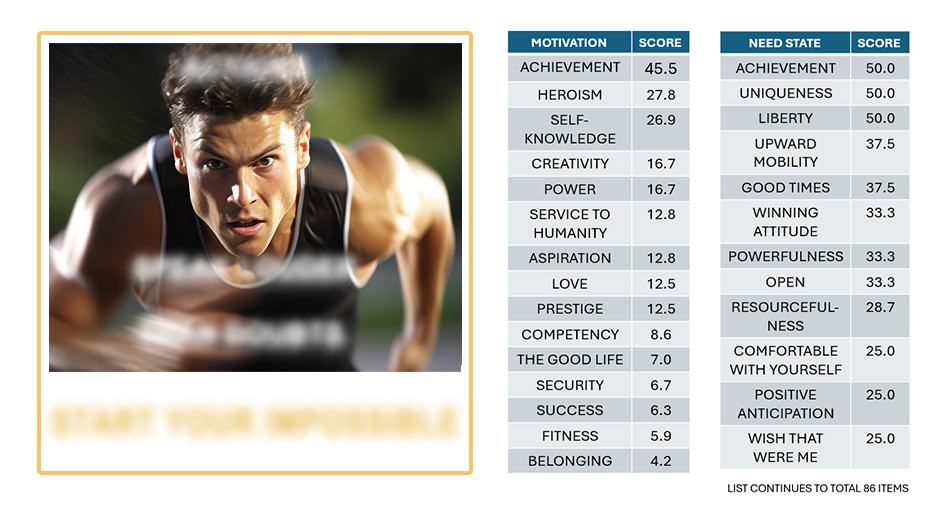
How can RMT deduce these motivations and need states (need states are subsets of motivations) from this ad? RMT goes far deeper, to 265 psychological dimensions distilled by AI and ML (machine learning) from every word in the English language, validated to be predictive of brand choice in every product category by Simmons. Need states are specific clusters of these 265 Value Signals, and the need states cluster into the 15 motivations.
Interestingly, at the 265 level, the average human being finds it easy to make a binary decision as to whether that specific word does or does not apply to that ad shown above, or to any ad or program or piece of content of any kind. The intercoder replicability of the RMT 265-variable method is 0.88. The average intercoder reliability is around 0.60 for tasks involving subjective classification.
The combining of these 265 shards into the 86 need states and then into the 15 motivations is the real source of the strength of this method, which Wharton Neuroscience has found to be the best* and only statistically significant predictor of EEG synchrony, the EEG metric which has a 0.82 r2 in predicting ad-produced sales.
The ARF Cognition Council has also validated that the RMT motivations predict IRI sales with an r2 of 0.48.
Writing the Creative Brief
Study which motivations have been projected by your brand’s most recent campaigns, and by the most successful campaigns in your brand’s history. Do the same for the competitors from whom you have decided to convert based on motivation similarities with your users. Is there a white space - motivations not recently used by anyone in the category but associated with some of the most winning campaigns you have ever run?
Write up the creative brief and also the media brief based on taking these targeted motivations into account in both messaging and in targeting addressable and non-addressable media. Addressable media can be motivationally targeted at the ID level and non-addressable media can be motivationally targeted at the content level. More on this subject in this post.
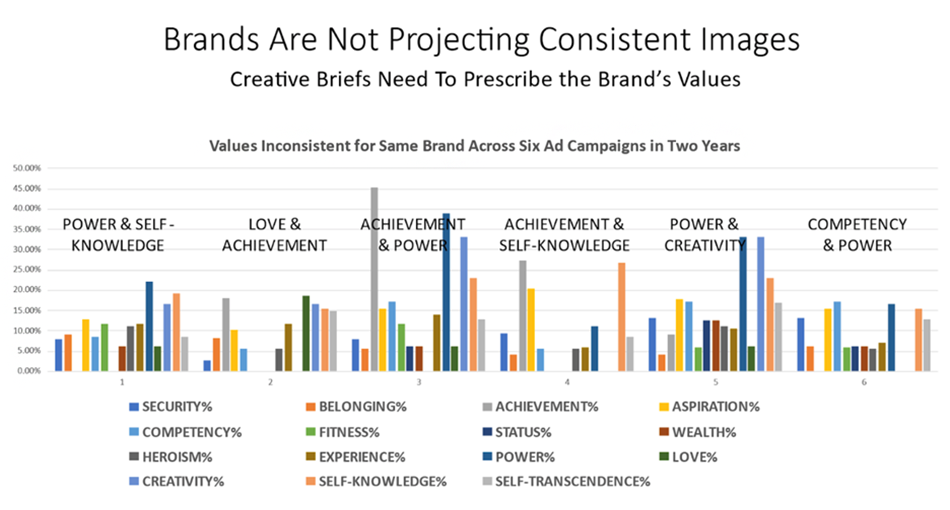
*In comparison with recall, persuasion, eye tracking, eye tracking with fixations, EEG attention, EEG memory, EEG approach. Source: Wharton Neuroscience and Bill Harvey Consulting 2024/2025 study sponsored by FOX.
Posted at MediaVillage through the Thought Leadership self-publishing platform.
Click the social buttons to share this story with colleagues and friends.
The opinions expressed here are the author's views and do not necessarily represent the views of MediaVillage.org/MyersBizNet.

Bill Harvey
Bill Harvey, who won an Emmy® Award in 2022 for his invention of set top box data, has spent over 35 years leading the way in media research with pioneer thinking in New Media, set top box data, optimizers, measurement standards, privacy standards, the A…